
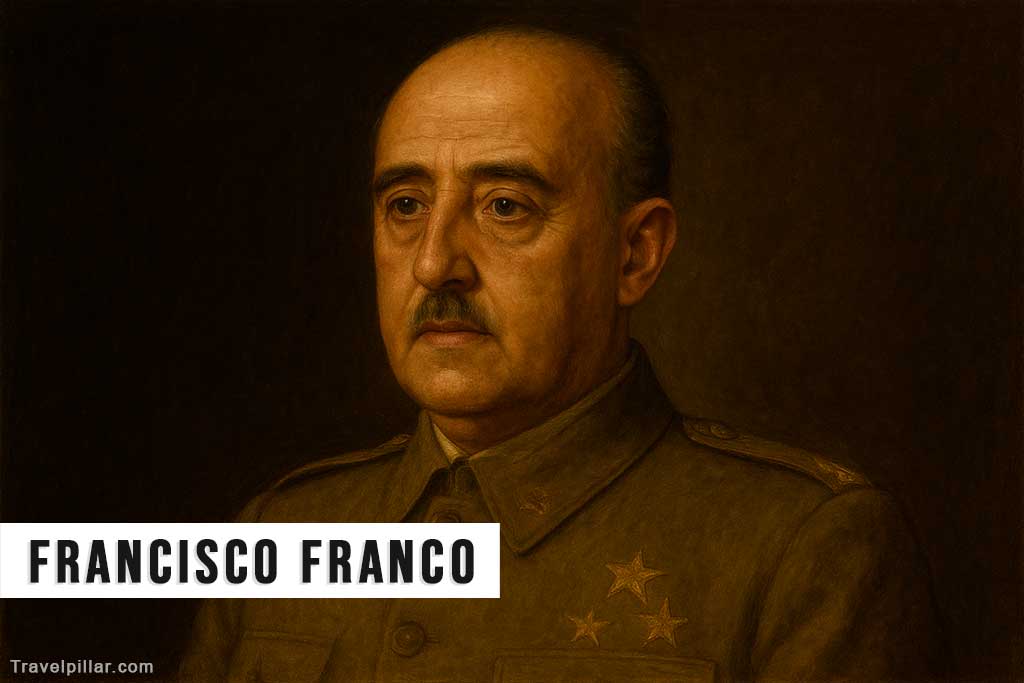
Francisco Franco Bahamonde (1892–1975) was a Spanish military general who rose to power during the Spanish Civil War, ruling Spain as a dictator from 1939 until his death in 1975. He led the right-wing Nationalist forces, supported by fascist Italy and Nazi Germany, in a brutal and divisive conflict against the democratically elected left-leaning Republican government.
Born in Ferrol, Spain, Franco came from a military family and entered the Spanish Army as a cadet at age 14. His career quickly advanced due to his professional competence and connections. He served in the Rif War in Morocco, where he gained fame and was promoted to general at the age of 33, the youngest in Europe.
In 1936, he joined a military revolt against the Popular Front government, marking the beginning of the Spanish Civil War. His strategic abilities and ruthless tactics, coupled with aid from Hitler and Mussolini, enabled his victory in 1939.
Franco’s regime, characterized as authoritarian and nationalist, was marked by harsh repression, censorship, and human rights abuses. He dismantled the democratic institutions of the Second Republic and established a single-party system under the fascist-inspired Falange party. His policies suppressed regional cultures and languages, favoring a unified Spanish identity.
Despite the regime’s brutality, it also implemented economic policies that modernized Spain, turning it from a largely agrarian economy into an industrialized nation. Franco also maintained Spain’s neutrality during World War II, a decision that ensured his regime’s survival in the post-war era.
In the 1960s, Franco introduced limited liberalization, allowing for some political parties and labor unions, a move seen as an attempt to ensure the continuity of his regime. Upon his death in 1975, a constitutional monarchy was established under King Juan Carlos I, marking the beginning of Spain’s transition to democracy.
Francisco Franco’s legacy is controversial, with many Spaniards regarding him as a necessary stabilizer, while others see him as a brutal dictator. The debates surrounding his memory continue to be a source of national discord.