
A physicist is a scientist who specializes in the field of physics, the study of matter and energy and how they interact with each other. This field of science deals with a variety of phenomena, from the tiniest subatomic particles to the largest structures in the universe, and everything in between.
Galileo Galilei
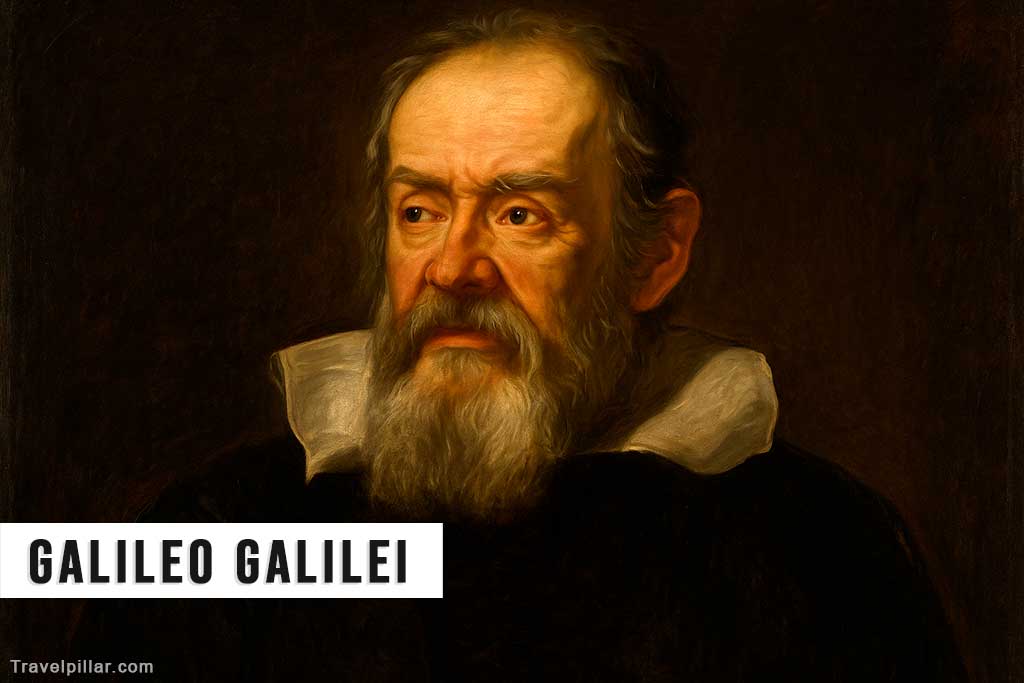
Galileo Galilei (1564–1642) was an Italian physicist, mathematician, and astronomer often regarded as the father of modern science. He improved the telescope and made significant astronomical discoveries, including the moons of Jupiter, phases of Venus, and mountains on the Moon, supporting the Copernican heliocentric model. Galileo also advanced mechanics through his studies of motion, inertia, and falling bodies. His advocacy of heliocentrism led to conflict with the Catholic Church, but his work laid the foundation for modern physics and astronomy.
Christiaan Huygens

Christiaan Huygens (1629-1695) was a Dutch mathematician and physicist known for his wave theory of light. Contrasting Newton’s corpuscular theory, Huygens proposed that light propagates as waves, explaining phenomena like diffraction and interference. He also invented the pendulum clock, improving time measurement precision. Additionally, his work in astronomy led to the discovery of Saturn’s ring system and its moon Titan, further showcasing his profound impact on the sciences.
Isaac Newton
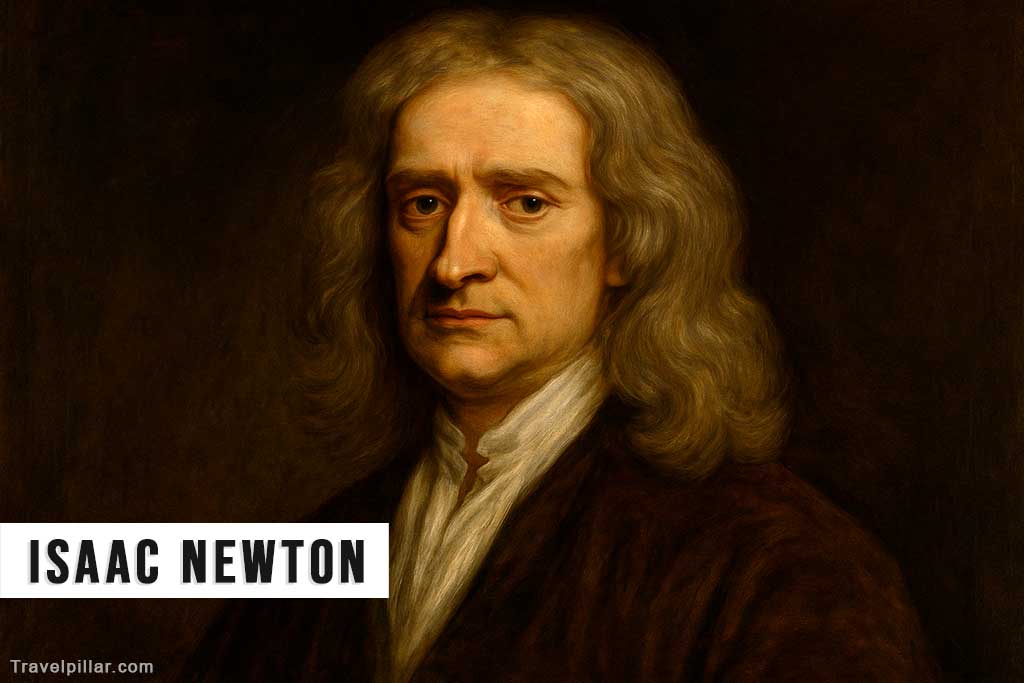
Sir Isaac Newton (1643-1727), an English physicist and mathematician, significantly influenced scientific thought with his laws of motion and universal gravitation. His seminal work, “Principia Mathematica,” presented these principles and established the foundation of classical mechanics. Newton also made substantial contributions to optics, developing a particle theory of light and inventing the reflecting telescope. His work in mathematics included the development of calculus, independently of Leibniz.
Thomas Young

Thomas Young (1773-1829) was a polymath and pioneer in various scientific disciplines, best known for his Double-Slit Experiment in physics, proving light’s wave-particle duality. Young also proposed the theory of colour vision, presenting the trichromatic colour theory. Furthermore, his expertise extended to linguistics, as he contributed significantly to deciphering the Rosetta Stone’s Egyptian hieroglyphics. Young’s diverse contributions significantly influenced our modern understanding of physics and human perception.
Michael Faraday

Michael Faraday (1791-1867) was an English scientist renowned for his groundbreaking work in electromagnetism and electrochemistry. Despite limited formal education, Faraday’s experimental skills led to the discovery of electromagnetic induction, the principle underlying electric transformers and generators. He also introduced concepts such as lines of force and discovered benzene, contributing to chemistry. Faraday’s work on electrolysis laid foundations for modern electrochemistry. His discoveries transformed theoretical science into practical technologies, influencing fields ranging from electricity to materials science.
James Clerk Maxwell

James Clerk Maxwell (1831-1879) was a Scottish physicist instrumental in developing electromagnetic theory. His seminal work comprised formulating the four Maxwell’s Equations, which mathematically describe how electric and magnetic fields interact. These equations predicted that electromagnetic waves should exist and propagate at a fixed speed, which matches the known speed of light. This connection between light and electromagnetism was groundbreaking, solidifying light’s identity as an electromagnetic wave.
Max Planck

Max Planck (1858-1947) was a German theoretical physicist, most renowned for initiating quantum theory, revolutionizing our understanding of atomic and subatomic processes. He postulated that energy is quantized, meaning it comes in discrete amounts, a fundamental shift from classical physics. His work earned him the Nobel Prize in Physics in 1918. Despite the adversities faced during World War II, Planck remained in Germany, continuing to influence the global scientific community through his work and theories.
Hermann Minkowski
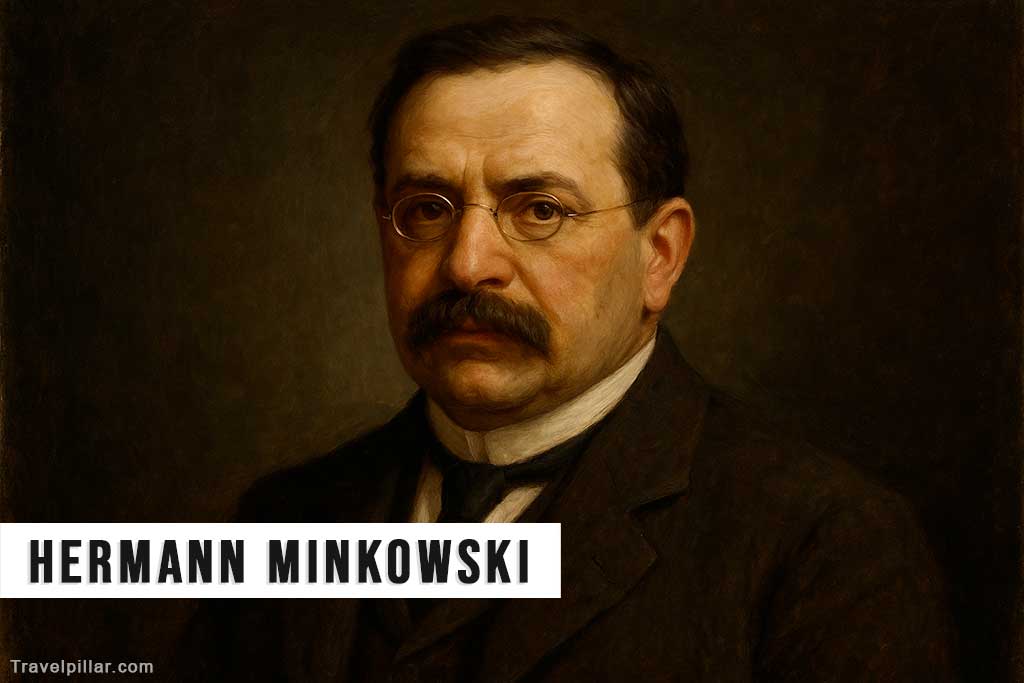
Hermann Minkowski (1864-1909) was a German mathematician who made significant contributions to number theory and the theory of relativity. His most impactful work was the introduction of Minkowski spacetime, a geometric interpretation of special relativity that views space and time as a single, interconnected four-dimensional entity. This approach profoundly influenced the understanding of spacetime physics and greatly facilitated the development of Albert Einstein’s general theory of relativity. Minkowski’s contributions continue to shape modern physics.
Ernest Rutherford
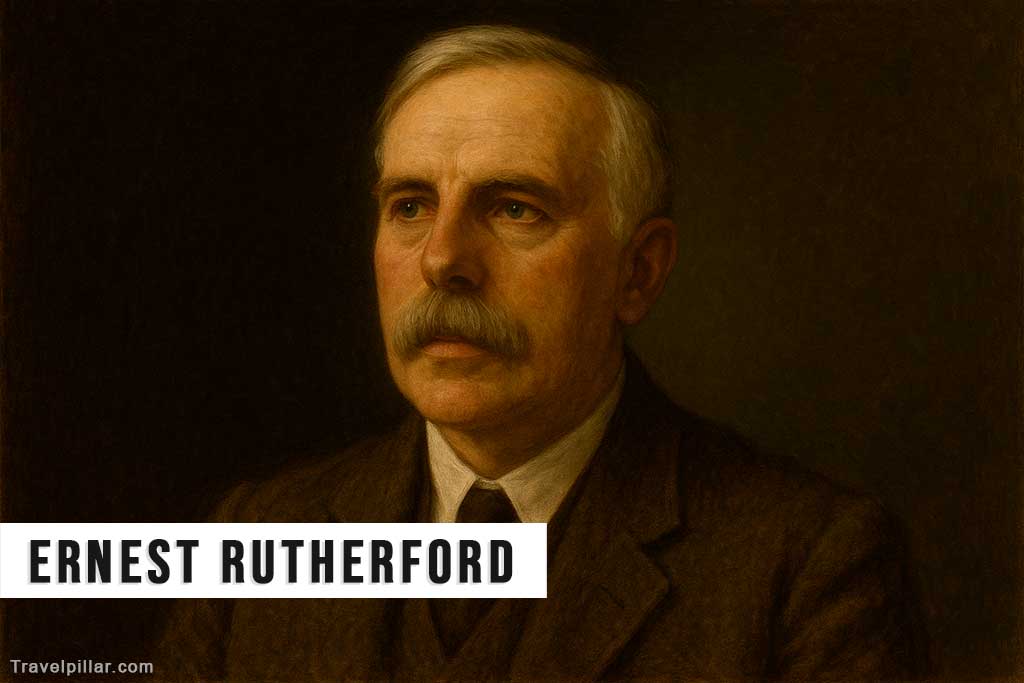
Ernest Rutherford (1871-1937), a New Zealand-born physicist, is regarded as the father of nuclear physics. He discovered the concept of radioactive half-life, identified alpha and beta radiation, and pioneered the theory of nuclear transmutation. His gold foil experiment demonstrated that atoms consist of a dense central nucleus surrounded by electrons, overturning earlier atomic models. Awarded the 1908 Nobel Prize in Chemistry, Rutherford’s work laid the foundation for modern atomic physics and nuclear science.
Albert Einstein

Albert Einstein (1879-1955) was a German-born theoretical physicist renowned for developing the theory of relativity, one of the two pillars of modern physics (alongside quantum mechanics). His mass-energy equivalence formula, E=mc^2, has become synonymous with his name. Einstein’s contributions to the understanding of physical reality were profound, earning him the Nobel Prize in Physics in 1921 for his explanation of the photoelectric effect. He emigrated to the United States in 1933, escaping Nazi persecution.
Clinton Davisson and Lester Germer

Clinton Davisson (1881-1958) and Lester Germer (1896-1971) were American physicists notable for their collaborative Davisson-Germer experiment, confirming wave-particle duality. Their groundbreaking research conducted at Bell Laboratories in 1927 provided experimental confirmation of Louis de Broglie’s hypothesis that particles such as electrons exhibit wave properties. This experiment bolstered the emerging field of quantum mechanics, shaping the course of modern physics and our understanding of the fundamental nature of matter.
Max Born

Max Born (1882-1970) was a German physicist and mathematician who made significant contributions to quantum mechanics. He interpreted the Schrödinger wave function as a probability amplitude, an interpretation still widely accepted today. Born’s work laid the groundwork for much of modern quantum mechanics and played a critical role in our understanding of subatomic particles’ behavior. For these pivotal contributions, he received the Nobel Prize in Physics in 1954.
Niels Bohr
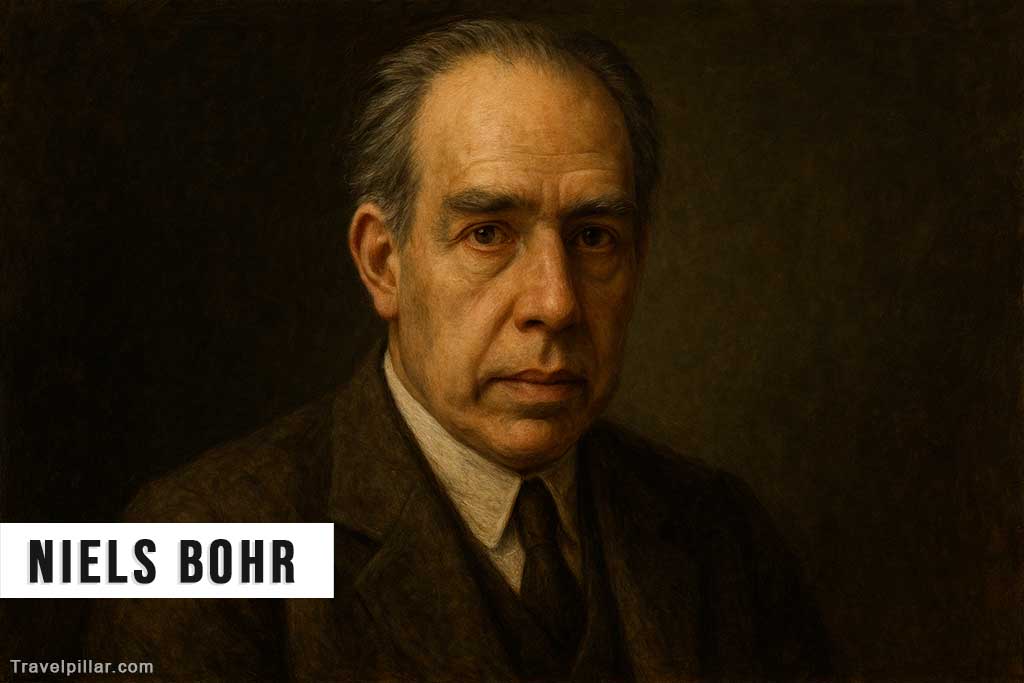
Niels Bohr (1885-1962) was a Danish physicist, recognized for his foundational contributions to understanding atomic structure and quantum theory. He proposed the Bohr model of the atom, with electrons orbiting the nucleus at discrete energy levels, a significant advance in early 20th-century physics. A Nobel laureate in Physics in 1922, Bohr was also instrumental in the establishment of CERN. During World War II, he escaped Nazi-occupied Denmark and became a central figure in the Manhattan Project.
Erwin Schrödinger

Erwin Schrödinger (1887-1961) was an Austrian physicist best known for formulating the Schrödinger equation, a fundamental piece in the framework of quantum mechanics. His work provided a wave description of particles, complementing Heisenberg’s matrix mechanics. Schrödinger was awarded the Nobel Prize in Physics in 1933. His philosophical thought experiment, Schrödinger’s Cat, aimed to highlight the paradoxical nature of quantum superposition, contributing significantly to debates about quantum mechanics’ interpretation.
George Paget Thomson

George Paget Thomson (1892-1975) was a British physicist recognized for his demonstration of the wave properties of electrons. Conducting a separate but similar experiment to Davisson and Germer’s, Thomson observed electron diffraction phenomena, providing further evidence for wave-particle duality. The combined results of these experiments formed a critical cornerstone for quantum mechanics. Thomson’s work won him the Nobel Prize in Physics in 1937, a distinction his father, J.J. Thomson, also held for discovering the electron.
Enrico Fermi
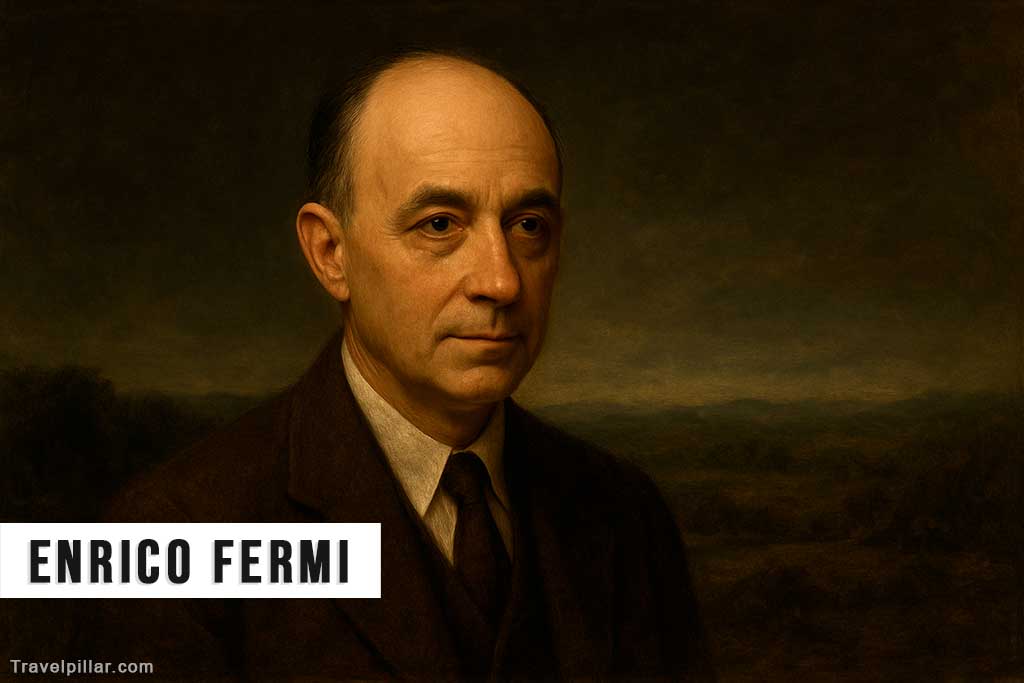
Enrico Fermi (1901–1954) was an Italian-American physicist recognized for his work in nuclear physics and quantum theory. He developed the first nuclear reactor, Chicago Pile-1, in 1942, marking the beginning of controlled nuclear chain reactions. Fermi contributed to statistical mechanics, quantum electrodynamics, and particle physics, notably formulating Fermi-Dirac statistics. Awarded the 1938 Nobel Prize in Physics for his work on induced radioactivity, he played a central role in the Manhattan Project and remains a pivotal figure in modern physics.
Werner Heisenberg
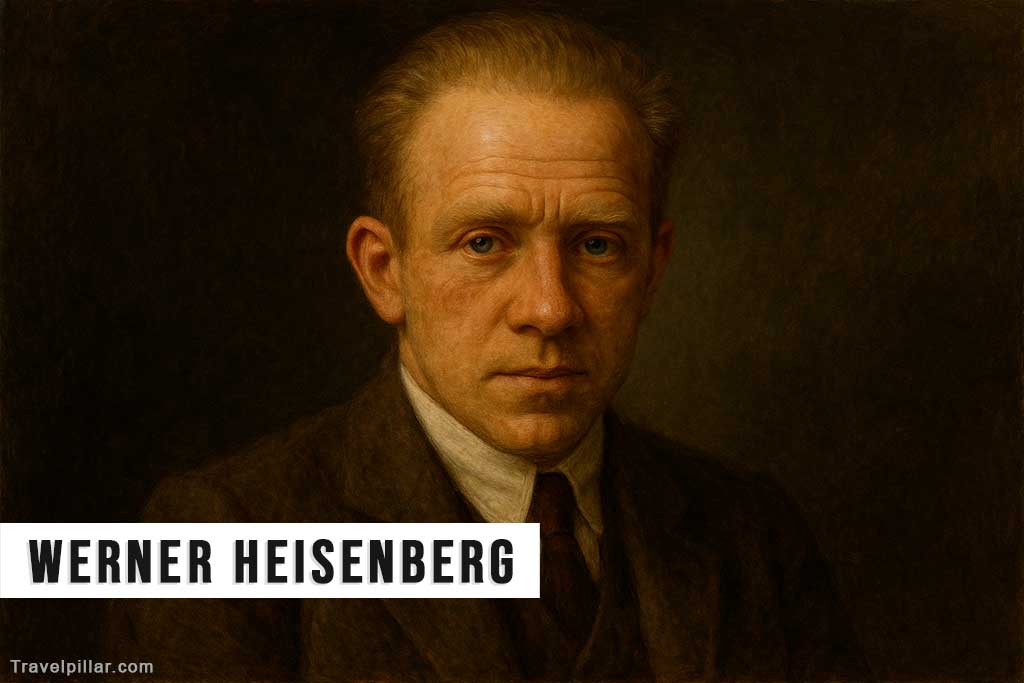
Werner Heisenberg (1901-1976) was a German theoretical physicist and one of the key pioneers of quantum mechanics. He is most noted for the formulation of the Heisenberg Uncertainty Principle, which asserts the impossibility of precisely measuring both the position and momentum of a particle simultaneously. His contributions to the field earned him the Nobel Prize in Physics in 1932. Despite controversial involvement in Germany’s nuclear program during WWII, his scientific legacy endures.
Wolfgang Pauli

Wolfgang Pauli (1900-1958) was an Austrian theoretical physicist, renowned for the formulation of the Pauli Exclusion Principle, which states that no two identical fermions can occupy the same quantum state simultaneously. This principle, vital in quantum physics, significantly influences the structure of matter and stability of atoms. Pauli was awarded the Nobel Prize in Physics in 1945 for this contribution. Known for his meticulousness, he played a key role in the development of quantum mechanics.
Paul Dirac

Paul Dirac (1902-1984) was an English theoretical physicist noted for his significant contributions to quantum mechanics and quantum electrodynamics. Dirac formulated the Dirac equation, which successfully married quantum mechanics and special relativity to describe the behavior of electron spin. His work predicted the existence of antimatter, leading to the discovery of the positron. Co-recipient of the Nobel Prize in Physics in 1933 with Schrödinger, Dirac’s legacy continues to shape modern physics.
John von Neumann

John von Neumann (1903-1957) was a Hungarian-American mathematician, physicist, and polymath who made significant contributions across various fields. In physics, his work on the mathematical foundations of quantum mechanics, especially his formulation of operator methods and the concept of a density matrix, was highly influential. Though not exclusively a physicist, his broad scientific impact included pioneering work in computer science, game theory, and numerical analysis, making him a key figure in 20th-century science.
John Archibald Wheeler
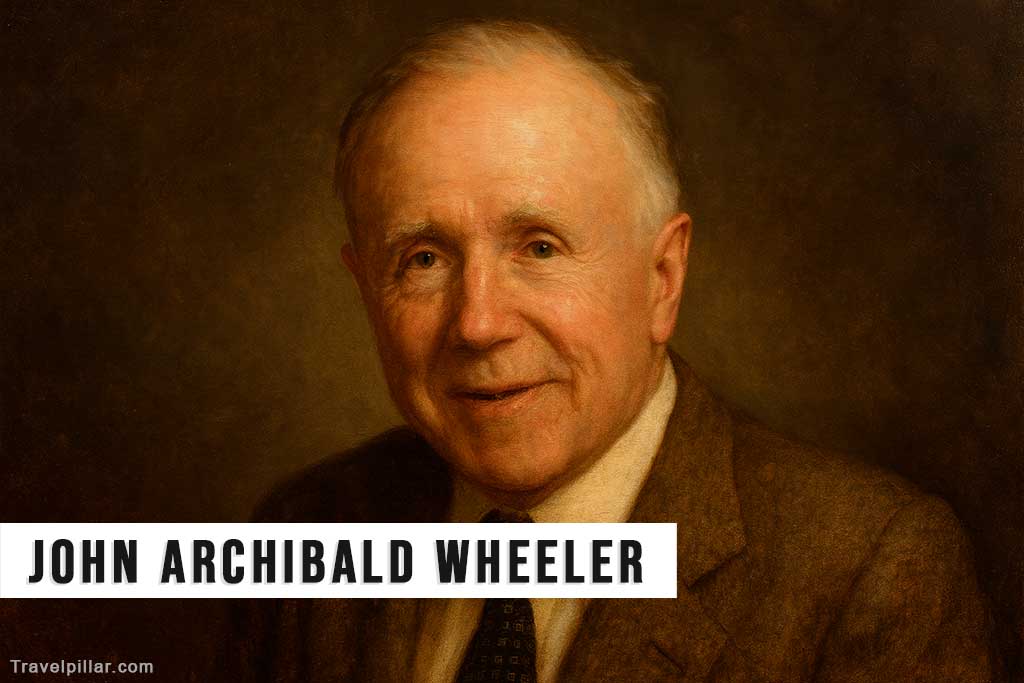
John Archibald Wheeler (1911-2008) was an American theoretical physicist who made significant contributions to physics’ fundamental understanding. He is best known for his work in relativity, particularly for coining the term ‘black hole’ to describe celestial bodies with gravitational fields strong enough to prevent light from escaping. Wheeler also contributed to quantum information theory and worked on the development of the hydrogen bomb. His students included renowned physicists like Richard Feynman and Kip Thorne.
David Bohm
David Bohm (1917–1992) was an American theoretical physicist known for his work on the foundations of quantum mechanics and his philosophical approach to science. He developed the pilot-wave theory, an alternative interpretation of quantum physics that emphasised determinism and non-locality. Bohm later introduced the concept of the implicate order, proposing that reality is fundamentally interconnected rather than composed of separate, independent parts.
Richard Feynman

Richard Feynman (1918-1988) was an American theoretical physicist known for his work in quantum mechanics, quantum electrodynamics, and particle physics. He contributed to the development of the path integral formulation of quantum mechanics and introduced Feynman diagrams, graphical representations that simplified complex quantum interactions calculations. Feynman shared the Nobel Prize in Physics in 1965 for his work in quantum electrodynamics. His charismatic teaching style left a lasting impact on science education.
John Stewart Bell

John Stewart Bell (1928-1990) was an Irish physicist noted for establishing Bell’s theorem, a seminal work in quantum physics. This theorem presented the Bell inequalities, which test the validity of quantum mechanical predictions against local hidden variable theories, revealing profound implications about the nature of reality. Despite not winning a Nobel Prize, Bell’s contributions are widely regarded as some of the most significant in quantum theory, deeply influencing our understanding of the quantum world.
Hugh Everett III

Hugh Everett III (1930-1982) was an American physicist known for proposing the Many-Worlds Interpretation (MWI) of quantum mechanics. This posits that all possible outcomes of quantum measurements are realized in some “world” or universe, as opposed to the Copenhagen Interpretation’s wave function collapse. Initially rejected, the MWI has since gained traction. Despite leaving academia, Everett’s theories continue to influence quantum mechanics and our understanding of reality.
Roger Penrose

Roger Penrose (born 1931) is a British mathematical physicist acclaimed for his work in general relativity and cosmology. Penrose collaborated with Stephen Hawking, resulting in important theorems about black holes in Einstein’s general theory of relativity. He also introduced the concept of Penrose tiling and twistor theory. For his profound contributions to the understanding of black holes and the universe’s formation, Penrose was co-awarded the Nobel Prize in Physics in 2020.