
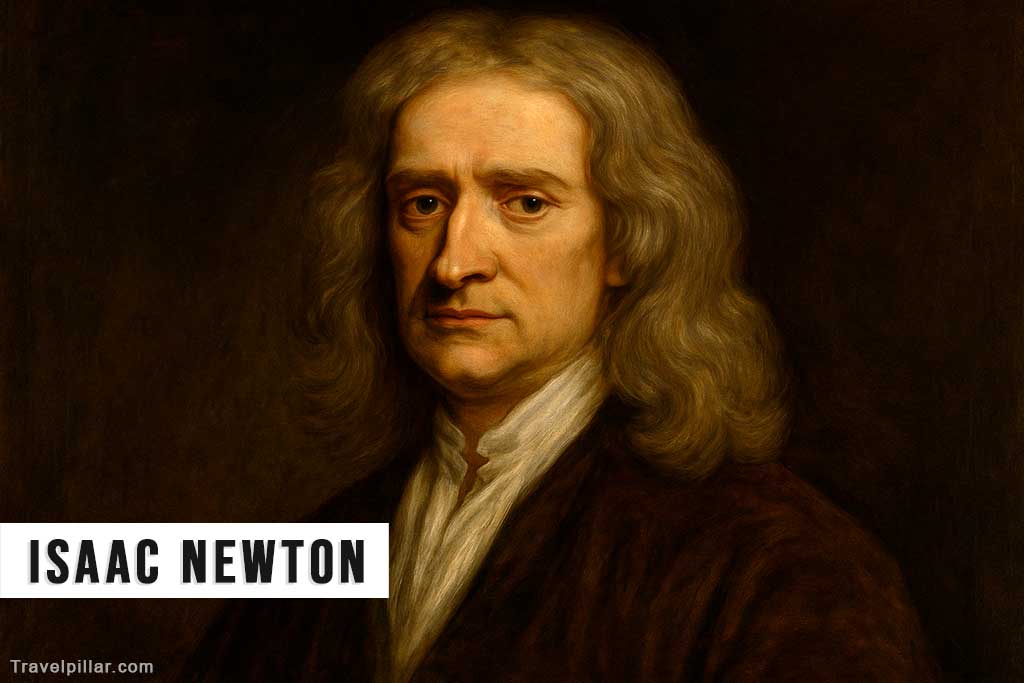
Sir Isaac Newton, born on December 25, 1642, in Woolsthorpe, England, was a mathematician, physicist, and astronomer whose groundbreaking work fundamentally changed our understanding of the natural world and laid the groundwork for the scientific revolution.
Newton’s most notable contribution is his formulation of the laws of motion and universal gravitation, which he published in his magnum opus, “Philosophiæ Naturalis Principia Mathematica” (Mathematical Principles of Natural Philosophy) in 1687. The three laws of motion describe the relationship between a body and the forces acting upon it, and its motion in response to those forces. His law of universal gravitation provides a comprehensive description of the motion of celestial and terrestrial bodies and remains a cornerstone of classical physics.
In mathematics, Newton developed differential and integral calculus, though his work was published later than that of Gottfried Wilhelm Leibniz, leading to a protracted dispute over priority. Newton’s method of fluxions or calculus, allowed mathematicians and physicists to integrate and differentiate with precision.
Newton also made significant contributions to optics. His experiments with refraction led to the discovery that white light is composed of a spectrum of colors, a phenomenon he explained in his book, “Opticks.”
Despite these significant achievements, Newton’s later life was marked by controversy, including his disputes with other scientists and his role as Warden and later Master of the Royal Mint, where he enforced laws against counterfeiting.
Newton died on March 31, 1727, but his legacy lives on. His laws of motion and gravitation form the basis of classical mechanics and continue to be fundamental to physics. His work has shaped our understanding of the physical universe and continues to influence science and technology. He is widely recognized as one of the most influential scientists of all time.