
Throughout history, certain events have transformed the course of civilisation. Some changed the way people lived, while others reshaped political borders, introduced new religions, inspired scientific discoveries or transformed entire societies. Together, these turning points explain how humanity developed from the first farming communities to today’s interconnected world.
Many of the world’s greatest historical destinations owe their significance to these events. Ancient cities, temples, castles, battlefields, museums and archaeological sites all tell part of this remarkable story, helping visitors understand not only what happened there but why it mattered. Whether exploring the pyramids of Egypt, the ruins of Rome, the battlefields of Europe or the historic cities of Asia, understanding these defining moments brings history to life.
The following timeline highlights some of the most influential events in world history, presented in chronological order.
The Dawn of Civilisation
The Neolithic Revolution
Beginning around 10,000 BC, the Neolithic Revolution marked humanity’s transition from hunting and gathering to farming and permanent settlement. The domestication of crops and animals allowed villages to grow into towns and eventually cities, laying the foundations for civilisation itself. Agriculture supported larger populations, encouraged trade and led to the development of governments, writing and organised religion. Many historians regard this as the single most important turning point in human history.
The Invention of Writing
Around 3500 BC, the people of ancient Mesopotamia developed the world’s earliest known writing system, known as cuneiform. For the first time, laws, trade, religious beliefs and historical events could be permanently recorded rather than passed on through memory alone. Writing transformed government, commerce, education and culture, allowing knowledge to be preserved and shared across generations. It marks the beginning of recorded history.
The Ancient World
The Building of the Great Pyramids of Egypt
Constructed during Egypt’s Old Kingdom around 2600 BC, the Great Pyramids of Giza remain among the greatest engineering achievements in history. Built as royal tombs for the pharaohs, they demonstrate the extraordinary organisation, mathematical knowledge and architectural skill of ancient Egyptian civilisation. More than 4,500 years later, they continue to stand as one of the world’s most recognisable monuments.
The Birth of Buddhism
Buddhism emerged in northern India during the 6th century BC through the teachings of Siddhartha Gautama, later known as the Buddha. His search for enlightenment gave rise to one of the world’s major religions and philosophical traditions, centred on compassion, wisdom and the overcoming of suffering. Buddhism spread throughout much of Asia, profoundly influencing religion, art, architecture and culture across the continent.
The Rise of the Persian Empire
Founded by Cyrus the Great around 550 BC, the Persian Empire became one of the largest and most sophisticated empires of the ancient world. Stretching from the Indus Valley to the Mediterranean, it developed efficient systems of government, impressive road networks and remarkable engineering projects while generally allowing conquered peoples to retain their own customs and religions. Its methods of administration influenced many later empires.
The Classical Greek Era
The Classical Greek Era, spanning the 5th and 4th centuries BC, transformed Western civilisation through extraordinary achievements in philosophy, politics, science, literature and the arts. Athens pioneered democracy, while thinkers such as Socrates, Plato and Aristotle laid the foundations of Western philosophy. Greek ideas about politics, mathematics, medicine and architecture continue to influence the modern world.
The Battle of Marathon
Fought in 490 BC, the Battle of Marathon was one of the most important victories of the ancient Greek world. Despite being heavily outnumbered, the Athenians defeated the invading Persian army, preserving the independence of the Greek city-states. The victory strengthened Greek confidence and helped create the conditions that allowed Classical Greek civilisation to flourish, shaping the future of Western culture.
The Roman Empire
Founded in 27 BC under Emperor Augustus, the Roman Empire became one of history’s greatest civilisations. At its height it stretched from Britain to the Middle East, connecting vast territories through an extensive network of roads, cities and trade routes. Roman achievements in engineering, architecture, law and government shaped Europe for centuries, while the spread of Latin and Christianity during the Roman period left a lasting influence that can still be seen throughout much of the world.
The Birth of Christianity
Christianity began in the 1st century AD with the life and teachings of Jesus of Nazareth in the Roman province of Judea. Following his crucifixion and the belief in his resurrection, his followers spread his message throughout the Roman Empire. Over the following centuries, Christianity became one of the world’s largest religions, profoundly influencing history, art, architecture, philosophy and the development of Western civilisation.
The Spread of Islam
Islam originated in the 7th century AD through the teachings of the Prophet Muhammad in the Arabian city of Mecca. Within little more than a century, Islam had spread across the Middle East, North Africa and parts of Europe and Asia, creating one of history’s great civilisations. Alongside its religious influence, the Islamic world became a centre of learning, making major contributions to mathematics, astronomy, medicine, architecture and philosophy that continue to influence society today.
The Middle Ages
The Fall of the Western Roman Empire
The fall of the Western Roman Empire in AD 476 marked the end of ancient Rome in Western Europe and the beginning of the Middle Ages. Although the empire had been weakened by political instability, economic decline and repeated invasions, the deposition of the last western emperor, Romulus Augustulus, became the traditional symbol of Rome’s collapse. The empire’s fall reshaped Europe, giving rise to new kingdoms that eventually evolved into many of today’s European nations.
The Black Death
The Black Death swept across Europe, Asia and North Africa between 1346 and 1353, becoming one of the deadliest pandemics in human history. Caused by the bacterium Yersinia pestis, the plague is estimated to have killed between one-third and one-half of Europe’s population. The enormous loss of life transformed society, weakening the feudal system, increasing the value of labour and bringing lasting economic and social change. Its impact can still be seen in the history, folklore and architecture of many European cities.
The Age of Exploration and Discovery
The Age of Discovery
The Age of Discovery, spanning the 15th and 16th centuries, saw European explorers venture far beyond the boundaries of the known world. Advances in navigation and shipbuilding allowed sailors to establish new sea routes to Africa, Asia and the Americas. Explorers including Christopher Columbus, Vasco da Gama and Ferdinand Magellan connected continents through trade and exploration, transforming geography, commerce and cultural exchange. This era marked the beginning of an increasingly globalised world.
The Renaissance
Beginning in Italy during the 14th century, the Renaissance was a remarkable period of artistic, cultural and intellectual revival inspired by the rediscovery of classical Greek and Roman learning. Artists including Leonardo da Vinci, Michelangelo and Raphael produced some of history’s greatest masterpieces, while advances in science, literature and philosophy transformed European thought. The Renaissance laid many of the foundations of the modern world and remains one of history’s most influential cultural movements.
The Protestant Reformation
The Protestant Reformation began in 1517 when Martin Luther challenged the authority and practices of the Roman Catholic Church by publishing his Ninety-five Theses. What started as a religious dispute soon developed into a movement that transformed Christianity, leading to the creation of Protestant churches across Europe. The Reformation reshaped politics, education and religious life while contributing to centuries of conflict and reform that changed the course of European history.
The Scientific Revolution
The Scientific Revolution of the 16th and 17th centuries transformed humanity’s understanding of the natural world. Thinkers such as Nicolaus Copernicus, Galileo Galilei, Johannes Kepler and Isaac Newton challenged long-held beliefs through observation, experimentation and mathematics. Their discoveries revolutionised astronomy, physics and other sciences while establishing the scientific method that continues to underpin modern scientific research.
The Age of Enlightenment
The Enlightenment, spanning the late 17th and 18th centuries, was an intellectual movement that placed reason, science and individual liberty at the centre of human progress. Philosophers including John Locke, Voltaire, Jean-Jacques Rousseau and Immanuel Kant questioned traditional authority and promoted ideas about democracy, human rights and religious tolerance. Their thinking inspired political reform, scientific progress and many of the democratic values that continue to shape the modern world.
The Age of Revolution
The American Revolution
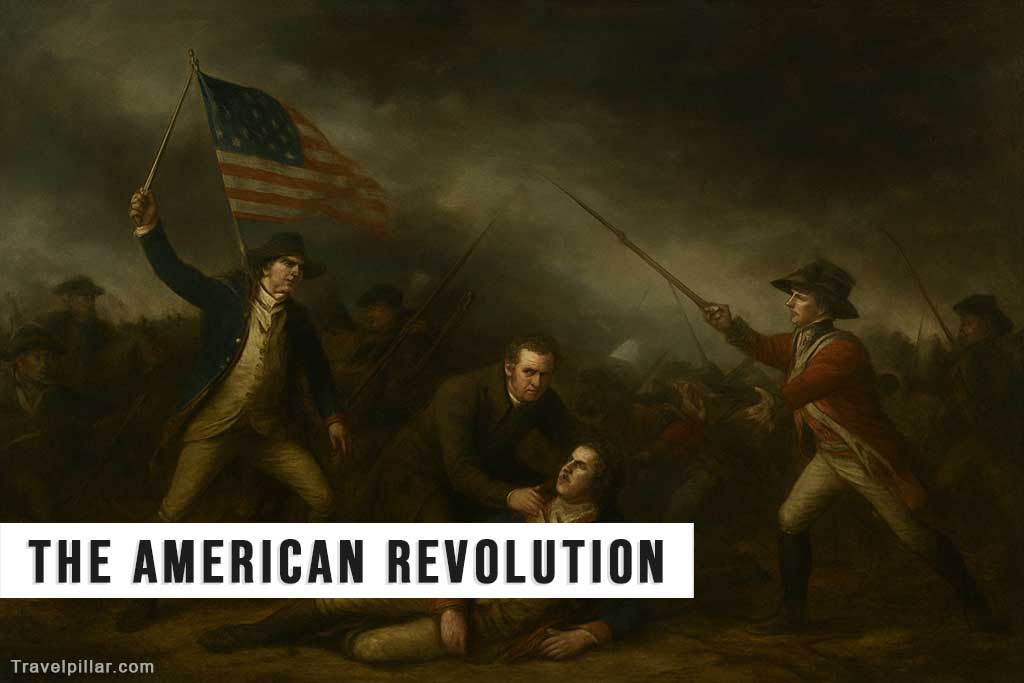
The American Revolution (1775–1783) led to the independence of Britain’s thirteen North American colonies and the creation of the United States of America. Inspired by ideas of liberty, self-government and individual rights, the revolution established one of the world’s first modern constitutional republics. Its principles influenced democratic movements across Europe and beyond, making it one of the most significant political revolutions in history.
The French Revolution
Beginning in 1789, the French Revolution overthrew the absolute monarchy and transformed France through sweeping political and social change. Driven by demands for liberty, equality and popular sovereignty, it abolished many of the privileges of the old aristocracy and inspired revolutionary movements throughout Europe. Although marked by periods of violence and instability, its ideals continue to influence democracy, human rights and modern political thought.
The Industrial Revolution
Beginning in Britain during the late 18th century, the Industrial Revolution transformed manufacturing, transport and everyday life through rapid technological innovation. Factories replaced small workshops, steam power revolutionised industry and railways connected cities on an unprecedented scale. Industrialisation accelerated urbanisation, increased global trade and laid the foundations of the modern industrial economy.
The Napoleonic Wars
The Napoleonic Wars (1803–1815) were a series of conflicts fought across Europe under the leadership of Napoleon Bonaparte. French armies conquered much of continental Europe before eventually being defeated at the Battle of Waterloo. The wars reshaped national borders, encouraged the rise of nationalism and permanently altered the balance of power in Europe. Their influence continued to shape European politics throughout the 19th century.
The Modern World
The Opium Wars
The Opium Wars (1839–1842 and 1856–1860) were two conflicts between China and Western powers, principally Britain, fought over trade, diplomacy and the illegal opium trade. China’s defeat forced it to sign a series of unequal treaties, opening additional ports to foreign trade and ceding Hong Kong to Britain. The wars marked the beginning of China’s so-called “Century of Humiliation” and profoundly influenced Chinese politics, international relations and the country’s path towards modernisation.
The American Civil War
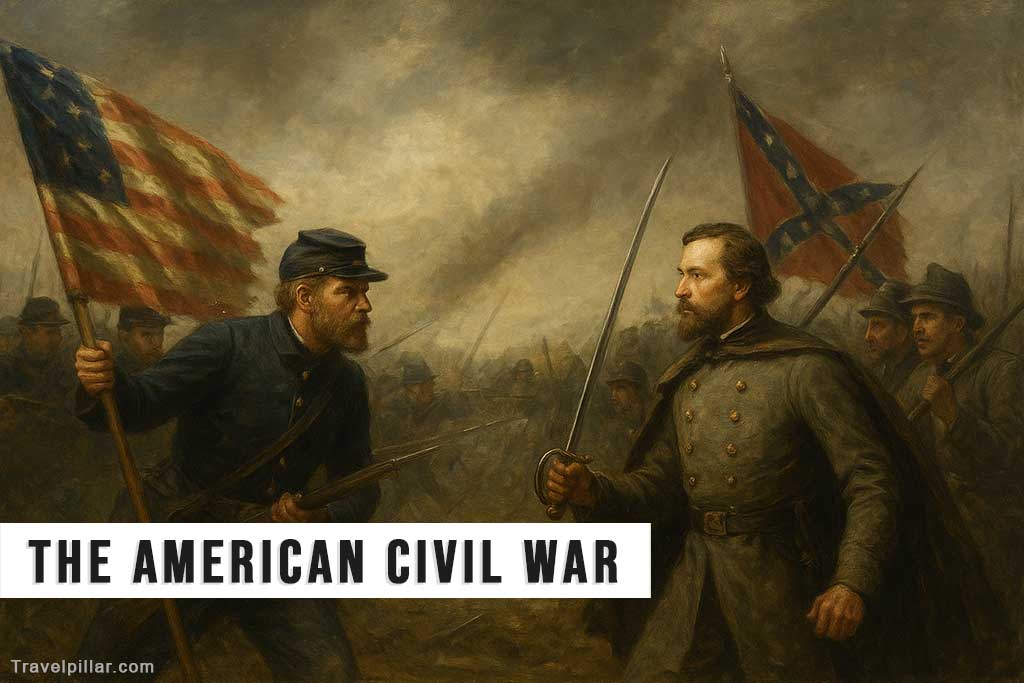
The American Civil War (1861–1865) was fought between the Union and the Confederate States, primarily over slavery and the future of the United States. It became the deadliest conflict in American history, claiming hundreds of thousands of lives. The Union’s victory preserved the nation, led to the abolition of slavery and fundamentally reshaped American society, politics and civil rights for generations to come.
The Abolition of Slavery
The abolition of slavery was one of the greatest humanitarian achievements in modern history. During the 18th and 19th centuries, campaigners across Europe and the Americas fought to end the transatlantic slave trade and abolish slavery itself. Britain outlawed the slave trade in 1807 and abolished slavery throughout most of the British Empire in 1833, while the United States formally ended slavery after the American Civil War with the Thirteenth Amendment in 1865. Although slavery continued in some parts of the world for many years, abolition marked a major step forward in the global struggle for human rights, equality and freedom.
The Russian Revolution
The Russian Revolution of 1917 brought an end to centuries of Tsarist rule and led to the creation of the world’s first communist state. The February Revolution forced Tsar Nicholas II to abdicate, while the October Revolution saw Vladimir Lenin and the Bolsheviks seize power. The revolution transformed Russia into the Soviet Union and profoundly influenced global politics throughout the 20th century.
World War I

World War I (1914–1918) was one of the first truly global conflicts, involving many of the world’s major powers. Triggered by the assassination of Archduke Franz Ferdinand, the war became notorious for trench warfare, machine guns, tanks and chemical weapons. The conflict led to the collapse of several empires, redrew the map of Europe and created political tensions that ultimately contributed to the outbreak of the Second World War.
The Discovery of Penicillin
In 1928, Scottish scientist Alexander Fleming discovered penicillin, the world’s first widely effective antibiotic. Although its full medical potential was not realised until the Second World War, penicillin revolutionised the treatment of bacterial infections and has since saved hundreds of millions of lives. The discovery transformed modern medicine, paving the way for the development of antibiotics that continue to play a vital role in healthcare worldwide.
World War II
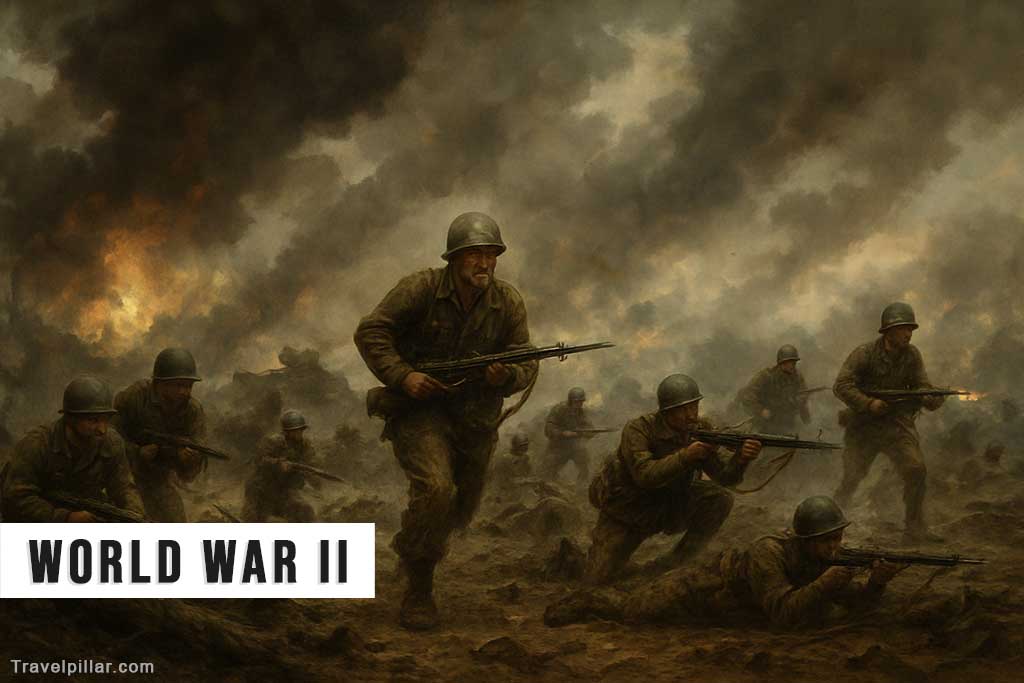
World War II (1939–1945) was the largest and most destructive conflict in human history. Fought across Europe, Africa and Asia, it involved more than 100 million military personnel and resulted in the deaths of an estimated 60 million people. The war witnessed the Holocaust, the first use of nuclear weapons and the defeat of Nazi Germany, Fascist Italy and Imperial Japan. Its outcome reshaped global politics and established the United States and the Soviet Union as the world’s leading superpowers.
Decolonisation
Following the Second World War, European colonial empires rapidly declined as countries across Asia, Africa and the Caribbean gained independence. India became independent in 1947, inspiring many other independence movements during the following decades. By the late 20th century, dozens of new nations had emerged as former colonies achieved self-government. Decolonisation transformed global politics, reshaped international relations and created many of the independent countries that exist today, making it one of the defining historical developments of the modern era.
The Cold War
The Cold War (1947–1991) was a prolonged period of political, ideological and military rivalry between the United States and the Soviet Union. Although the two superpowers never fought each other directly, their competition influenced conflicts around the world, including the Korean and Vietnam Wars, the Berlin Crisis and the Cuban Missile Crisis. The era also saw the nuclear arms race and the Space Race before ending with the collapse of the Soviet Union in 1991.
The Space Race
The Space Race was a technological competition between the United States and the Soviet Union during the Cold War. Beginning with the launch of Sputnik 1 in 1957, it led to extraordinary achievements including Yuri Gagarin becoming the first person in space and the Apollo 11 Moon landing in 1969. Beyond its political significance, the Space Race accelerated advances in science, engineering, computing and satellite technology that continue to benefit modern society.
The Fall of the Berlin Wall
The fall of the Berlin Wall on 9 November 1989 became one of the defining moments of the late 20th century. For almost three decades, the wall had symbolised the division between communist Eastern Europe and the democratic West. Its opening marked the beginning of the end of the Cold War, led to the reunification of Germany and encouraged democratic reforms across Eastern Europe. Today, it remains one of the world’s most powerful symbols of freedom and political change.
The Digital Revolution
Beginning in the late 20th century, the Digital Revolution transformed the way people communicate, work and access information. The development of personal computers, the internet, mobile technology and, more recently, artificial intelligence has reshaped almost every aspect of modern life. Like the Industrial Revolution before it, the Digital Revolution continues to influence business, education, healthcare, entertainment and global communication, making it one of the defining developments of the modern age.
The Legacy of History
History is shaped by countless events, but a relatively small number fundamentally changed the direction of human civilisation. From the first farmers and the invention of writing to world religions, scientific discoveries, revolutions and global conflicts, these defining moments continue to influence the way we live, govern, communicate and understand the world.
Understanding these events adds depth to travel. Ancient ruins become more than archaeological sites, castles and battlefields reveal the struggles that shaped nations, while museums and monuments tell the stories behind humanity’s greatest achievements and challenges. Exploring the places where history unfolded provides a richer appreciation of how the past continues to shape the present and offers valuable insight into the world we live in today.