
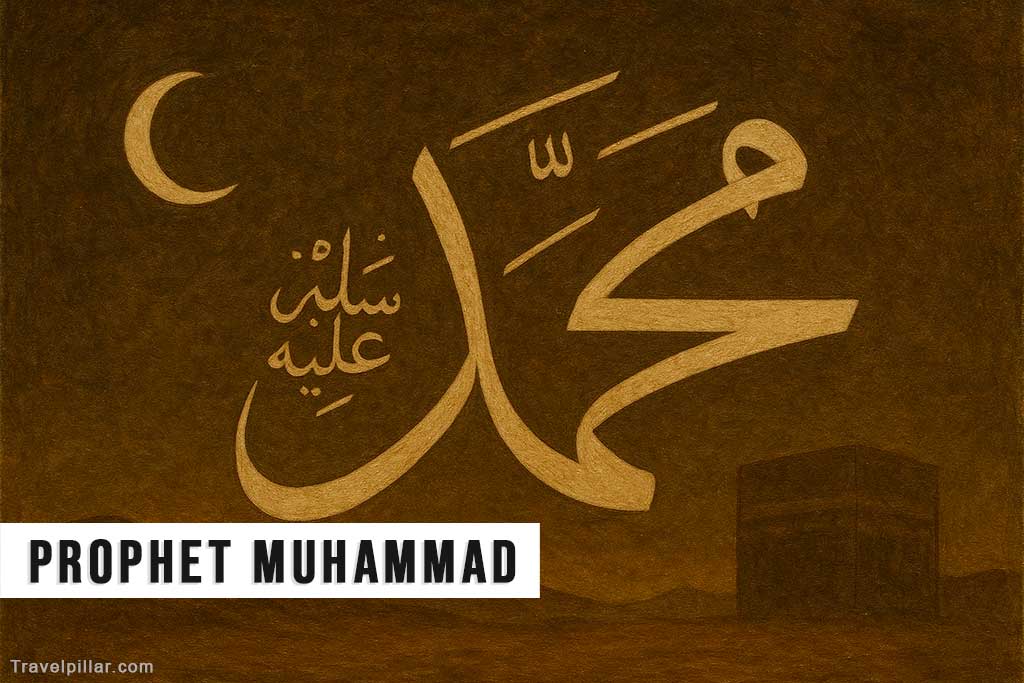
Muhammad, known as the Prophet Muhammad, is the founder of Islam and is considered by Muslims to be a messenger and prophet of God. Born in Mecca in 570 AD, into the Quraysh tribe, he grew up in a society marked by tribal warfare and polytheistic religious practices.
Around 610 AD, at the age of forty, Muhammad began experiencing revelations that he, and those who follow Islam, believe were from God, relayed to him by the angel Gabriel. These revelations, which continued for 23 years, are compiled in the Qur’an, the holy book of Islam. The fundamental teachings of the Qur’an include the belief in one God (Allah), daily prayer, almsgiving, fasting during Ramadan, and pilgrimage to Mecca (Hajj), which are known as the Five Pillars of Islam.
Muhammad began to preach these revelations, advocating monotheism and righteousness, which faced strong opposition in Mecca. In 622 AD, facing persecution, he and his followers migrated to the city of Medina, an event known as the Hijrah, which marks the beginning of the Islamic lunar calendar.
In Medina, Muhammad became a religious and political leader, creating a constitution and consolidating the Muslim community. He led several military campaigns to protect his community and spread the message of Islam. By the time of his death in 632 AD, almost all of the Arabian Peninsula had converted to Islam.
Muhammad’s life—his teachings, deeds, and the Sunnah (his lived example)—has significant influence on the lives of Muslims worldwide and forms the basis for Islamic law (Sharia). His teachings emphasized social equality, charitable acts, and moral rectitude. Despite controversy and misinterpretations, Muhammad remains one of the most influential figures in human history, with Islam being one of the world’s largest religions.