
Ancient Greek philosophers laid the foundations of Western thought through their study of reason, ethics, and the nature of reality. Emerging in the 6th century BCE, their ideas shifted human understanding from mythological explanations to rational inquiry. Thinkers such as Socrates, Plato, and Aristotle explored questions about knowledge, virtue, and the ideal society. Their methods of logical argument and observation continue to influence modern philosophy, science, and education across the world.
Thales of Miletus (624-546 BCE)
Thales of Miletus, active in the 6th century BCE, is often regarded as the first Western philosopher. He sought natural explanations for the world rather than relying on mythology, proposing that water was the fundamental substance of all things. Thales also contributed to early mathematics and astronomy, predicting solar eclipses and studying geometric principles. His work marked the beginning of rational inquiry in philosophy and laid the groundwork for later scientific thought in ancient Greece.
Anaximander of Miletus (610-546 BCE)
Anaximander of Miletus was an ancient Greek philosopher, often recognized as a student of Thales. He significantly contributed to cosmology, geography, and biology. Anaximander proposed that the ‘Apeiron’, or the boundless, was the source of all things. Notably, he also pioneered the concept of evolutionary theory, suggesting that humans evolved from simpler life forms. Anaximander’s innovative ideas made him one of the key figures in the early Pre-Socratic philosophical tradition.
Pythagoras (570-495 BCE)
Pythagoras of Samos, who lived in the 6th century BCE, was a Greek philosopher and mathematician best known for the Pythagorean theorem. He founded a philosophical and religious school that studied mathematics, music, and the nature of the soul. Pythagoras believed that numbers formed the basis of all reality and that harmony reflected cosmic order. His ideas influenced later philosophical thought, linking mathematics with metaphysics and shaping early Greek understandings of science and spirituality.
Heraclitus (535-475 BCE)
Heraclitus was a pre-Socratic Greek philosopher from Ephesus, known for his doctrine of change as the fundamental essence of the universe, famously captured in the phrase “No man ever steps in the same river twice”. He introduced the term ‘Logos’ to philosophical discourse, signifying the underlying order and structure of the world. His cryptic style and the aphoristic nature of his writings led to him being called “The Obscure”.
Parmenides (515-450 BCE)
Parmenides of Elea (c. 515 – c. 450 BC) was a pre-Socratic Greek philosopher renowned for his work on metaphysics and ontology. He fundamentally challenged the understanding of existence, positing that reality is unchanging and indivisible, and that all change is illusory. His poem “On Nature”, presenting his philosophical arguments, marks a significant departure from previous cosmological theories, hence, initiating a paradigm shift in Greek philosophy towards more rigorous logical analysis.
Democritus (460-370 BC)

Democritus (460–370 BC) was a pre-Socratic Ancient Greek philosopher, renowned for formulating an influential atomic theory of the universe. Born in Abdera, Thrace, he studied under Leucippus and expanded on his teacher’s theories. Democritus posited that everything is composed of “atoms”, indivisible and indestructible particles. His contributions, while overlooked in his era due to the dominance of Platonic and Aristotelian philosophies, were pivotal to later scientific and philosophical thought.
Socrates (469-399 BCE)
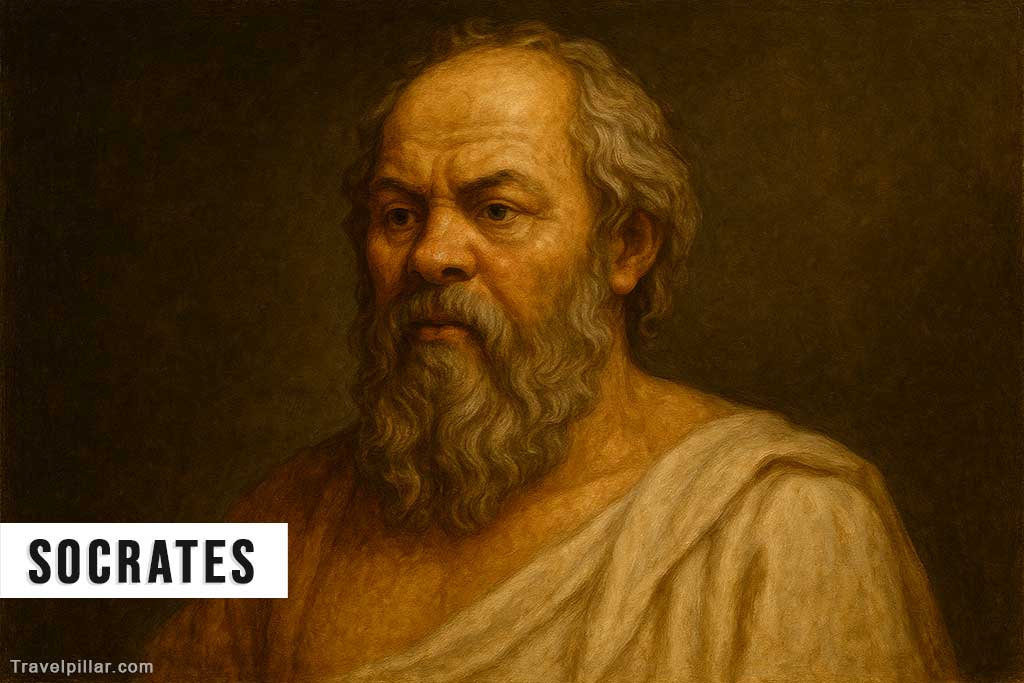
Socrates, active in Athens during the 5th century BCE, is considered one of the founders of Western philosophy. He focused on ethics and the pursuit of moral truth through dialogue and questioning, a method now known as the Socratic method. Socrates encouraged critical thinking and self-examination, believing that understanding oneself was the key to virtue. Though he wrote nothing himself, his ideas were recorded by his student Plato and continue to influence philosophical inquiry today.
Plato (427-347 BCE)

Plato, a student of Socrates, was a central figure in ancient Greek philosophy and the founder of the Academy in Athens, one of the first institutions of higher learning in the Western world. He explored topics such as justice, knowledge, and the nature of reality through his written dialogues. Plato’s theory of Forms proposed that the physical world is a reflection of higher, unchanging truths. His ideas deeply influenced Western philosophy, politics, and education.
Aristotle (384-322 BCE)

Aristotle, a student of Plato, made significant contributions to logic, metaphysics, ethics, biology, and many other fields. He emphasized empirical observation and the study of the natural world. Aristotle’s works encompass a wide range of topics, including his Nicomachean Ethics and Politics.
Zeno of Citium (c. 334–c. 262 BCE)

Zeno of Citium was a Hellenistic philosopher and the founder of Stoicism, a school of thought that emphasized rationality, virtue, and living in accordance with nature. Born in Cyprus, Zeno moved to Athens, where he studied under Cynic and other philosophical teachers before developing his own system. His teachings, delivered at the Stoa Poikile, focused on ethics, logic, and natural law, advocating emotional self-control and resilience as paths to human flourishing.
Epicurus (341 – 270 BCE)

Epicurus (341 – 270 BC) was an ancient Greek philosopher who founded the school of philosophy known as Epicureanism. His philosophy revolved around the pursuit of ataraxia, a state of tranquility free from fear, and aponia, the absence of physical pain, achieved through knowledge, friendship, and virtuous, temperate living. Misunderstood, Epicurus wasn’t an advocate of rampant hedonism. Instead, he proposed a life of modest pleasure, intellectual contemplation, and minimal desires as the path to happiness.
Archimedes (c. 287 – c. 212 BCE)
Archimedes of Syracuse (c. 287 – c. 212 BC) was an ancient Greek mathematician, physicist, engineer, and inventor. He made significant contributions to the understanding of the principles of lever and buoyancy. His mathematical studies led to the development of integral calculus concepts. Archimedes also developed innovative war machines, which were used during the siege of Syracuse. His creative insights continue to profoundly influence scientific understanding, earning him a place among the greatest minds of antiquity.
These philosophers represent just a small sample of the rich tradition of Greek philosophy. Their ideas and methods laid the groundwork for future philosophical developments and continue to be studied and debated by philosophers today. Greek philosophy’s influence extends beyond the ancient world, shaping the trajectory of Western thought and the foundation of many philosophical disciplines.