
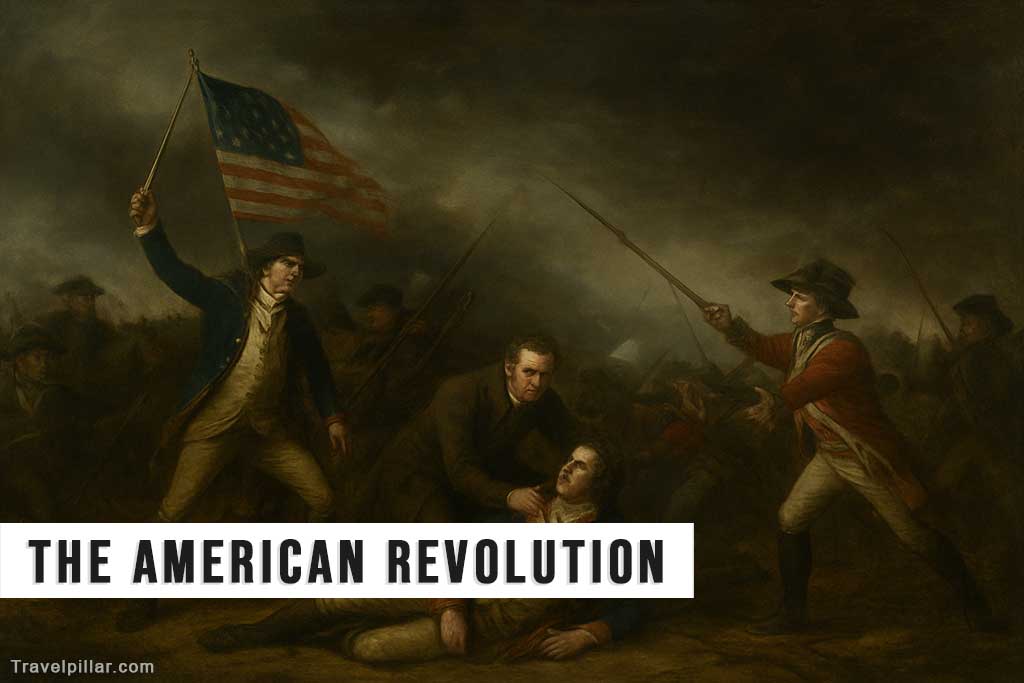
The American Revolution (1775–1783) was a significant conflict between the thirteen American colonies and Great Britain. It marked the colonies’ fight for independence, resulting in the formation of the United States of America. The Revolution was driven by growing tensions over British policies, taxation without representation, and a desire for self-governance.
The origins of the conflict can be traced back to the aftermath of the French and Indian War (1754–1763). Britain, seeking to recover war expenses, imposed taxes on the colonies, including the Stamp Act (1765) and the Townshend Acts (1767). These taxes were met with resistance, as the colonists argued they had no representation in the British Parliament. Protests escalated, notably during the Boston Tea Party in 1773, where colonists dumped British tea into Boston Harbor as an act of defiance.
The Revolution began on April 19, 1775, with the battles of Lexington and Concord in Massachusetts, where British troops clashed with colonial militia. The conflict soon spread, leading to the formation of the Continental Army, commanded by General George Washington. In 1776, the Continental Congress adopted the Declaration of Independence, authored primarily by Thomas Jefferson, proclaiming the colonies’ separation from British rule.
The war was marked by key battles, such as the Battle of Bunker Hill (1775), which demonstrated the resolve of the colonial forces despite a British victory. The Battle of Saratoga (1777) was a turning point, as it led to French support for the American cause, significantly bolstering the Continental Army. The final major battle occurred at Yorktown, Virginia, in 1781, where British General Cornwallis surrendered to Washington, effectively ending the war.
The American Revolution formally concluded with the Treaty of Paris in 1783. Britain recognized the independence of the United States, granting the new nation territory from the Atlantic Ocean to the Mississippi River. The Revolution established principles of liberty, individual rights, and self-governance, laying the foundation for the country’s political system.
Today, numerous historical sites related to the American Revolution can be visited. The Freedom Trail in Boston includes landmarks such as the Old North Church and Paul Revere’s House, providing insight into the early days of the conflict. Valley Forge National Historical Park in Pennsylvania offers a glimpse into the harsh conditions faced by Washington’s army during the winter of 1777–1778. Additionally, Colonial Williamsburg in Virginia and the Yorktown Battlefield showcase pivotal moments and settings of the Revolutionary War, preserving its legacy and impact on American history.