
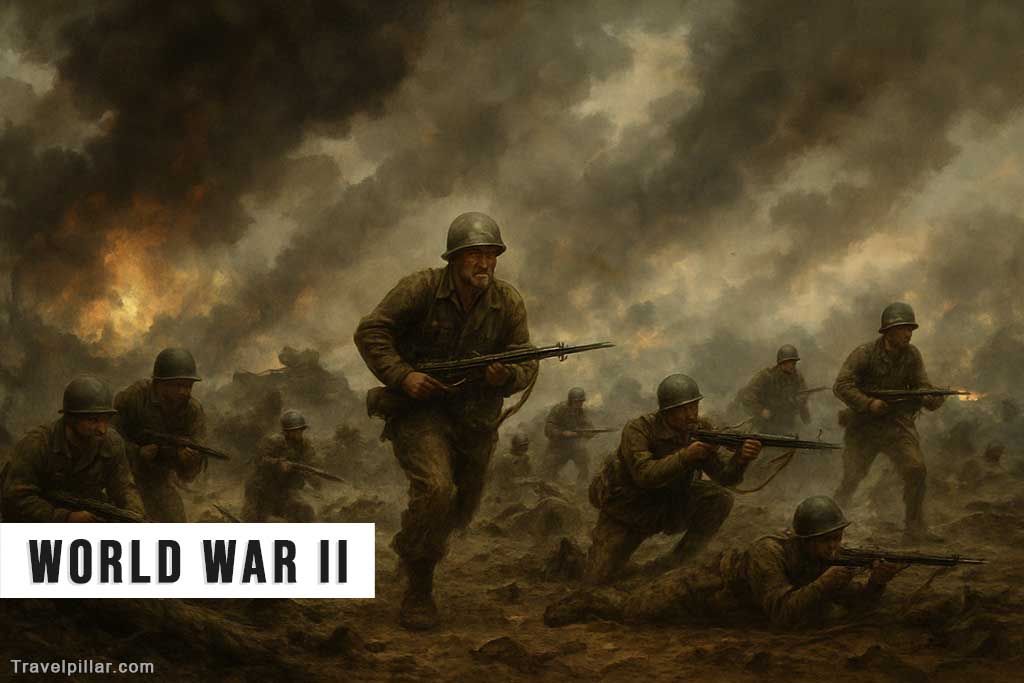
World War II (Second World War), spanning from 1939 to 1945, was a global conflict that involved the majority of the world’s nations, including all the great powers, organized into two opposing alliances: the Allies and the Axis powers. The war was triggered by a series of aggressive actions by Nazi Germany, led by Adolf Hitler, and its expansionist ambitions.
The war began on September 1, 1939, when Germany invaded Poland, prompting Britain and France to declare war in response. The Axis powers, primarily consisting of Germany, Italy, and Japan, aimed to establish dominance and territorial control through military conquest.
World War II witnessed the use of innovative and destructive technologies on a massive scale. Air power played a significant role, with strategic bombing campaigns carried out by both sides. The introduction of tanks, submarines, and aircraft carriers revolutionized warfare, leading to large-scale engagements on land, sea, and in the air.
The war saw numerous major battles and campaigns across various theaters of operation. The Battle of Stalingrad, fought between German and Soviet forces, was a turning point in the conflict, marking the first major defeat for the Axis powers. The Battle of Midway in the Pacific halted Japanese expansion and shifted the balance in favor of the Allies. Other significant battles include the D-Day invasion of Normandy, the Battle of El Alamein in North Africa, and the Battle of Okinawa in the Pacific.
The Holocaust, a systematic genocide carried out by the Nazis, was one of the most horrifying aspects of World War II. Millions of Jews, along with other minority groups, were persecuted and killed in concentration camps, illustrating the depths of human brutality.
The war culminated in the Allied victory. The United States, Soviet Union, and Great Britain played pivotal roles in defeating the Axis powers. The dropping of atomic bombs on Hiroshima and Nagasaki by the United States hastened Japan’s surrender in August 1945.
World War II had far-reaching consequences. The formation of the United Nations aimed to prevent future conflicts and promote global cooperation. The war also led to significant geopolitical changes, including the division of Germany and the rise of the United States and the Soviet Union as superpowers, ushering in the Cold War era.
In conclusion, World War II was a global conflict marked by unprecedented destruction and loss of life. It involved the use of advanced military technologies and witnessed major battles across multiple theaters. The war’s legacy continues to shape international relations and serves as a stark reminder of the devastating consequences of human conflict.