
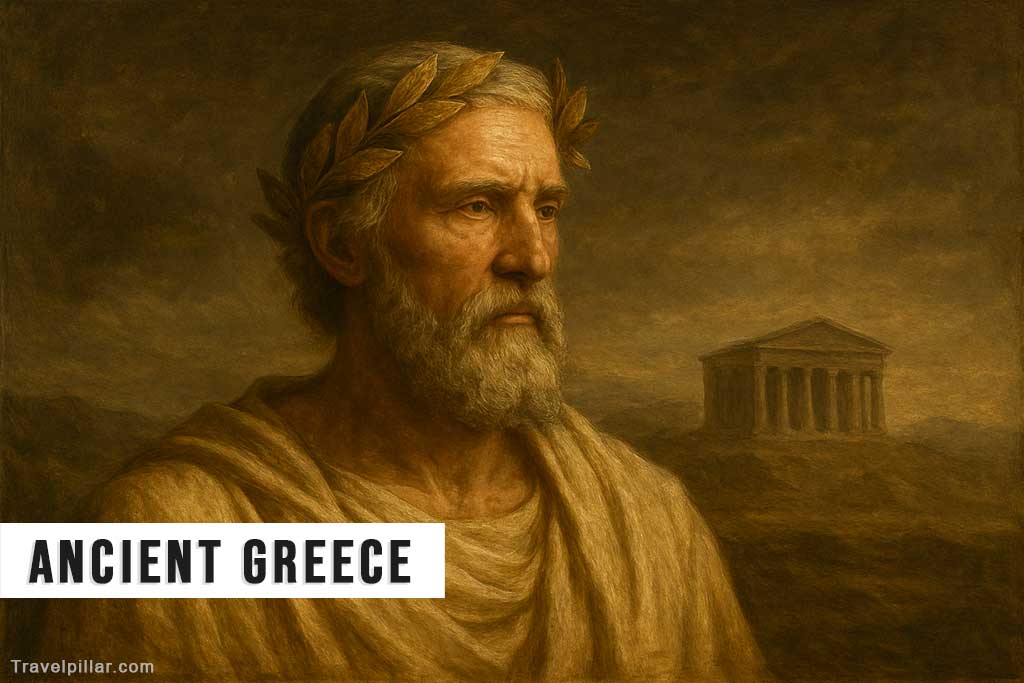
Ancient Greece is one of the most influential civilizations in human history, contributing to various fields like philosophy, politics, science, and the arts. Its period is typically considered to span from the 12th-9th century BC (the Greek Dark Ages) to the end of antiquity (around 600 AD).
The civilization of Ancient Greece was not a unified nation as we understand it today, but a collection of several city-states (poleis), each with its own government and laws. The two most famous of these city-states were Athens and Sparta, known for their cultural, political, and military rivalries.
Archaic Period (800-500 BC)
The beginning of the Archaic period saw the emergence of the polis as a distinctive feature of Greek civilization. The Greeks began to create colonies across the Mediterranean and the Black Sea. This period also saw the first inklings of democracy in some city-states.
Classical Period (500-336 BC)
This is often considered the pinnacle of Greek cultural achievement. The Persian Wars in the early part of the 5th century BC led to the establishment of Athens as a major power. The so-called “Golden Age of Athens” in the mid-5th century BC was a period of significant cultural growth and innovation, with figures such as Socrates, Hippocrates, and Herodotus making lasting contributions.
In this period, Athens developed a form of government known as democracy, where eligible citizens (free male Athenians) had the right to vote on laws and public policies. This political innovation has had a profound influence on the development of Western political thought and governance.
In contrast to Athens, Sparta was a militaristic society known for its disciplined and formidable army. Unlike Athens, which was a democracy, Sparta was ruled by two kings and an oligarchy.
Hellenistic Period (336-146 BC)
The death of Philip II of Macedon and the subsequent rise of his son, Alexander the Great, marked the beginning of the Hellenistic period. Alexander’s conquests spread Greek culture throughout the parts of three continents, from Egypt to Afghanistan. This period is marked by the fusion of Greek traditions with the cultures of the conquered lands, creating a synthesis that is characteristic of the Hellenistic period.
Roman Greece (146 BC – 324 AD)
Greece fell to the Roman Republic in 146 BC. Despite being ruled by Rome, Greek culture continued to thrive and significantly influenced Roman culture. This cultural exchange is one reason why the period is often referred to as “Greco-Roman.”
Byzantine Period (324-1453 AD)
The Byzantine Empire, which was essentially the eastern half of the Roman Empire, was Greek-speaking and Greek-cultured, preserving Greek learning and culture through the Middle Ages.
Contributions to Civilization
The contributions of Ancient Greece to the world are immeasurable and have greatly influenced Western society. Their developments in the fields of philosophy, politics, and science form the foundations for much of our current knowledge. Greek philosophers like Socrates, Plato, and Aristotle laid the groundwork for Western philosophy. Greek contributions to the field of science include the work of Pythagoras in mathematics and Hippocrates in medicine.
In literature, epic poet Homer, dramatists Aeschylus, Sophocles, Euripides and Aristophanes, and historians Herodotus and Thucydides have left a profound mark on Western literary tradition. The Greeks also pioneered various genres and styles of art, including drama, history, comedy, sculpture, and architecture.
The influence of the Ancient Greeks on the language, politics, educational systems, philosophy, science, arts, and sports of Western society is so profound that they are often