
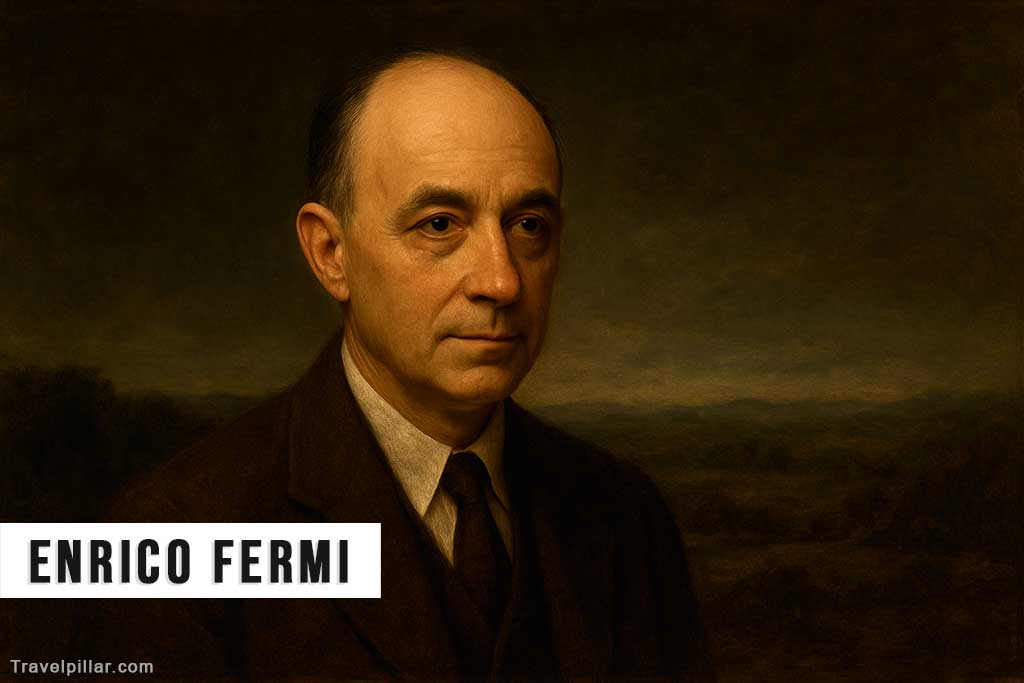
Enrico Fermi: Architect of Nuclear Physics
Enrico Fermi (1901–1954) was an Italian-American physicist whose pioneering contributions spanned nuclear physics, quantum theory, and particle physics. His work bridged theoretical insight and experimental practice, making him one of the most versatile and influential scientists of the twentieth century.
Fermi was born in Rome and studied physics at the Scuola Normale Superiore in Pisa, where he quickly distinguished himself as a talented theorist. In the 1920s, he contributed to the development of quantum mechanics, particularly through his formulation of Fermi-Dirac statistics, which describe the distribution of particles known as fermions. This concept became fundamental to quantum theory, governing the behavior of electrons, protons, and neutrons.
In the 1930s, Fermi turned his attention to nuclear physics. He conducted experiments bombarding elements with neutrons, leading to the discovery of nuclear reactions by slow neutrons. His group in Rome succeeded in creating new isotopes and produced evidence of nuclear fission, though its significance was not immediately recognized. For this work on induced radioactivity, Fermi was awarded the Nobel Prize in Physics in 1938. Shortly thereafter, he emigrated to the United States, partly due to anti-Semitic laws in Fascist Italy that endangered his Jewish wife, Laura Capon.
In America, Fermi became central to the Manhattan Project. At the University of Chicago, he oversaw the construction of Chicago Pile-1, the world’s first artificial nuclear reactor, which achieved a self-sustaining chain reaction in December 1942. This achievement marked a milestone in the controlled release of nuclear energy and laid the foundation for both nuclear power and nuclear weapons.
Beyond nuclear physics, Fermi also made lasting contributions to particle physics, including work on beta decay that introduced the weak interaction theory, a precursor to the electroweak theory. Known for his clarity and practicality, he combined theoretical brilliance with experimental skill, a rare trait among physicists.
Enrico Fermi died in 1954, but his legacy endures in the fundamental principles of quantum and nuclear physics, as well as in the technological applications derived from his discoveries. The element fermium, named in his honor, reflects his lasting impact on science.