
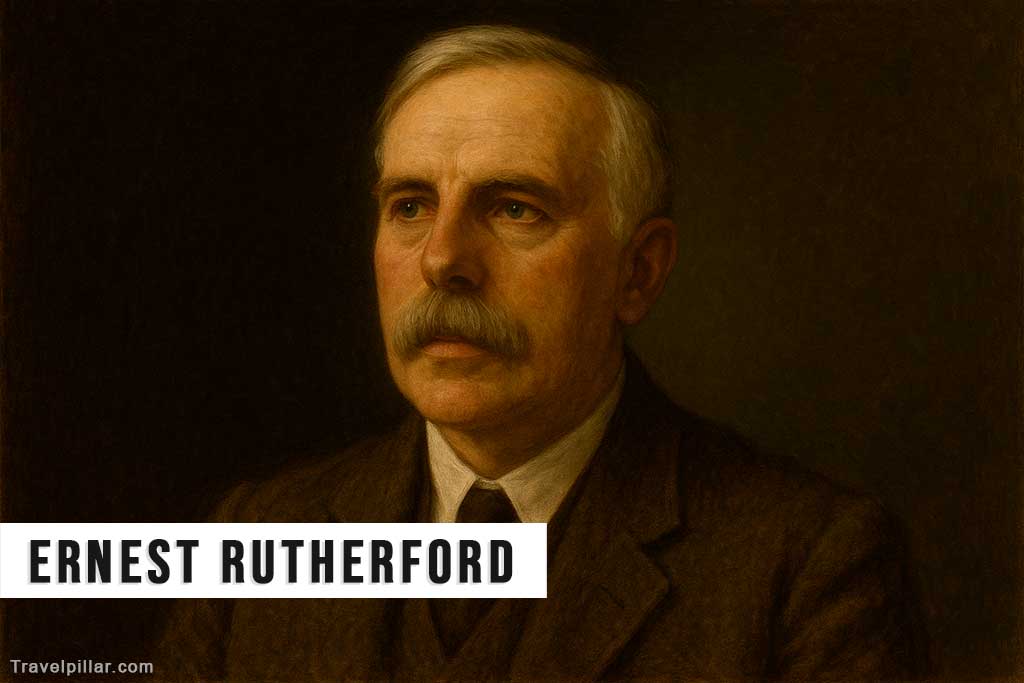
Ernest Rutherford: The Father of Nuclear Physics
Ernest Rutherford (1871–1937) was a New Zealand-born physicist whose experimental work transformed the understanding of atomic structure and radioactivity. Often described as the father of nuclear physics, his investigations into the nature of the atom redefined modern physics and chemistry.
Rutherford studied at Canterbury College in Christchurch before moving to the University of Cambridge to work under J. J. Thomson. Early in his career, he classified radiation into alpha, beta, and gamma rays, providing the first clear differentiation of radioactive emissions. His research on radioactivity laid the foundation for understanding atomic decay and half-lives, earning him the Nobel Prize in Chemistry in 1908.
One of his most influential achievements was the gold foil experiment, conducted with Hans Geiger and Ernest Marsden in 1909. By bombarding thin sheets of gold with alpha particles, Rutherford observed that while most particles passed through, some were deflected at sharp angles. This led to the revolutionary conclusion that atoms consist of a dense, positively charged nucleus surrounded by largely empty space with orbiting electrons. This nuclear model of the atom replaced the prevailing plum pudding model proposed by Thomson.
Rutherford also pioneered nuclear transmutation, demonstrating that nitrogen atoms could be converted into oxygen through bombardment with alpha particles. This was the first artificial nuclear reaction, proving that one element could be transformed into another. He further predicted the existence of the neutron, later confirmed experimentally by James Chadwick in 1932.
Throughout his career, Rutherford held key academic positions, including professorships at McGill University, the University of Manchester, and the University of Cambridge, where he became Cavendish Professor of Physics. He trained and mentored a generation of physicists, many of whom went on to make their own major contributions to nuclear and atomic science.
Ernest Rutherford died in 1937, leaving an enduring legacy as the founder of nuclear physics. His discoveries remain central to atomic theory, nuclear energy, and the broader understanding of matter. The element rutherfordium (Rf), named in his honor, reflects his lasting impact on science.