
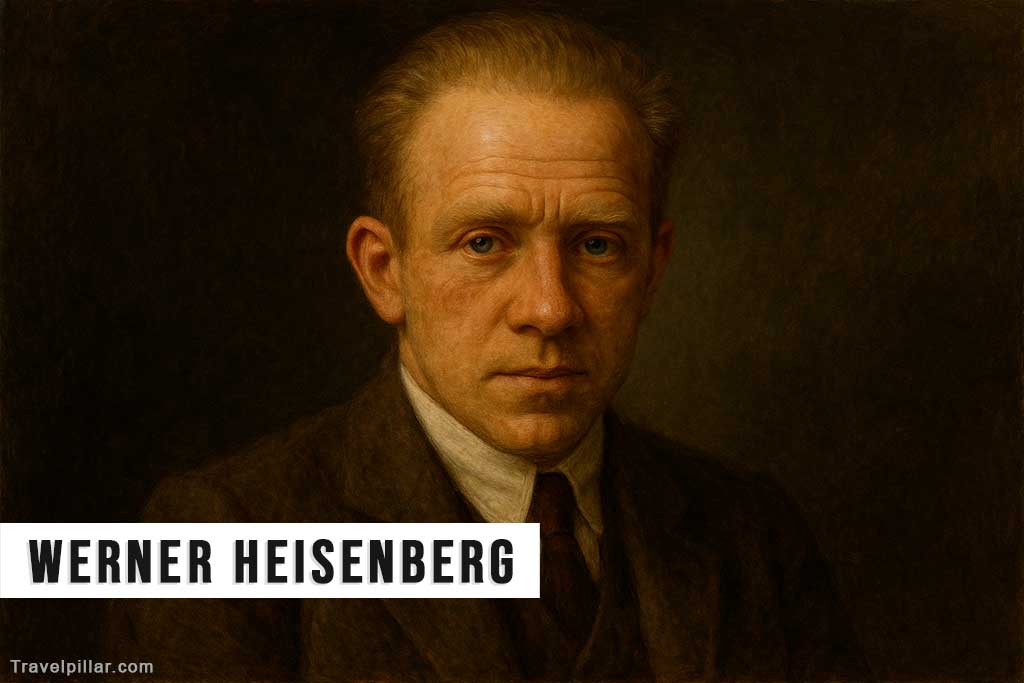
Werner Heisenberg: The Mastermind Behind the Uncertainty Principle
Werner Heisenberg, born in 1901 in Würzburg, Germany, is a titan of modern physics. His work fundamentally transformed the scientific understanding of the quantum world. Heisenberg’s uncertainty principle and matrix mechanics have been pivotal in the development of quantum mechanics, shaping our understanding of the universe at the most fundamental level.
Heisenberg studied physics and mathematics at the University of Munich. Influenced by luminaries such as Arnold Sommerfeld and Niels Bohr, he focused on the then-emerging field of quantum mechanics.
In 1925, Heisenberg formulated matrix mechanics, a novel mathematical formalism for quantum theory. This became one of the foundations of quantum mechanics, marking a significant shift from classical mechanics.
The most famous of Heisenberg’s contributions, the uncertainty principle, came in 1927. He proposed that it is impossible to precisely measure both the position and momentum of a particle simultaneously. This profound insight challenged the deterministic view of the universe that classical physics upheld, suggesting instead an inherent uncertainty at the quantum level.
Heisenberg’s work was recognized with the Nobel Prize in Physics in 1932, marking him as one of the foremost scientists of his age. During World War II, Heisenberg controversially led Germany’s nuclear energy project. Despite this, he made no significant progress in developing an atomic bomb.
After the war, Heisenberg contributed to the development of quantum field theory and had a major role in rebuilding science in Germany. He also advocated for scientific collaboration and communication during the Cold War, believing in the importance of dialogue in the divided scientific community.
Werner Heisenberg passed away in 1976, leaving behind a legacy of profound scientific insight and innovation. His contributions to quantum mechanics have had far-reaching implications, impacting not just physics but also our philosophical understanding of reality. His work continues to shape our perception of the quantum world.