
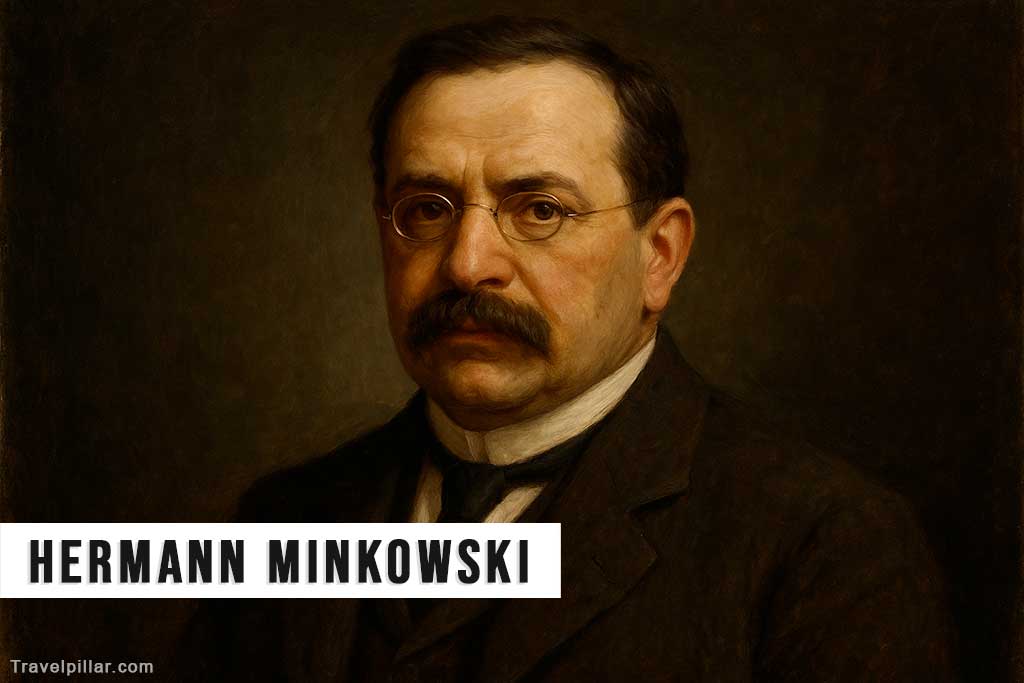
Born in 1864 in the Russian partition of Poland, Hermann Minkowski was an innovative mathematician and physicist who fundamentally reshaped the understanding of spacetime, significantly contributing to Albert Einstein‘s theory of relativity.
Minkowski’s mathematical prowess was evident from his youth, leading him to study at the University of Königsberg, where he excelled in his studies and later held a professorship. He taught at several other institutions, including the Swiss Federal Polytechnic in Zürich, where he had Albert Einstein among his students.
Minkowski’s substantial contributions were predominantly in the field of number theory and the theory of relativity. However, it was in 1907, when he combined the three dimensions of space and the dimension of time into a four-dimensional “Minkowski space,” that he made his most impactful contribution to physics.
Minkowski proposed that space and time were not separate entities, as traditionally understood, but rather intertwined in a single four-dimensional continuum known as ‘spacetime’. This bold concept was a departure from conventional physics but offered a crucial tool to understand Einstein’s special theory of relativity.
In Minkowski’s geometric interpretation of special relativity, the laws of physics took on the same form in any inertial frame of reference. He expressed the principles of relativity in terms of the geometry of spacetime, enabling the subsequent formulation of Einstein’s general theory of relativity.
Although Minkowski’s life was cut short in 1909 at the age of 44, his contributions to modern physics and mathematics were substantial and enduring. Minkowski spacetime has become an essential tool in theoretical physics and is instrumental in understanding and interpreting Einstein’s theory of relativity. Hermann Minkowski’s insightful fusion of space and time continues to guide the exploration of the universe’s fundamental nature.