
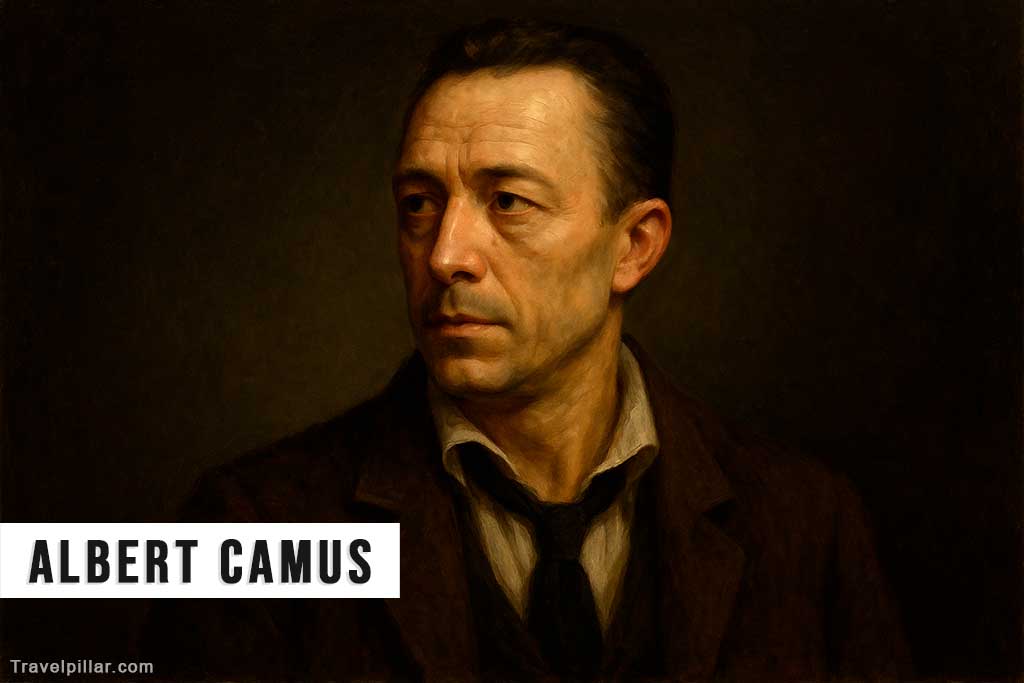
Albert Camus (1913–1960) was a French-Algerian philosopher, writer, and journalist known for his contributions to existentialism and the philosophy of the absurd. While he resisted the existentialist label, Camus’s ideas are often associated with existentialist themes, particularly in relation to human freedom, alienation, and the search for meaning. His work emphasized the tension between humanity’s desire for order and meaning and the inherent meaninglessness of the world.
Central to Camus’s philosophy is the concept of the “absurd,” which he explores in his 1942 essay The Myth of Sisyphus. The absurd arises from the conflict between humans’ desire for significance and the indifference of the universe. Camus argued that life is fundamentally devoid of purpose, and any attempt to impose meaning confronts an uncaring reality. Rather than succumbing to despair, however, he proposed an approach of acceptance. For Camus, recognizing the absurdity of life becomes an opportunity to live more freely, embracing existence without clinging to illusions or false hopes.
Camus famously illustrated the absurd condition through the Greek myth of Sisyphus, condemned by the gods to eternally roll a boulder up a mountain, only to watch it roll back down. This image of endless, futile labor becomes a metaphor for human life, which Camus suggests is marked by repetitive struggles with no ultimate purpose. Despite this bleak portrayal, Camus saw Sisyphus as an emblem of resilience; by accepting his fate without surrendering, Sisyphus finds a form of freedom. Camus concludes that “we must imagine Sisyphus happy,” highlighting his belief that one can live meaningfully even within an absurd existence.
Camus’s ideas about the absurd inform much of his other work, including his novels The Stranger (1942) and The Plague (1947). In The Stranger, the protagonist Meursault embodies the absurd man who lives without conventional moral frameworks, while The Plague presents a community confronted with an epidemic, exploring themes of human solidarity, resilience, and moral responsibility in an absurd world.
Camus also engaged with political and ethical questions, particularly around issues of justice, freedom, and resistance. He opposed totalitarianism and promoted a philosophy grounded in individual responsibility, solidarity, and the rejection of violence as a means to achieve justice.
Albert Camus remains a significant figure in modern philosophy and literature, known for his exploration of existential themes through the lens of the absurd. His work continues to resonate for its insights into human resilience, the limitations of human reason, and the pursuit of meaning within a seemingly indifferent world.