
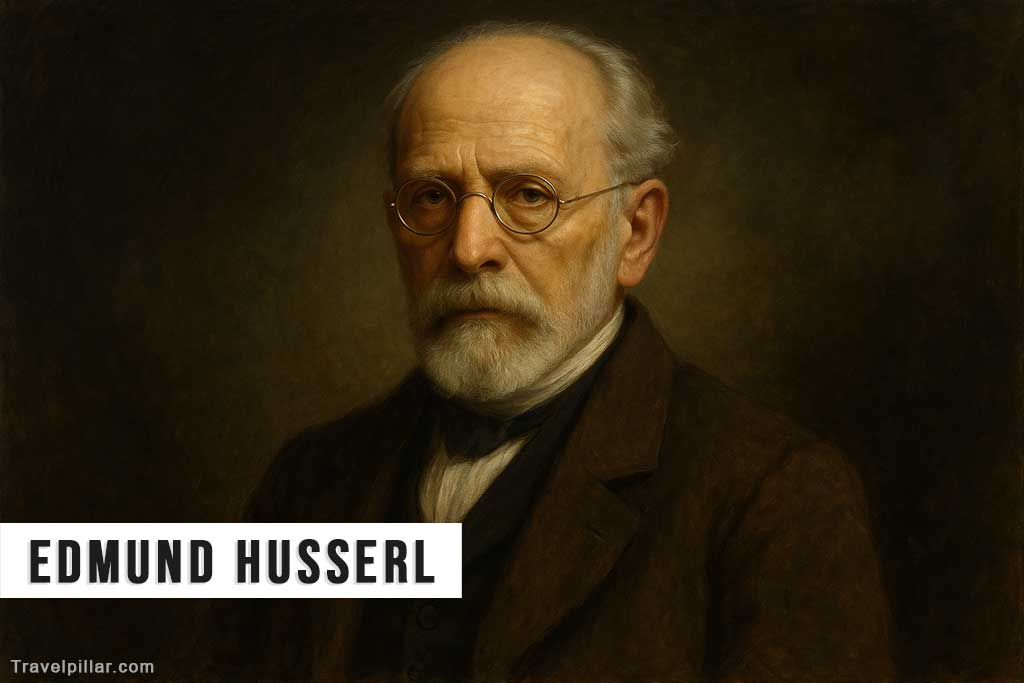
Edmund Husserl (1859–1938) was a German philosopher best known as the founder of phenomenology, a method of philosophical inquiry focused on the study of conscious experience and perception. Initially trained in mathematics, Husserl turned to philosophy in search of a more rigorous approach to understanding the nature of reality and human experience. His work laid the foundation for much of modern continental philosophy and has had a significant influence on fields such as psychology, cognitive science, and existentialism.
At the heart of Husserl’s philosophy is the concept of phenomenology, which he developed as a systematic method for examining how things appear to us in consciousness. Phenomenology seeks to describe experiences as they are lived, without the assumptions or theories typically imposed by scientific or abstract analysis. Husserl aimed to study consciousness in its purest form by focusing on subjective experience rather than objective facts. His approach is often referred to as “bracketing” or “epoché,” which involves setting aside preconceived beliefs and focusing solely on the immediate aspects of experience.
Husserl introduced the concept of “intentionality,” the idea that consciousness is always directed toward something, whether a physical object, an idea, or an emotional state. Intentionality implies that consciousness is relational, linking the mind with the objects or events it perceives. This concept is foundational to phenomenology, as it shifts the focus from examining isolated thoughts or perceptions to exploring the interconnectedness between individuals and their surroundings. By studying how individuals experience the world, Husserl aimed to reveal the basic structures of consciousness, such as time, space, and self-awareness, which shape human understanding and perception.
One of Husserl’s most influential contributions is his notion of “lifeworld” (or Lebenswelt in German), which he describes as the world of everyday lived experience. Unlike the abstract or scientific world of theoretical knowledge, the lifeworld refers to the pre-reflective realm of direct, personal experience. For Husserl, understanding human experience requires examining this lifeworld, as it is the context within which all meaning is constructed and perceived.
Husserl’s ideas were highly influential, particularly for later philosophers such as Martin Heidegger, Jean-Paul Sartre, and Maurice Merleau-Ponty, who expanded on phenomenology to explore issues of existence, freedom, and embodiment. Today, phenomenology continues to impact various disciplines, shaping approaches to understanding perception, cognition, and the human condition.
Husserl’s legacy is a comprehensive method of analyzing consciousness, which provides a structured way to study human experience without reducing it to abstract or impersonal theories. His work encourages a mindful approach to understanding reality as it appears in direct experience, underscoring the importance of examining subjective perception to gain deeper insights into the nature of existence.