
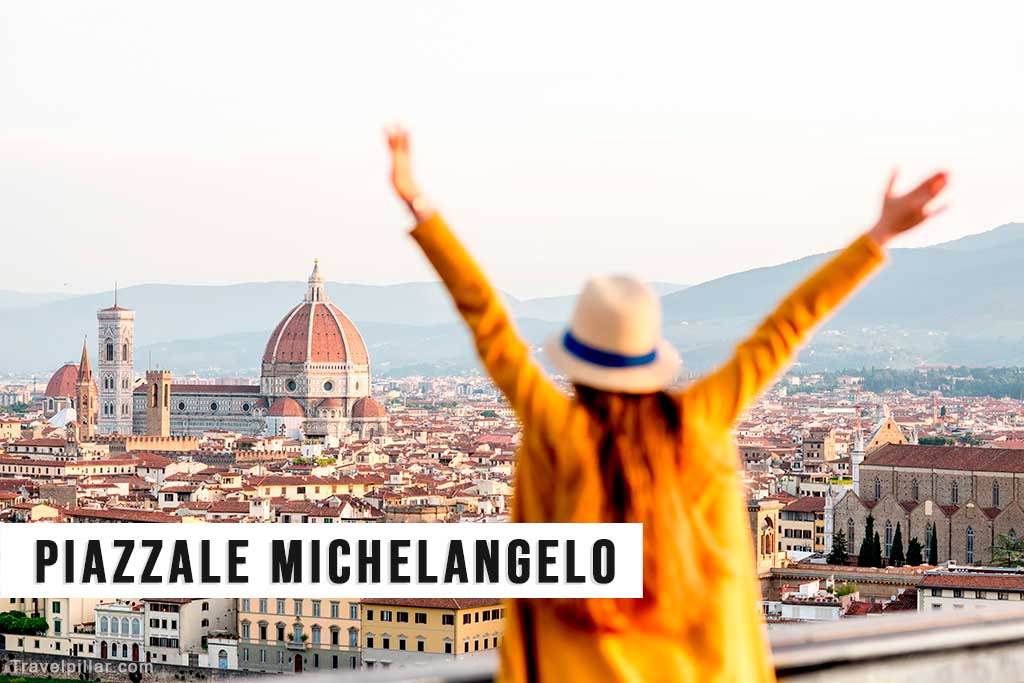
Piazzale Michelangelo is a 19th-century panoramic terrace situated on a hill on the south side of the Arno River in Florence. It offers one of the most comprehensive views of the city’s historic center, including major landmarks such as the Cathedral of Santa Maria del Fiore (Duomo), Palazzo Vecchio, Ponte Vecchio, and the Basilica of Santa Croce. The square is a popular destination for both tourists and locals, especially at sunset.

The terrace was designed by Florentine architect Giuseppe Poggi in 1869 as part of the city’s urban renewal project during the period when Florence was briefly the capital of Italy (1865–1871). The project included the creation of the Viale dei Colli, a wide boulevard leading up the hill, culminating in this large square. Poggi’s design envisioned Piazzale Michelangelo as a monument to Michelangelo Buonarroti, one of the most prominent artists of the Renaissance. At the center of the piazza is a large bronze replica of Michelangelo’s David, accompanied by reproductions of four of his allegorical sculptures from the Medici Chapels. These statues were cast in bronze in 1873.

Although the terrace was initially intended to house a museum dedicated to Michelangelo, that plan was never completed. The building constructed for this purpose now operates as a café and restaurant. The square itself is often crowded, particularly in the evenings, as it remains a favored vantage point for photographing Florence’s skyline.

Piazzale Michelangelo is accessible by car, tour bus, or on foot. A walk up from the city center typically takes 20 to 30 minutes, with well-maintained steps and scenic paths leading through the surrounding gardens, including the Rose Garden (Giardino delle Rose) and the Iris Garden (Giardino dell’Iris), which are open seasonally.
The site continues to serve as a prominent example of 19th-century urban planning in Florence and remains an enduring symbol of the city’s effort to balance historical preservation with modern tourism.
Google map