
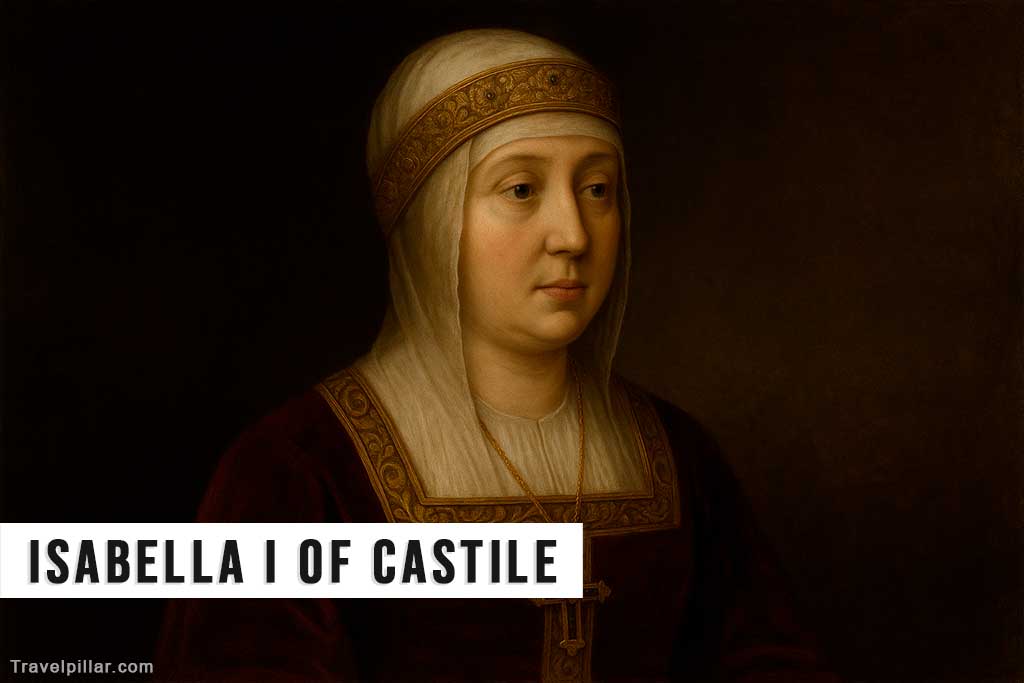
Isabella I of Castile (1451–1504), also known as Isabella the Catholic, was a central figure in the late Middle Ages and early Renaissance periods of European history. She was Queen of Castile and León from 1474 to 1504 and, by marriage, Queen of Aragon. With her husband, Ferdinand II of Aragon, they are remembered as the Catholic Monarchs, whose union effectively laid the foundation for the consolidation of Spain under their grandson, Charles V.
Born into the House of Trastámara, Isabella was the half-sister of Henry IV, the then King of Castile. When Henry died in 1474, Isabella’s claim to the throne was contested, leading to a civil war known as the War of the Castilian Succession. Her victory marked the start of a joint rule with her husband Ferdinand II of Aragon, bringing multiple Spanish kingdoms under a unified rule.
Isabella’s reign was marked by significant administrative, military, and religious reforms. She and Ferdinand standardized legal codes across their kingdoms, centralized royal power, and restructured the system of royal finance. These reforms helped to curb violence and establish relative internal peace, strengthening the monarchy’s control over the nobility.
Internationally, Isabella’s reign is perhaps best known for her support of Christopher Columbus. In 1492, she funded Columbus’s voyage across the Atlantic, which resulted in the European discovery of the New World. This monumental decision paved the way for the extensive Spanish Empire in the Americas, transforming Spain into a world power.
On the religious front, Isabella pursued a policy of Catholic orthodoxy. She established the Spanish Inquisition in 1478 to maintain Catholic orthodoxy in her kingdoms and oversaw the expulsion of the Jews in 1492. These actions have led to significant debate among historians regarding the legacy of her reign.
Isabella I of Castile’s influence extended beyond her life, with her decisions shaping the course of Spanish and world history. Today, she is remembered as a powerful monarch whose reign had a lasting impact on her nation and the world.