
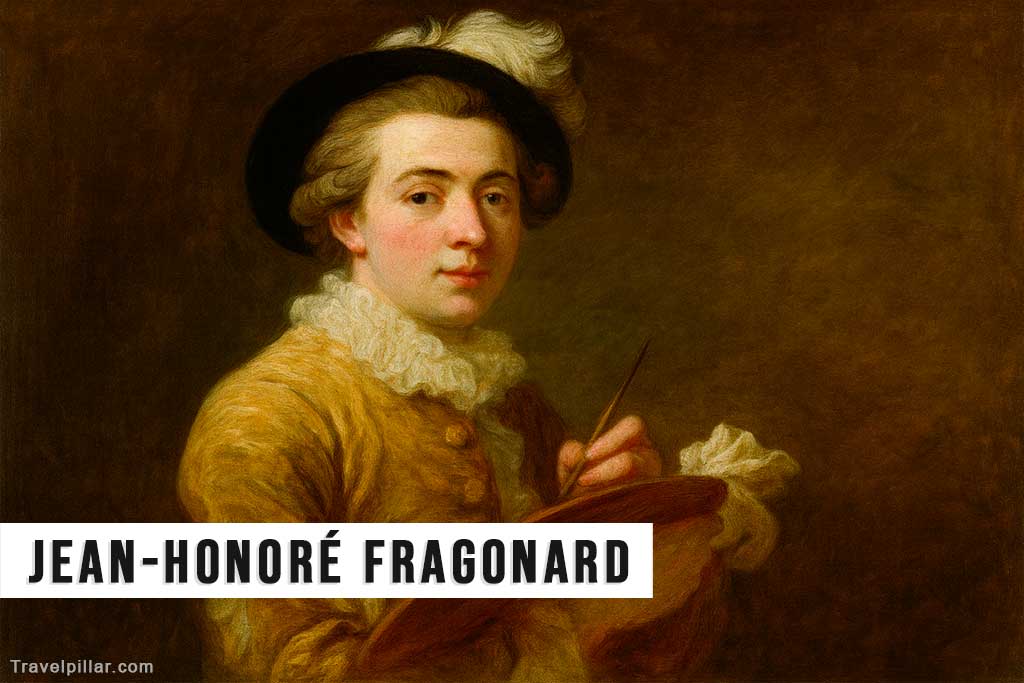
Jean-Honoré Fragonard (1732–1806) was a French painter and a prominent figure of the Rococo movement. Known for his lighthearted and romantic scenes, Fragonard’s works epitomized the elegance and exuberance of 18th-century aristocratic life. His style is characterized by fluid brushwork, soft pastel tones, and a focus on themes of love, leisure, and sensuality.
Fragonard trained in Paris under François Boucher, a leading Rococo artist, and later studied in Rome, where he developed an appreciation for Italian Renaissance and Baroque art. His exposure to classical works influenced the composition and fluidity of his paintings, even as he embraced the playful and decorative aspects of Rococo. Upon returning to France, Fragonard gained royal and aristocratic patronage, which allowed him to produce works that celebrated the carefree lifestyle of the upper classes.
One of Fragonard’s most famous paintings, “The Swing” (1767), exemplifies the Rococo aesthetic. It depicts a young woman on a swing, playfully pushed by an older man, while her lover hides in the bushes to admire her. The painting’s lush garden setting, soft lighting, and dynamic composition reflect Fragonard’s mastery of mood and storytelling.
In addition to romantic and pastoral themes, Fragonard also painted portraits, landscapes, and historical scenes. However, the French Revolution in 1789 brought an end to the opulent lifestyle that had inspired much of his work. With the decline of Rococo’s popularity and a shift toward Neoclassicism, Fragonard fell out of favor and spent his later years in relative obscurity.
Despite this decline, Fragonard’s influence endured, particularly in the decorative arts. His works remain celebrated for their technical skill and ability to capture the spirit of 18th-century France. Today, many of his paintings can be seen in major museums, including the Louvre in Paris and the Wallace Collection in London, offering visitors an opportunity to explore the artistry and charm of the Rococo period. Fragonard’s legacy is a testament to the enduring appeal of his playful yet sophisticated style.