
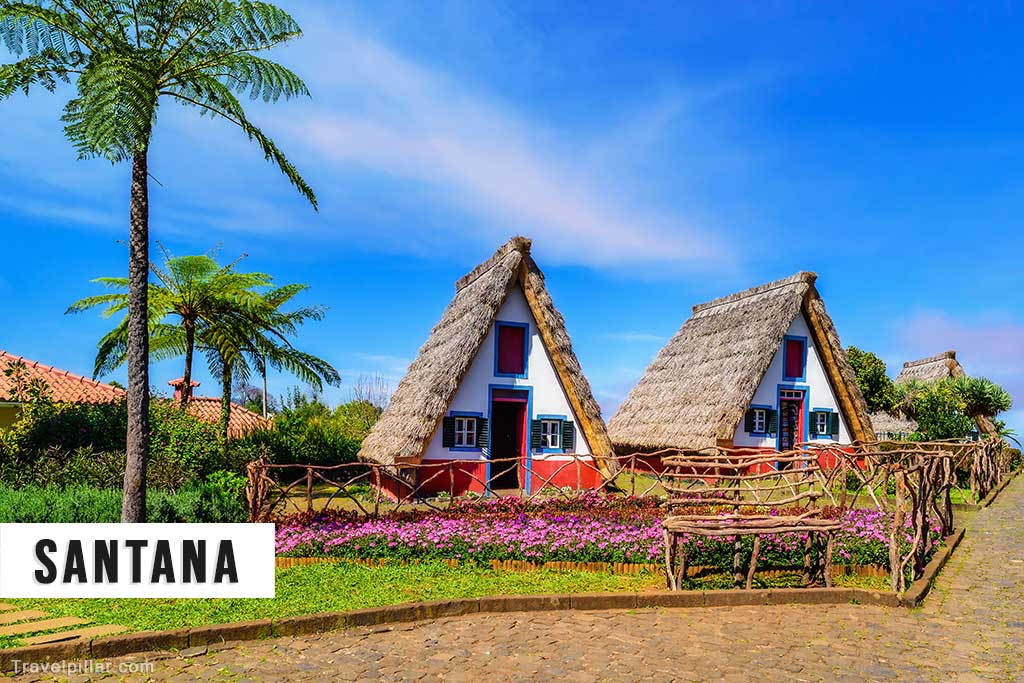
The Santana Typical Houses, known locally as Casas Típicas de Santana, are traditional dwellings located in the northeastern municipality of Santana on Madeira Island. These small, triangular houses are characterised by steeply pitched thatched roofs and brightly painted wooden façades, typically in red, blue, and white. Historically, they were used as rural homes by local farmers and date back several centuries, although the exact origins are uncertain.
The design of the Santana houses is functional and adapted to Madeira’s climate. The thatched roof extends nearly to the ground on both sides, providing natural insulation and protection from wind and rain. The structures are usually one-and-a-half storeys high, with a ground floor used for living space and an upper loft for storing agricultural goods such as maize or tools. Built using local materials, including timber and straw, the houses are an example of vernacular architecture specific to the region.
Most original Santana houses have disappeared or fallen into disrepair due to modernisation and changes in construction practices. However, a small group of preserved and reconstructed examples can be found in the centre of Santana, near the Town Hall. These have been maintained primarily for cultural and touristic purposes and are no longer used as residences. Some function as exhibition spaces or small shops selling regional products and crafts.
Visitors can view the houses at no cost, and the site includes information panels explaining the architectural features and historical context. The surrounding area features landscaped gardens and seating areas, making it a convenient stop for tour groups and independent travellers. The Santana Typical Houses are often included in day tours of Madeira’s northern coast, frequently in combination with visits to viewpoints, local restaurants, and levada trails.
Although no longer part of daily life, the Santana Typical Houses remain an important symbol of Madeira’s rural heritage and are regularly featured in promotional materials for the island. Their distinct appearance and cultural significance continue to attract visitors interested in local history and architecture.
Google map Santana Provence
Google map Santana Typical Houses 4.2/5
Google map Santana Cable Car to Rocha do Navio 4.4/5
Google map Rocha do Navio 4.7/5
Google map Ponta do Clérigo 4.7/5