
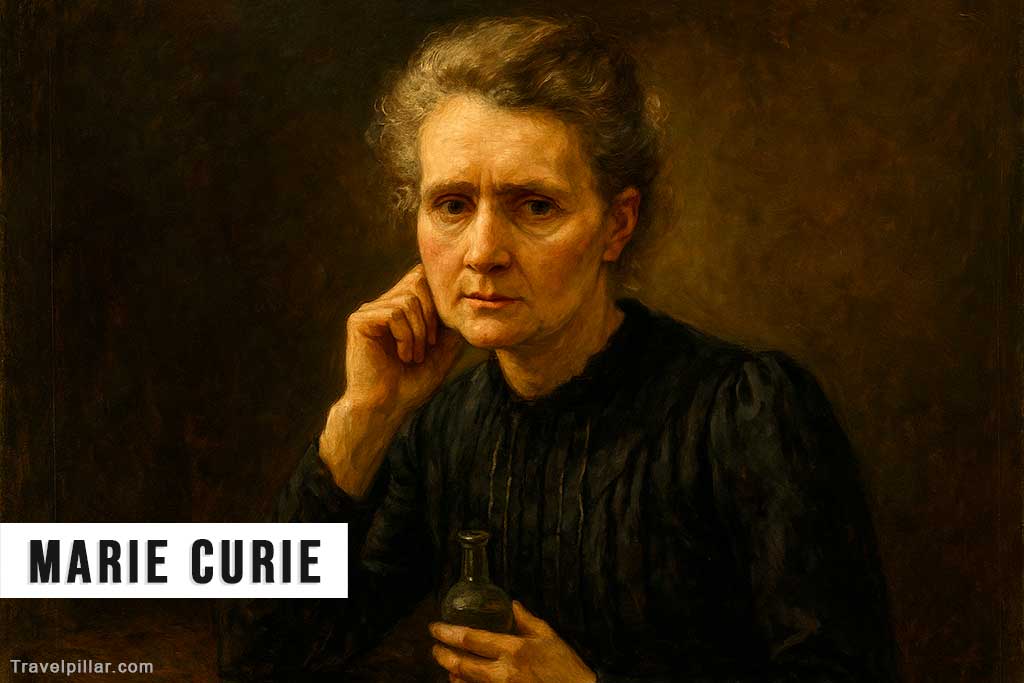
Marie Curie, born on November 7, 1867, in Warsaw, Poland, was a pioneering physicist and chemist whose groundbreaking work on radioactivity not only transformed modern science but also shattered many barriers for women in the scientific community.
Born as Maria Sklodowska, Curie moved to Paris in 1891 to continue her scientific studies at the Sorbonne. Here, she met Pierre Curie, a fellow scientist, whom she married in 1895. They began their groundbreaking work on radioactivity, a term that Marie herself coined.
Curie’s meticulous research led to the discovery of two new elements, polonium (named after her native Poland) and radium, both of which were far more radioactive than uranium, the element previously known for its radioactive properties. Her findings challenged existing scientific understanding and opened up a whole new field of study: nuclear physics.
In 1903, the Curies shared the Nobel Prize in Physics with Henri Becquerel for their combined work on radioactivity. After Pierre’s tragic death in 1906, Marie took his place as a professor at the Sorbonne, becoming the first woman to hold such a position.
Curie’s further work on radioactivity earned her a second Nobel Prize in 1911, this time in Chemistry, making her the first person ever to win the Nobel Prize in two different sciences. During World War I, she developed mobile radiography units, known as “Little Curies,” to provide X-ray services to field hospitals.
Marie Curie passed away on July 4, 1934, from aplastic anemia, a condition linked to her prolonged exposure to radiation. Her pioneering research, her role as a female scientist in a male-dominated field, and her humanitarian efforts during World War I contribute to a legacy that continues to inspire scientists and women around the world. Despite the risks associated with her work, her discoveries laid the foundation for the development of medical diagnostics, cancer treatments, and the atomic age.
Today, Marie Curie remains a significant scientific figure associated with pioneering research in radioactivity. Sites related to her life include the Musée Curie in Paris, located at her former laboratory, which displays her scientific instruments and personal items. She also worked at the Radium Institute, now part of the Curie Institute. Her remains were later interred in the Panthéon in Paris, alongside other distinguished French figures, where her tomb can be visited.