
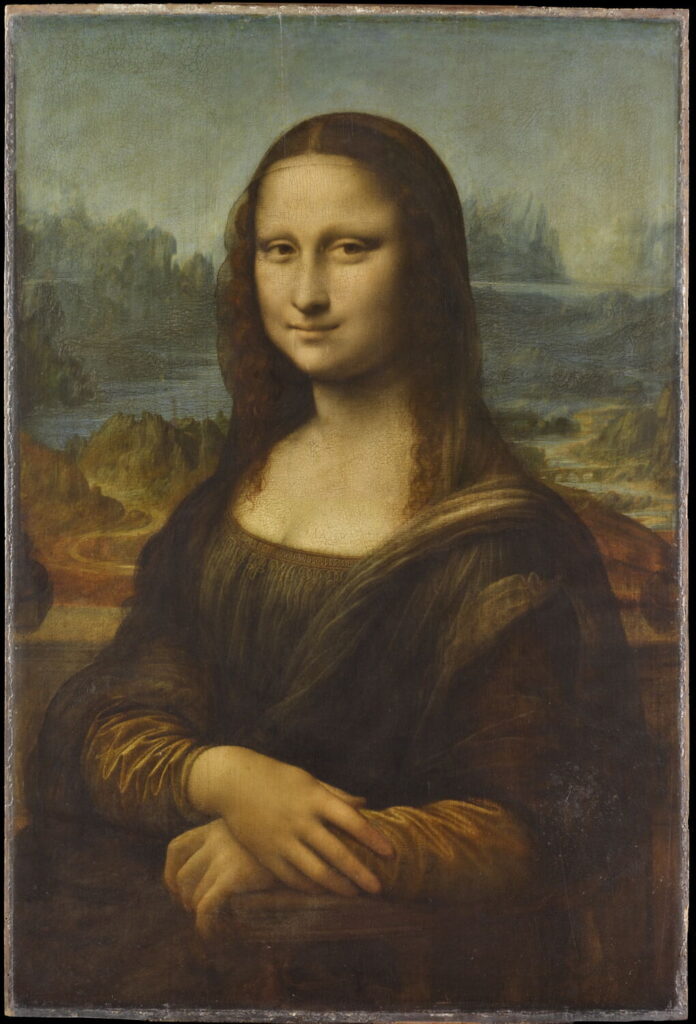
Housed in the Denon Wing of the Louvre Museum in Paris, the Mona Lisa is probably the most famous painting in the world. Painted by the Italian Renaissance artist Leonardo da Vinci between around 1503 and 1506, the portrait attracts enormous crowds each day, with many visitors making the journey to the Louvre specifically to see it. Despite its worldwide fame, the painting itself is surprisingly small, measuring just over 77 centimetres tall.
The portrait is widely believed to depict Lisa Gherardini, the wife of a Florentine merchant, although historians still debate aspects of her identity. At first glance the composition appears relatively simple: a seated woman looking directly at the viewer against a distant landscape of winding rivers, mountains and bridges. Yet much of the painting’s reputation comes from the extraordinary subtlety with which Leonardo painted it.
One of the most discussed features is the subject’s expression. The famous smile seems to change depending on where the viewer stands or focuses their eyes. Leonardo achieved this effect through delicate layers of translucent paint and his use of sfumato, a technique that softened outlines and blended light and shadow almost invisibly. This gave the face a lifelike quality that was highly unusual during the early 16th century.
The Mona Lisa became even more famous after it was stolen from the Louvre in 1911 by an Italian museum employee named Vincenzo Peruggia. For more than two years the painting disappeared, generating international newspaper coverage and turning the portrait into a global celebrity. Ironically, the theft probably contributed more to the painting’s modern fame than centuries of artistic admiration.
Many viewers are surprised by how calm and restrained the portrait feels compared with its huge reputation. Unlike dramatic religious paintings or scenes of war and mythology, the Mona Lisa presents an ordinary human face with remarkable psychological depth. Leonardo’s ability to suggest personality, intelligence and emotion through subtle expression helped redefine portrait painting in Europe.
Today, standing before the Mona Lisa is as much part of the Louvre experience as seeing the museum itself. The painting represents not only the achievements of the Italian Renaissance, but also the enduring human fascination with mystery, identity and artistic skill.
Weblink: https://collections.louvre.fr/en/