

Place de la Concorde, located at the eastern end of the Champs-Élysées in Paris, is the city’s largest public square and one of its most historically significant sites. Covering over 19 acres, the square is known for its grand scale, symmetrical design, and association with pivotal moments in French history.
Designed by Ange-Jacques Gabriel in 1755, Place de la Concorde was originally named Place Louis XV and featured an equestrian statue of the king. During the French Revolution, the statue was destroyed, and the square was renamed Place de la Révolution. It became infamous as the location of the guillotine, where Louis XVI, Marie Antoinette, and many others were executed. Following the Revolution, the square was renamed Place de la Concorde in 1795 to symbolize national reconciliation.

The square’s most prominent feature is the Luxor Obelisk, a 3,300-year-old monument from Egypt gifted to France in 1829. Standing 23 meters tall and weighing 227 tons, the obelisk is adorned with hieroglyphs celebrating the reign of Pharaoh Ramses II. It occupies the central position, replacing the site of the guillotine.
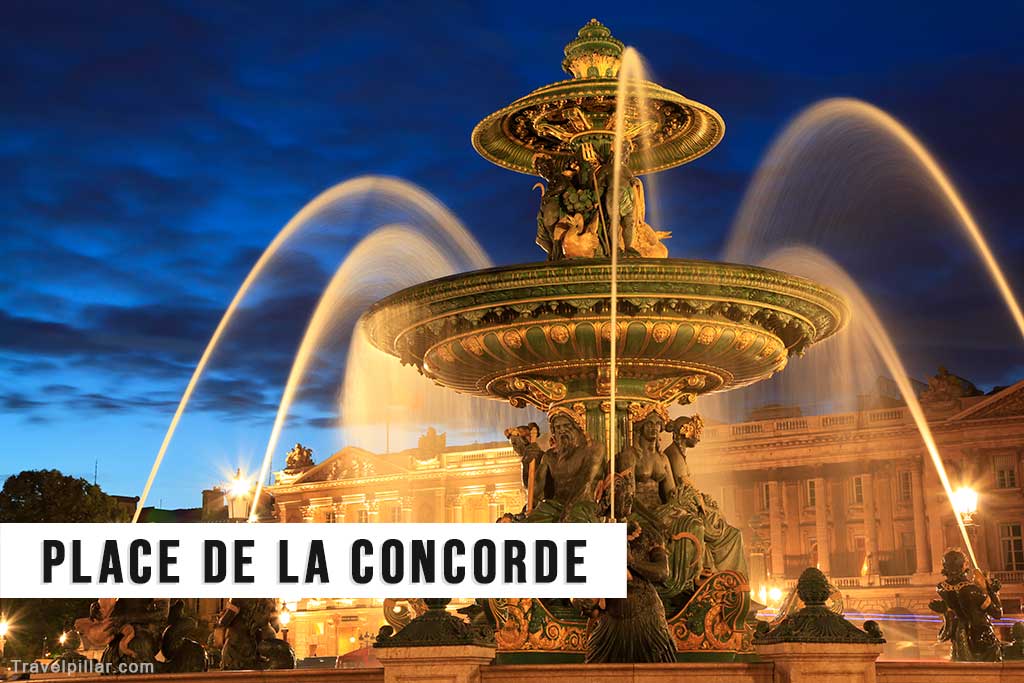
Two monumental fountains, the Fontaine des Mers and the Fontaine des Fleuves, designed by Jacques Ignace Hittorff, flank the obelisk. These ornate fountains, inspired by the grandeur of Rome, add symmetry and elegance to the square.
Place de la Concorde is framed by significant architectural landmarks, including the Hôtel de Crillon and the French Naval Ministry to the north. To the west lies the Jardin des Tuileries, providing a direct link to the Louvre Museum. The square’s strategic location makes it a gateway to many of Paris’s most famous attractions.
Today, the square is a major thoroughfare and a site for public events and celebrations, including the finish line for the Tour de France. Its rich history, monumental design, and central role in Parisian life make it an essential destination for visitors exploring the city’s cultural and historical heritage.
Google map 4.6/5