
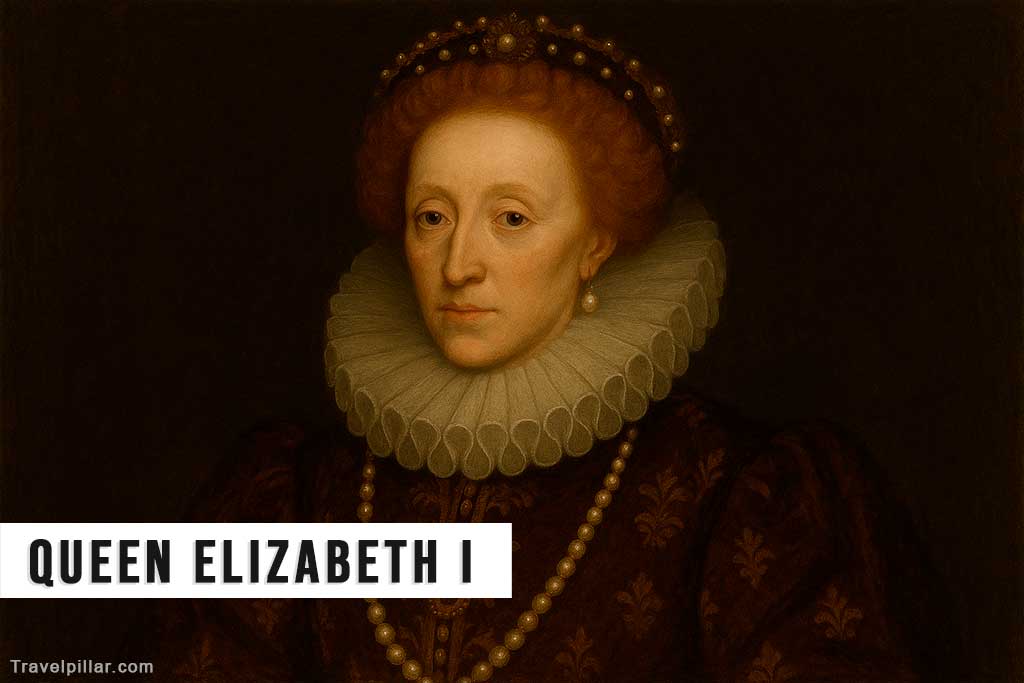
Queen Elizabeth I, born on September 7, 1533, was the Queen of England and Ireland from 1558 until her death in 1603. Known as the “Virgin Queen,” she was the last of the five monarchs of the House of Tudor. Her reign, referred to as the Elizabethan era, is considered one of the most culturally and politically significant periods in English history.
Elizabeth was the daughter of Henry VIII and Anne Boleyn. Her early life was marked by uncertainty and danger due to her father’s tumultuous marital history. However, Elizabeth ascended to the throne in 1558, following the death of her half-sister, Mary I.
One of Elizabeth’s most significant achievements was the establishment of an English Protestant church, which later evolved into the Church of England, marking a decisive break from Roman Catholicism. Her religious policies, termed the Elizabethan Settlement, sought a middle ground between Roman Catholicism and Protestantism, an approach that brought relative peace to England during a time of religious conflict across Europe.
Elizabeth’s reign is often referred to as the “Golden Age” of English history. It was a period of relative political stability, significant exploration and colonization (including the establishment of England’s first American colony), and cultural growth, notably in drama and literature, with William Shakespeare and Christopher Marlowe among her contemporaries.
Queen Elizabeth I was a highly intelligent, politically astute leader who successfully navigated the complex diplomatic and religious conflicts of her time. She never married or had children, leading to the end of the Tudor dynasty upon her death on March 24, 1603. Her reign left an indelible mark on English history, and she remains one of England’s most famous and influential monarchs.