

The Imperial Fora are a series of monumental public squares constructed in Rome between 46 BC and 113 AD. Located adjacent to the Roman Forum, the Imperial Fora served as the center of political, religious, and commercial activity during the Roman Empire. These fora were developed to alleviate congestion in the Roman Forum and to provide additional space for administrative and ceremonial functions. The Imperial Fora consist of five main forums: Forum of Caesar, Forum of Augustus, Forum of Nerva, Forum of Vespasian (also known as the Forum of Peace), and Trajan’s Forum.
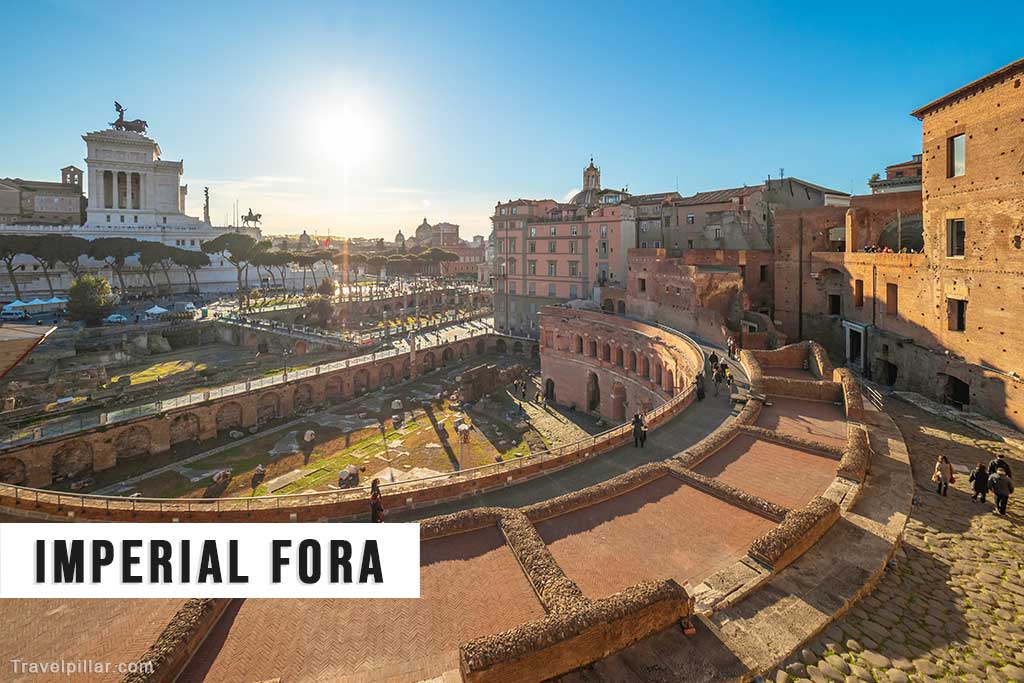
The Forum of Caesar was the first of the Imperial Fora, constructed by Julius Caesar in 46 BC. It was designed to supplement the Roman Forum, providing additional space for judicial activities and housing the Temple of Venus Genetrix, which honored the goddess Venus, the divine ancestor of the Julian family. The forum’s layout and design set the precedent for the subsequent Imperial Fora.
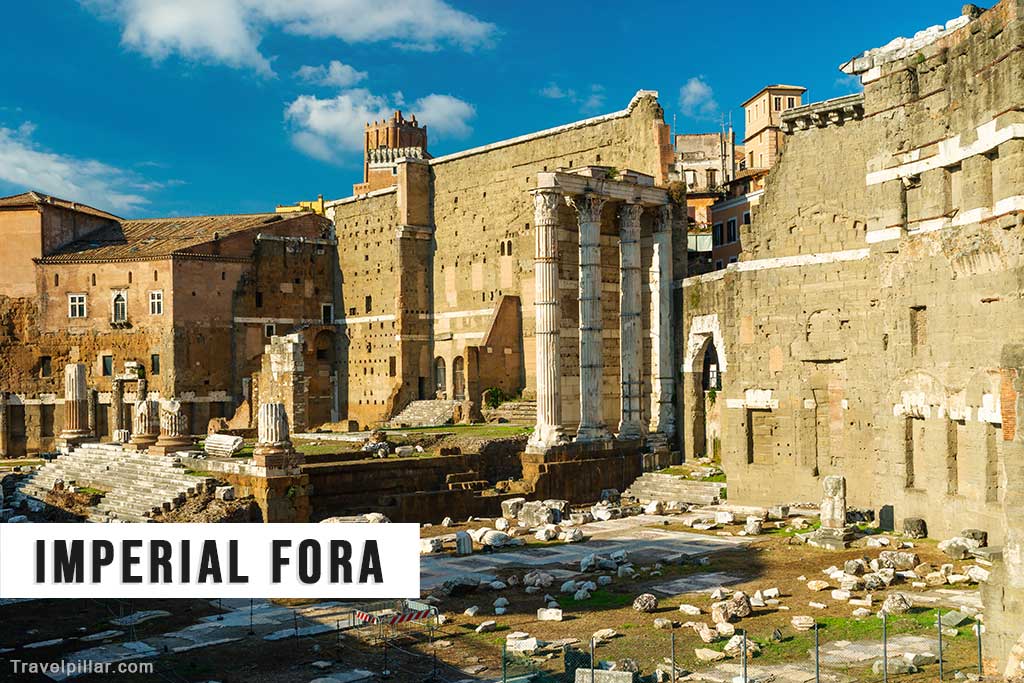
The Forum of Augustus, built by Emperor Augustus and completed in 2 BC, was designed to celebrate his victory at the Battle of Philippi. It housed the Temple of Mars Ultor (Mars the Avenger), dedicated to the Roman god of war. The forum was intended to symbolize Augustus’s military successes and divine favor, featuring a portico with statues of famous Romans and the imperial family.
The Forum of Vespasian, or Forum of Peace, was constructed by Emperor Vespasian in 75 AD to commemorate his victory in the Jewish War and the subsequent capture of Jerusalem. It contained the Temple of Peace, which served as a repository for spoils of war and valuable art. The forum was designed as a place of tranquility and cultural enrichment, with gardens, fountains, and libraries.
The Forum of Nerva, completed in 97 AD during the reign of Emperor Nerva, served as a transitional space connecting the Forum of Augustus and the Forum of Vespasian. It featured the Temple of Minerva, dedicated to the goddess of wisdom and strategic warfare. Due to its narrow shape, it was also known as the Forum Transitorium.
Trajan’s Forum, the last and largest of the Imperial Fora, was constructed between 107 and 113 AD under Emperor Trajan. Designed by the architect Apollodorus of Damascus, the forum was built to commemorate Trajan’s victory in the Dacian Wars. It included the Basilica Ulpia, the Trajan’s Column, and the Trajan’s Market. The column, intricately carved with reliefs depicting scenes from the Dacian Wars, remains one of Rome’s most famous monuments. Trajan’s Market, a multi-level commercial complex, provided additional space for shops and administrative offices.
Today, the ruins of the Imperial Fora are an important archaeological site, offering insight into the architectural and cultural achievements of ancient Rome. Visitors can explore the remains of these grand structures and learn about the history and evolution of the Roman Empire. The site continues to be a significant point of interest for those studying ancient history, architecture, and archaeology.
Google map 4.7/5