
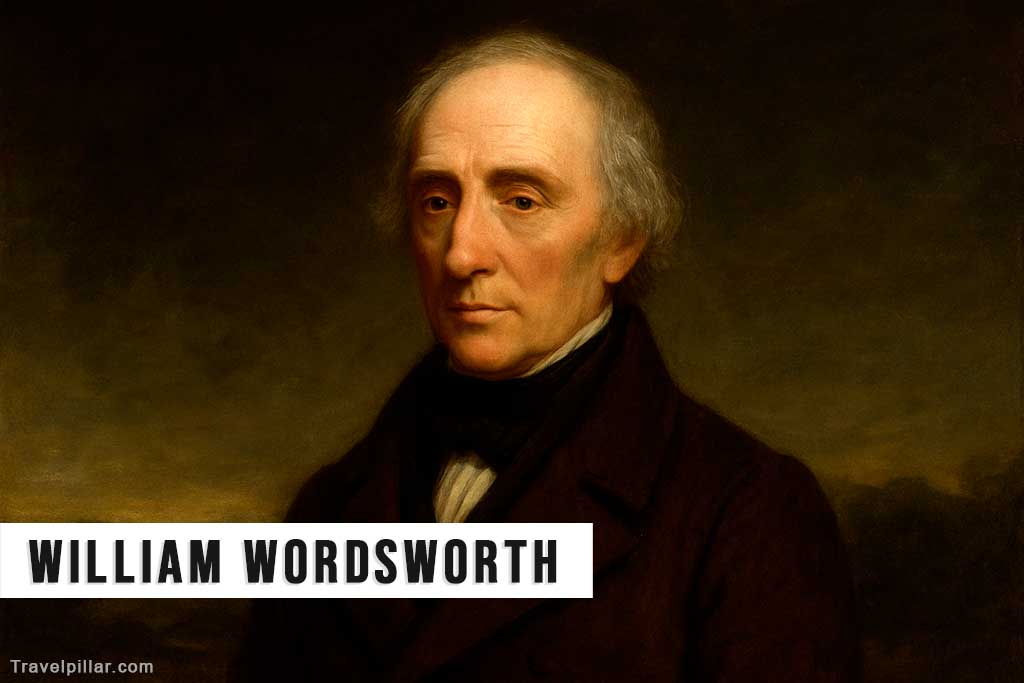
William Wordsworth (1770–1850) was a prominent English poet whose work greatly influenced the Romantic movement in literature. Known for his focus on nature, emotion, and the human spirit, Wordsworth’s poetry sought to break away from the formal styles of the 18th century, emphasizing simplicity, personal experience, and a deep connection with the natural world. His work often celebrates rural landscapes, childhood innocence, and the idea of nature as a source of inspiration and moral guidance. Wordsworth’s literary contributions, along with those of his close friend and collaborator Samuel Taylor Coleridge, helped define Romanticism as a movement focused on individual perception, imagination, and an emotional response to nature.

William Wordsworth was born in Cockermouth, in England’s Lake District, an area that profoundly shaped his poetic vision. His early life was marked by loss and upheaval; his mother died when he was eight, and his father died just a few years later, leading to a disrupted childhood and separation from his siblings. Despite these hardships, Wordsworth’s connection to the natural world grew, influenced by the rural landscapes surrounding him. His experience with nature during his formative years laid the foundation for his later work, which often emphasizes the restorative and transformative power of nature.

After studying at St. John’s College, Cambridge, Wordsworth spent time traveling in Europe, where he witnessed the early stages of the French Revolution. Initially inspired by the revolutionary ideals of liberty and equality, he became disillusioned as the revolution turned increasingly violent. This shift in perspective influenced his later poetry, where he often emphasizes a more introspective and personal connection to freedom, centered on the individual’s inner experience rather than political movements.

One of Wordsworth’s most significant works is Lyrical Ballads (1798), co-authored with Samuel Taylor Coleridge. This collection is considered a landmark in English literature, marking the beginning of the Romantic era. In the preface to the second edition of Lyrical Ballads, Wordsworth outlines his poetic philosophy, asserting that poetry should be rooted in the “spontaneous overflow of powerful feelings” and use language “really used by men.” He emphasizes simplicity and a focus on common life, particularly the lives of rural people, as a means to reveal universal truths. Lyrical Ballads includes several of Wordsworth’s notable poems, such as “Tintern Abbey,” which reflects his deep spiritual and emotional connection to nature and his belief in its power to shape and sustain the human soul.
Wordsworth’s masterpiece, The Prelude, is a semi-autobiographical poem that recounts the development of his own mind and character. Written over several years and published posthumously, The Prelude explores Wordsworth’s formative experiences, his love of nature, and his philosophical reflections on life. It represents one of the earliest examples of the Romantic emphasis on self-exploration, tracing the poet’s journey from youthful enthusiasm to mature introspection. The poem is regarded as one of the most profound reflections on the growth of a poet’s mind and the transformative power of nature.
Later in life, William Wordsworth became increasingly conservative, distancing himself from his earlier revolutionary ideals. He served as the Poet Laureate of England from 1843 until his death in 1850, receiving widespread recognition for his contributions to English literature. His later work, while often seen as less innovative, continued to reflect his love for nature and his commitment to themes of morality and simplicity.
Wordsworth’s legacy endures as a poet who transformed English literature by emphasizing the beauty of the natural world, the importance of personal experience, and the emotional depth of ordinary life. His work captures the essence of Romanticism, blending a reverence for nature with a profound insight into human emotion, and remains a cornerstone of English poetry.
I Wandered Lonely as a Cloud
I wandered lonely as a cloud
That floats on high o’er vales and hills,
When all at once I saw a crowd,
A host, of golden daffodils;
Beside the lake, beneath the trees,
Fluttering and dancing in the breeze.
Continuous as the stars that shine
And twinkle on the milky way,
They stretched in never-ending line
Along the margin of a bay:
Ten thousand saw I at a glance,
Tossing their heads in sprightly dance.
The waves beside them danced; but they
Out-did the sparkling waves in glee:
A poet could not but be gay,
In such a jocund company:
I gazed—and gazed—but little thought
What wealth the show to me had brought:
For oft, when on my couch I lie
In vacant or in pensive mood,
They flash upon that inward eye
Which is the bliss of solitude;
And then my heart with pleasure fills,
And dances with the daffodils.
This poem is celebrated for its vivid imagery and the way it captures a simple moment that brings lasting joy and reflection.