
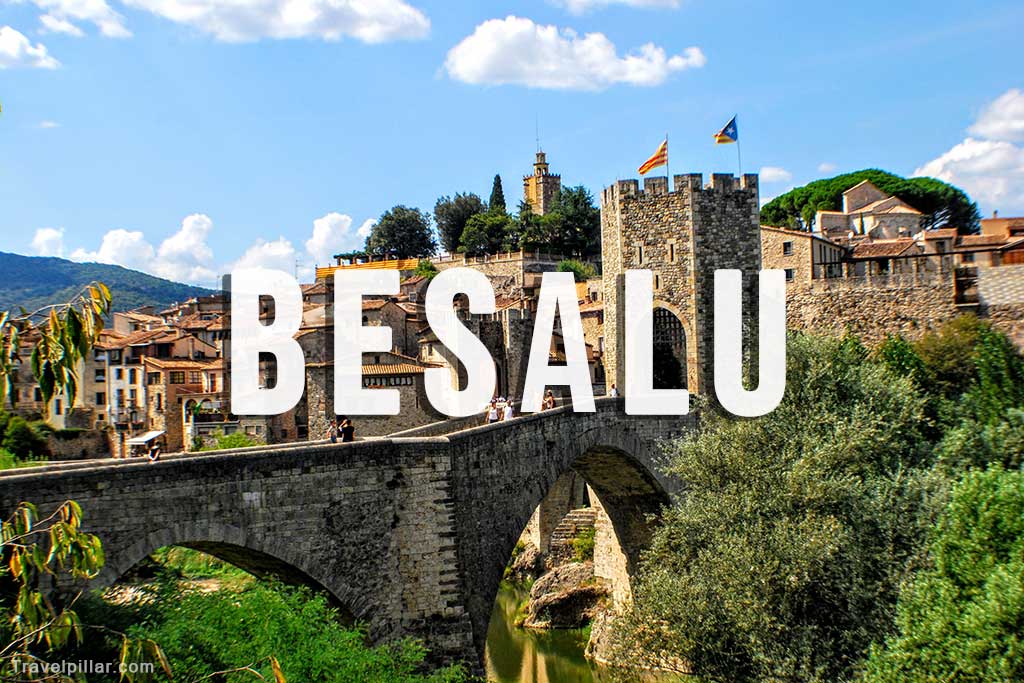
Besalú is a historic inland town in Catalonia located northwest of Girona and within reasonable driving distance of the Costa Brava. The town is best known for its medieval architecture, fortified stone bridge and well-preserved historic centre. Although small in size, Besalú is regarded as one of the most important medieval towns in the region and is a popular cultural destination for visitors exploring northeastern Catalonia.
The town developed during the medieval period around an important crossing point over the Fluvià River. Its most recognisable landmark is the Romanesque bridge, which dates largely from the eleventh and twelfth centuries and includes a fortified gateway tower at its centre. The bridge remains one of the best-known medieval structures in Catalonia and forms the main entrance into the old town.
Inside the historic centre are narrow stone streets, small squares and a collection of Romanesque and medieval buildings. Important historic sites include the former Monastery of Sant Pere, the Church of Sant Vicenç and remains linked to the town’s medieval Jewish community. Besalú contains one of the few surviving medieval Jewish ritual baths, or mikveh, in Spain, reflecting the town’s historical importance before the expulsion of Jewish communities in the late fifteenth century.
Much of the old town has been carefully preserved and modern development remains limited within the historic core. Small shops, cafés and restaurants occupy restored medieval buildings, while much of the town can be explored on foot within a relatively short time.
Although Besalú is inland rather than coastal, it is frequently visited as a day trip from the Costa Brava and Girona areas. The town provides a contrast to the beaches and coastal resorts of the Mediterranean coast and is particularly valued for its architecture, local history and relatively compact medieval setting.
Top 10 Things to Do in Besalu
Besalú Bridge (Pont Vell)
The 12th-century Romanesque bridge over the Fluvià River is the most recognisable feature of Besalú. Its seven arches and central fortified tower illustrate medieval engineering and defensive design. The bridge was essential for trade and communication, linking the town to surrounding territories. Restored in the 20th century, it remains the primary symbol of Besalú and a focal point for visitors.
Google map
Jewish Quarter and Mikveh
Besalú once hosted a significant Jewish community, whose remains are visible in the Jewish Quarter. Narrow alleys, foundations of houses, and a 12th-century mikveh, or ritual bath, survive. The mikveh is one of the few of its kind preserved in Spain. This area illustrates the cultural and religious diversity of medieval Besalú and its role as a regional centre of Jewish life.
Google map
Monastery of Sant Pere
Founded in the 10th century, the Benedictine Monastery of Sant Pere became an important spiritual and political institution. The Romanesque church, consecrated in 1003, survives as the main structure. Its simple façade and sculpted capitals represent early Catalan Romanesque architecture. The monastery reflects the town’s religious prominence during the Middle Ages.
Google map
Sant Vicenç Church
The parish church of Sant Vicenç, built in the 11th century, stands within the old town. It has a Romanesque nave and Gothic additions, illustrating the evolution of local architecture. Inside, stone tombs and fresco fragments provide insight into medieval worship and funerary customs. The church remains a key monument in Besalú’s urban landscape.
Google map
Sant Martí Church
This Romanesque church, mentioned as early as the 10th century, preserves a simple design with a single nave and bell gable. It was historically linked to a nearby hospital for pilgrims. Though modest, Sant Martí illustrates the religious network that served travellers along medieval routes through the region.
Google map
Plaça Major
The central square of Besalú is surrounded by arcaded houses dating from the medieval and early modern periods. It has long served as a marketplace and civic gathering point. Today it remains active with cafés and shops, reflecting continuity of urban life. The square represents the social and commercial core of Besalú.
Google map
Cornellà House
This 12th-century Romanesque mansion belonged to the noble Cornellà family. It preserves a façade with arcades and windows, illustrating medieval domestic architecture. The building reflects the social hierarchy of Besalú, where aristocratic residences stood alongside modest dwellings. It remains one of the most notable private buildings in the town.
Google map
Museum of Miniatures and Microminiatures
This museum displays a collection of miniature artworks and objects, some so small they require magnification to view. While not historical, the museum adds a modern cultural element to Besalú. It demonstrates the town’s role in sustaining varied forms of heritage, combining medieval preservation with contemporary attractions.
Google map
Sant Julià Church
Located at the edge of the old town, Sant Julià was originally a pilgrim hospital chapel. It preserves a Romanesque structure with later modifications. Its role in supporting travellers illustrates Besalú’s function as a stop on historic routes. Though less prominent than other churches, it remains part of the town’s religious network.
Google map
Medieval Festivals and Markets
Besalú hosts annual medieval fairs and cultural events that recreate aspects of its past. Markets, craft stalls, and reenactments take place in the old town, reinforcing its historic atmosphere. While primarily for tourism, these events sustain public awareness of Besalú’s heritage and provide continuity between its medieval identity and its modern role as a cultural destination.
Google map