
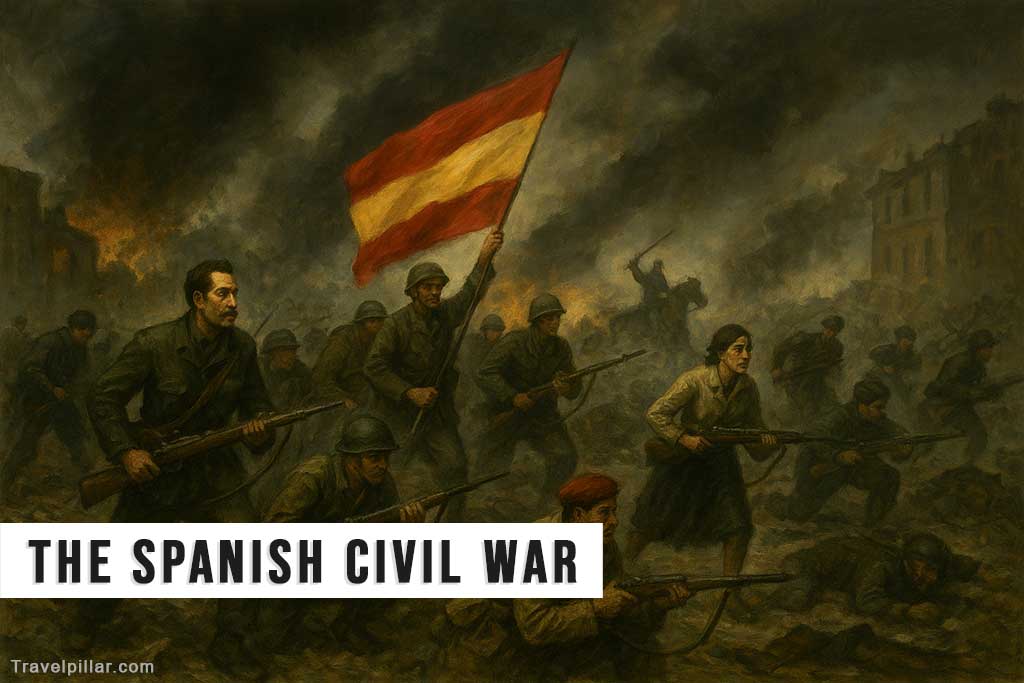
The Spanish Civil War, which took place between 1936 and 1939, was a significant conflict in Spain‘s history that set the stage for its future political landscape. The war pitted two major factions against each other: the Republicans and the Nationalists. At its core, the war was a struggle between competing political ideologies, social classes, and visions for Spain’s future. It was also a conflict marked by widespread international involvement and devastating consequences for the nation.
The roots of the Spanish Civil War can be traced back to deep-seated political and social tensions within Spain. The country was sharply divided between conservative and liberal elements, with longstanding conflicts over land reform, church-state relations, and regional autonomy. The establishment of the Second Spanish Republic in 1931 brought about major reforms, leading to a highly polarized society. While the left-wing Republicans, composed of socialists, communists, anarchists, and other progressive groups, sought to modernize Spain and diminish the power of traditional elites, the right-wing conservatives, including monarchists, landowners, the military, and the Catholic Church, were vehemently opposed to these changes.
The tipping point came in July 1936, when a group of right-wing military officers, led by General Francisco Franco, staged a coup against the Republican government. The rebellion initially had mixed success, as the coup was not universally supported within the military or throughout the country. This division quickly escalated into a full-scale civil war, with both sides rallying support from various factions within Spain and from abroad. The Republicans received aid primarily from the Soviet Union and international volunteers in the form of the International Brigades. Meanwhile, the Nationalists, led by Franco, were supported by fascist Italy and Nazi Germany, who provided military equipment, personnel, and strategic assistance.
The war was brutal and marked by extensive violence and atrocities. Both sides committed acts of repression against perceived enemies, leading to civilian casualties and widespread fear. The Nationalists gradually gained the upper hand, largely due to their unified command under Franco, superior military organization, and significant foreign support. By contrast, the Republicans suffered from internal divisions, with disagreements and infighting among communists, socialists, and anarchists weakening their resistance.
The conflict officially ended on April 1, 1939, when Franco declared victory. Spain then fell under his authoritarian rule, which would last until his death in 1975. The Spanish Civil War left deep scars on the country, with an estimated 500,000 people killed, and thousands more executed or imprisoned during the post-war period of repression. The war also served as a prelude to World War II, foreshadowing the broader conflict between fascist and communist ideologies in Europe.
For travelers interested in Spanish history, the legacy of the Civil War is still visible throughout the country. Monuments, museums, and preserved battle sites offer insights into the conflict’s impact on Spain. The war remains a key chapter in Spain’s past, influencing its culture, politics, and regional dynamics even to this day.