
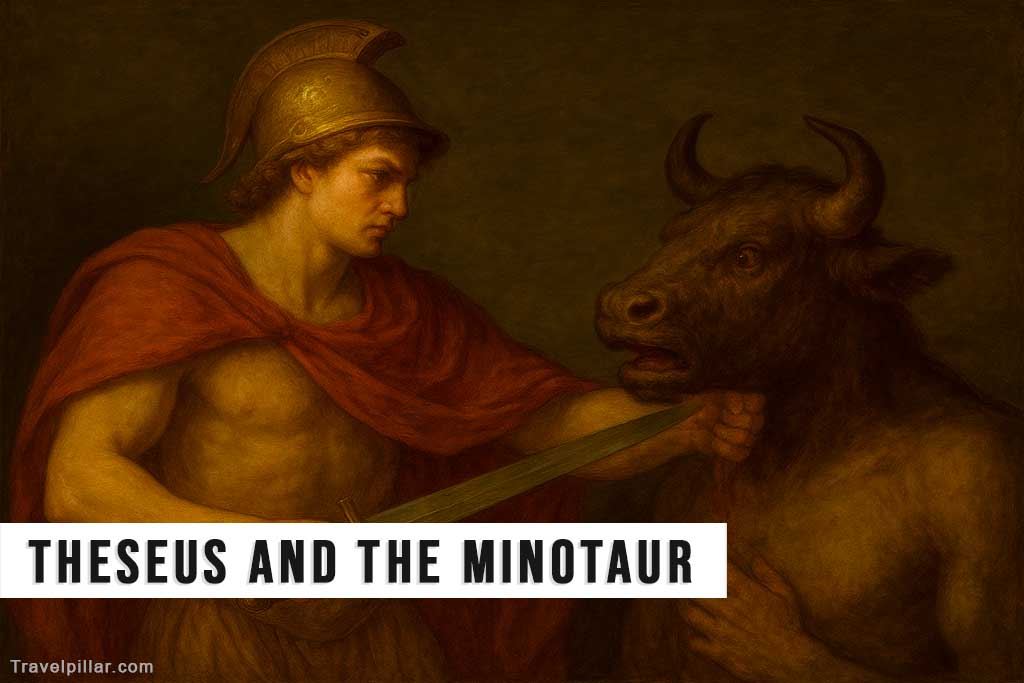
Theseus, one of the most celebrated heroes of Greek mythology, is best known for his role as the slayer of the Minotaur and as the legendary king of Athens. He was the son of Aegeus, king of Athens, and Aethra, a princess of Troezen. Theseus’ early life was marked by his journey to Athens, during which he overcame several dangerous challenges, including defeating bandits and monsters that plagued the roads, establishing his reputation as a courageous and capable hero.
Theseus’ most famous myth involves his journey to Crete to confront the Minotaur, a monstrous creature with the body of a man and the head of a bull. The Minotaur was kept in a labyrinth designed by the architect Daedalus, and each year, Athens was forced to send seven young men and seven young women as tribute to be sacrificed to the creature. Determined to end this cruel practice, Theseus volunteered to go to Crete and kill the Minotaur.
With the help of Ariadne, the daughter of King Minos of Crete, who gave him a ball of thread to find his way back through the labyrinth, Theseus successfully killed the Minotaur and freed Athens from the oppressive tribute. After this victory, he returned to Athens, but his failure to change the black sails of his ship (a prearranged signal that he had survived) led to his father’s tragic death. Aegeus, thinking his son was dead, threw himself into the sea, which was thereafter named the Aegean Sea.
Theseus became the king of Athens and was regarded as a wise and just ruler. His reign was characterized by his efforts to unify the region of Attica under Athens, turning the city into a powerful center of Greek culture and governance.
Visitors to Athens can explore the myth of Theseus by visiting ancient sites such as the Acropolis and the Temple of Hephaestus, where sculptures and art depict his heroic deeds. His story reflects themes of bravery, intelligence, and leadership, making him one of the most important figures in Greek mythology.