
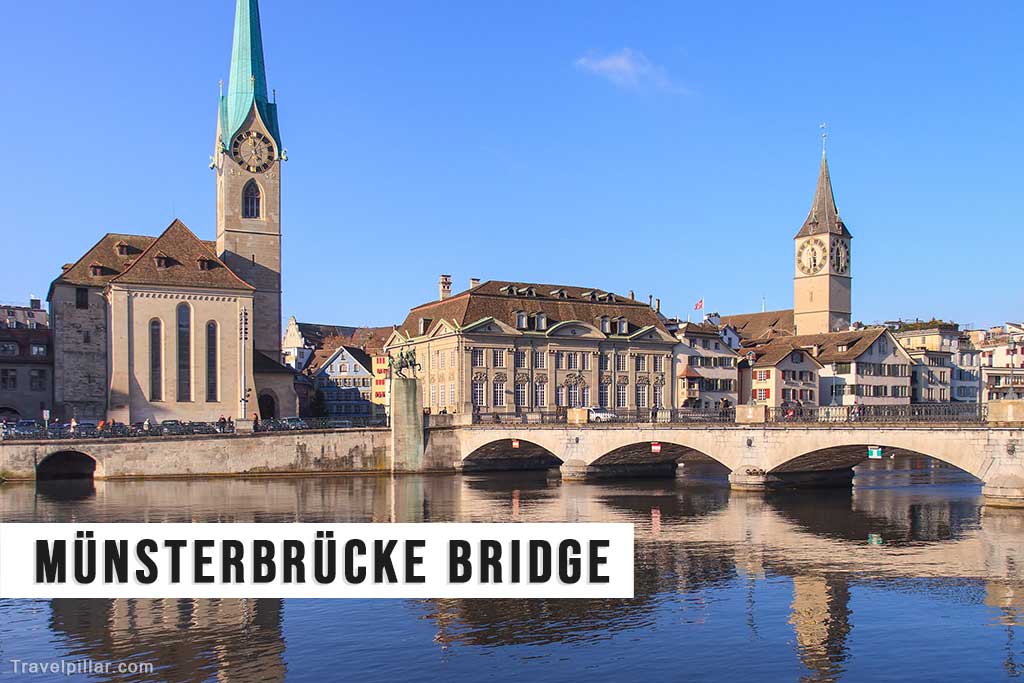
The Münsterbrücke is a 19th-century stone bridge spanning the Limmat River in the historic centre of Zurich. It serves as a key connection between the Fraumünster and Grossmünster churches, two of the city’s most prominent religious and architectural landmarks. Located near the point where the river flows out of Lake Zurich, the bridge plays an integral role in the city’s layout and daily circulation.

Construction of the Münsterbrücke began in the early 1830s and was completed in 1838. It replaced an earlier wooden structure and was built using sandstone, with a series of low arches that allow for the steady flow of the Limmat beneath. The bridge was designed not only for functionality but also to complement the surrounding historical architecture. It reflects the practical engineering and restrained aesthetic common to early 19th-century civic infrastructure.
The bridge measures approximately 80 metres in length and accommodates both pedestrian and vehicular traffic, though it is frequently used by walkers moving between the two riverbanks and visiting nearby landmarks. From the bridge, there are unobstructed views of the old town, including the towers of Grossmünster to the east and the stained glass windows of Fraumünster to the west.
Münsterbrücke has maintained its original appearance with minimal alterations, preserving its historical character within a modern urban environment. It is also the site of occasional public events and processions, given its central location and symbolic function as a link between civic and ecclesiastical institutions.
As a crossing point, viewing platform, and architectural feature, the Münsterbrücke contributes to Zurich’s identity as a city that balances historical continuity with contemporary functionality. Its understated design and durable construction have allowed it to remain a consistent and integral part of the cityscape for nearly two centuries.
Google map Münsterbrücke bridge 4.8/5