
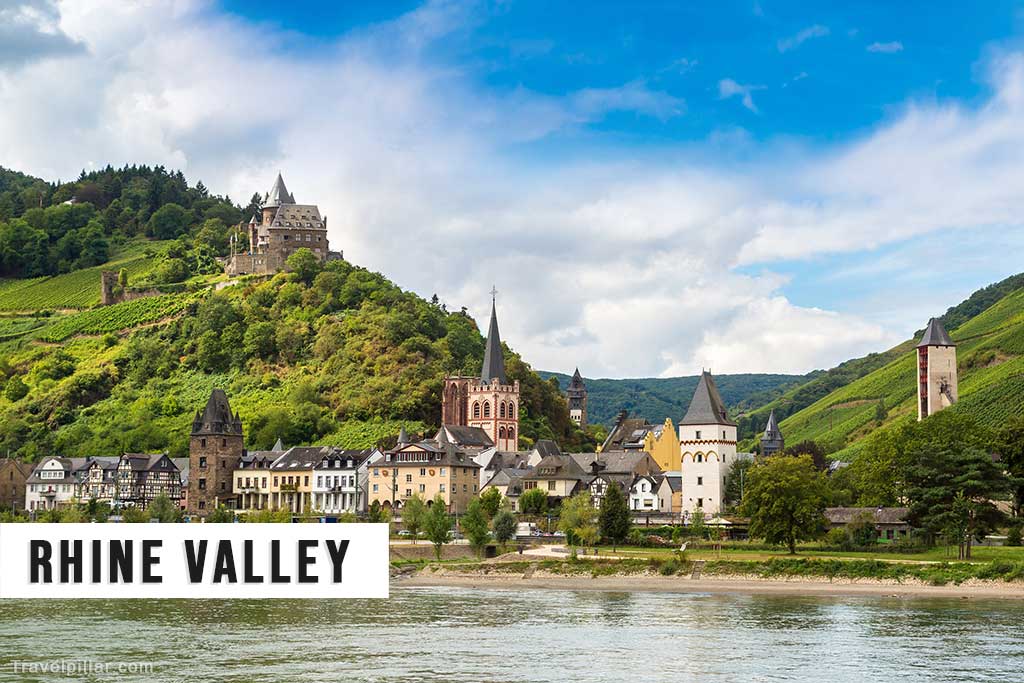
The Rhine Valley, particularly the stretch between Bingen and Koblenz known as the Upper Middle Rhine, is one of the most distinctive cultural landscapes in Germany. Recognised as a UNESCO World Heritage Site, it combines steep vine-covered slopes, medieval castles, and riverside towns with a long history of trade and settlement.
The river has served as a major transport route since Roman times, shaping the development of towns and fortifications along its course. Castles were built from the Middle Ages onwards to control commerce and defend territory, many of which survive as ruins or restored monuments. Villages and towns developed with characteristic timber-framed houses, churches, and marketplaces, reflecting the prosperity brought by wine production and river trade.
Today the Rhine Valley is equally valued for its cultural heritage and natural scenery. River cruises, hiking trails such as the Rheinsteig, and wine festivals highlight its appeal. The combination of landscapes, castles, and living traditions ensures the valley’s enduring role as one of Germany’s most important tourist destinations.
The Rhine Valley Top 10
1. Marksburg Castle
Marksburg Castle, near Braubach, is the only medieval hill castle along the Rhine never destroyed. Built in the 12th century, it preserves its original keep, walls, and towers. Furnished rooms and exhibitions illustrate medieval life, weapons, and domestic arrangements. Its intact condition makes it one of the most important fortifications on the Rhine.
Official website: https://www.marksburg.de/en/
Google map 4.6/5
2. Lorelei Rock
The Lorelei Rock rises 132 metres above a narrow bend of the Rhine near St. Goarshausen. Associated with legends of a siren who lured sailors, it has inspired poets, musicians, and painters. The viewpoint provides panoramic views of the river, vineyards, and passing ships, making it one of the valley’s most recognisable natural landmarks.
3. Rheinfels Castle
Rheinfels Castle, above St. Goar, was built in the 13th century and became one of the largest fortresses on the Rhine. Though partly ruined, its extensive walls, towers, and tunnels remain accessible. The site includes a museum on regional history. Rheinfels reflects the military and economic power once exerted by the lords of the valley.
4. Rüdesheim am Rhein
Rüdesheim am Rhein is a historic wine town at the southern end of the valley. The Drosselgasse, a narrow lane lined with taverns, is particularly well known. The town is also a base for Rhine cruises and visits to vineyards. Wine culture and tourism together ensure Rüdesheim’s popularity.
5. Niederwalddenkmal
The Niederwalddenkmal is a monument above Rüdesheim, completed in 1883 to commemorate German unification after the Franco-Prussian War. The 38-metre-high statue of Germania overlooks the Rhine and vineyards below. Surrounding paths and viewpoints connect the monument to the region’s cultural landscape.
6. Bacharach
Bacharach is a small town noted for its timber-framed houses, medieval towers, and fortified walls. Stahleck Castle, overlooking the town, now functions as a youth hostel. Bacharach’s preserved streets and wine-growing traditions make it one of the most atmospheric towns in the valley.
7. Koblenz and Deutsches Eck
Koblenz lies at the confluence of the Rhine and Moselle rivers. The Deutsches Eck, or German Corner, is marked by a monument to Emperor William I. The Ehrenbreitstein Fortress across the river is accessible by cable car. Koblenz combines Roman origins, medieval heritage, and modern regional significance.
8. Boppard
Boppard retains Roman walls, medieval churches, and a riverside promenade. Its vineyards on the Bopparder Hamm bend of the Rhine produce notable wines. The town also offers access to sections of the Rheinsteig hiking trail. Boppard illustrates the layered history of settlement and viticulture along the Rhine.
9. Oberwesel
Oberwesel is known as the “Town of Towers,” with sections of medieval wall and gates still intact. The Gothic Church of Our Lady is a landmark, while Schönburg Castle above the town operates as a hotel and museum. The combination of fortifications, churches, and river views makes Oberwesel a distinctive site.
10. Kaub and Pfalzgrafenstein Castle
Kaub is notable for Pfalzgrafenstein Castle, built on an island in the Rhine in the 14th century as a toll station. Its distinctive hexagonal keep and defensive walls remain intact. The castle’s position in mid-river highlights the strategic importance of controlling navigation and trade along the Rhine.