
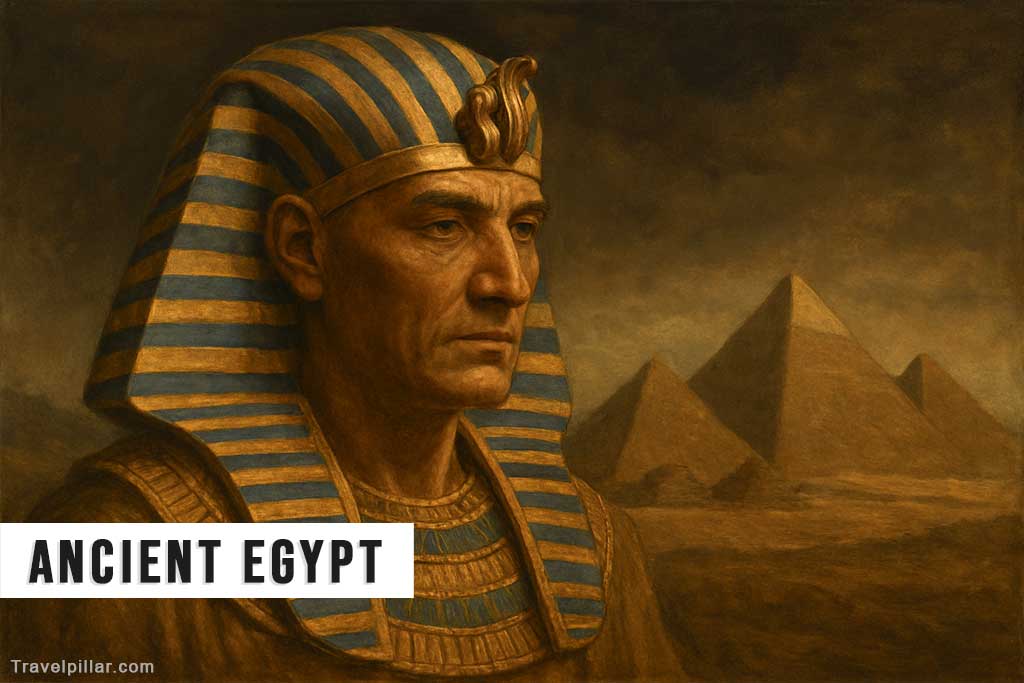
Ancient Egypt was one of the world’s first great civilizations. It emerged in the northeastern corner of Africa, along the lower parts of the Nile River around 5000 BC and thrived as an influential powerhouse for nearly 3000 years until it was conquered by the Roman Empire in 30 BC.
Periods of Ancient Egypt
Ancient Egypt’s long history is generally divided into three kingdoms and two intermediate periods:
- The Old Kingdom (2700–2200 BC): Known as the “Age of the Pyramids,” this period saw the construction of the iconic Pyramids of Giza, including the Great Pyramid, one of the Seven Wonders of the Ancient World. The Old Kingdom is also known for the development of a centralized state and an artistic style that was remarkably uniform.
- The First Intermediate Period (2200–2050 BC): This was a time of political instability and decentralization.
- The Middle Kingdom (2050–1650 BC): This period saw political stability and rejuvenation, with the pharaohs re-establishing central control and planning substantial public works, including irrigation projects and tombs.
- The Second Intermediate Period (1650–1550 BC): This period is best known for the rule of the foreign Hyksos rulers, and the eventual expulsion of the Hyksos by native Egyptians marked the start of the New Kingdom.
- The New Kingdom (1550–1050 BC): Often referred to as the “Egyptian Empire,” this period is when Egypt reached the peak of its power, with expansive foreign policy and remarkable prosperity. The famous pharaohs of this time include Hatshepsut, Thutmose III, Akhenaten, Tutankhamun, and Ramesses II.
Religion and Culture
The ancient Egyptians were polytheists who worshipped a wide array of gods and goddesses. These deities were involved in all aspects of existence, from creation and life on earth to death and the afterlife. The Egyptians also believed in an afterlife and saw mortal existence as just part of an eternal journey, and this belief had a profound influence on their culture.
Their religious beliefs are vividly demonstrated in their funeral practices, which included mummification to preserve the body for the afterlife, the construction of elaborate tombs filled with supplies for the afterlife, and the Book of the Dead, a guide to navigating the dangers of the afterlife.
Contributions to Civilization
The civilization of ancient Egypt made significant contributions in various fields:
- Architecture and Engineering: The Egyptians are renowned for their monumental architecture, particularly the pyramids, temples, and obelisks. Their skill in engineering is evident in the precision and scale of these constructions.
- Writing: The Egyptians developed one of the earliest known writing systems, known as hieroglyphs. They also created a cursive script known as hieratic, and later demotic.
- Mathematics and Astronomy: Ancient Egyptians used a decimal system and could perform complex mathematical operations like fractions, multiplication, and division. They also had advanced knowledge of astronomy, used to predict the flooding of the Nile and to align their temples accurately.
- Medicine: Ancient Egyptian texts show an understanding of some medical conditions, anatomy, and medical procedures.
- Art: Egyptian art is renowned for its distinct style, including statues, wall paintings, and other artefacts.
- Law: Ancient Egypt had a well-developed law system. While no comprehensive legal code has been found, court documents show that Egyptian law was based on a common-sense view of right and wrong.
By the time of its absorption into the Roman Empire in 30 BC, ancient Egypt had made an indelible mark on the world, influencing subsequent civilizations in the realms of art, architecture, mathematics, and more.