
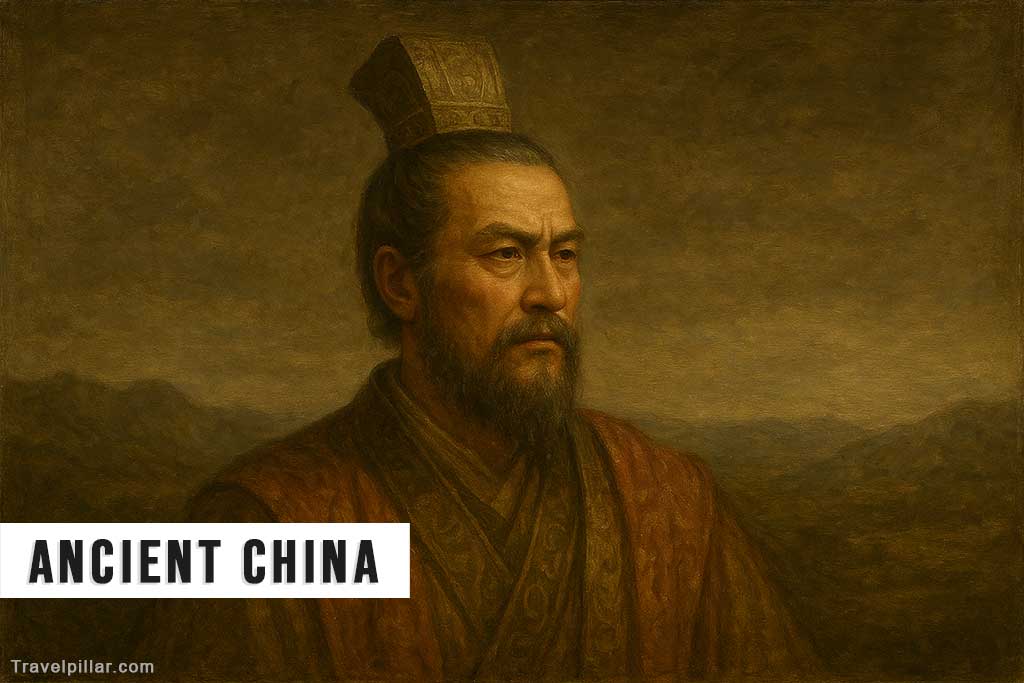
Ancient China is one of the world’s oldest civilizations, with recorded history dating back over 4,000 years. It was characterized by complex societies with advanced technology, highly developed culture, and significant influence over adjacent areas.
The traditional account of Ancient China includes distinct dynastic periods, each named after the ruling family.
The Dynastic Periods of Ancient China
Xia Dynasty (2070–1600 BC)
This is the first dynasty to be described in ancient historical chronicles, though records are sparse and some historians consider it more legend than fact. The Xia Dynasty marked the transition from the Neolithic age to the Bronze age in China.
Shang Dynasty (1600–1046 BC)
The Shang Dynasty is the earliest dynasty for which we have secure historical evidence, including inscriptions on oracle bones and a wealth of artifacts. This period saw significant advances in bronze technology and was characterized by a complex hierarchical society.
Zhou Dynasty (1046–256 BC)
The longest-ruling dynasty in Chinese history, the Zhou Dynasty can be divided into the Western Zhou and Eastern Zhou, based on the geographic location of their capitals. This era is known for its great intellectual achievements, including the beginnings of Confucian and Daoist philosophies.
The Eastern Zhou is further divided into the Spring and Autumn period and the Warring States period. The latter period was marked by the creation of the Great Wall, a series of fortifications built to protect the states from nomadic invasions.
Qin Dynasty (221–206 BC)
The Qin Dynasty is significant because it was the period when China was unified under Emperor Qin Shi Huang. The Emperor is also famous for the creation of the Terracotta Army, a massive collection of sculptures depicting his armies, built to protect him in the afterlife. This period also saw the standardization of currency, weights, and measures, and the codification of laws.
Han Dynasty (206 BC – 220 AD)
The Han Dynasty is considered a golden age in Chinese history, during which arts, culture, and technology significantly developed. The Silk Road trade route was established during this period, linking China with the West. The Han period also saw the further development of Confucianism and the creation of paper.
Contributions to Civilization
Ancient China contributed greatly to human civilization with many inventions and advancements:
- Writing System: The Chinese writing system (logographic characters) is one of the oldest still in use today.
- Printing: The invention of woodblock printing (and later movable type) revolutionized the dissemination of knowledge and information.
- Paper: The invention of paper was a huge boon to communication and record keeping.
- Gunpowder: Gunpowder was a major invention that has not only military but also cultural implications (fireworks).
- Compass: The invention of the magnetic compass had a profound impact on navigation and exploration.
- Silk: Silk production and the trade routes to deliver it (the Silk Road) had significant cultural and economic impacts.
- Porcelain: China is known for its development of incredibly fine porcelain ceramics, often colloquially referred to as “china” in the West because of this.
- Philosophy: Chinese philosophy includes Confucianism, Taoism, and Legalism, all of which have deeply influenced Chinese culture and other cultures worldwide.
Ancient China’s Legacy Today
Today, travelers can explore numerous sites across China that reflect its ancient history. The Great Wall of China, stretching over 13,000 miles, offers insights into the military strategies of different dynasties. The Forbidden City in Beijing, built during the Ming Dynasty, showcases the grandeur of imperial China. The Terracotta Army in Xi’an provides a glimpse into the Qin Dynasty’s might and artistic prowess. These sites, along with others like the ancient water towns of Suzhou and the Mogao Caves in Dunhuang, make China a key destination for those interested in exploring the legacy of one of history’s most enduring civilizations.