
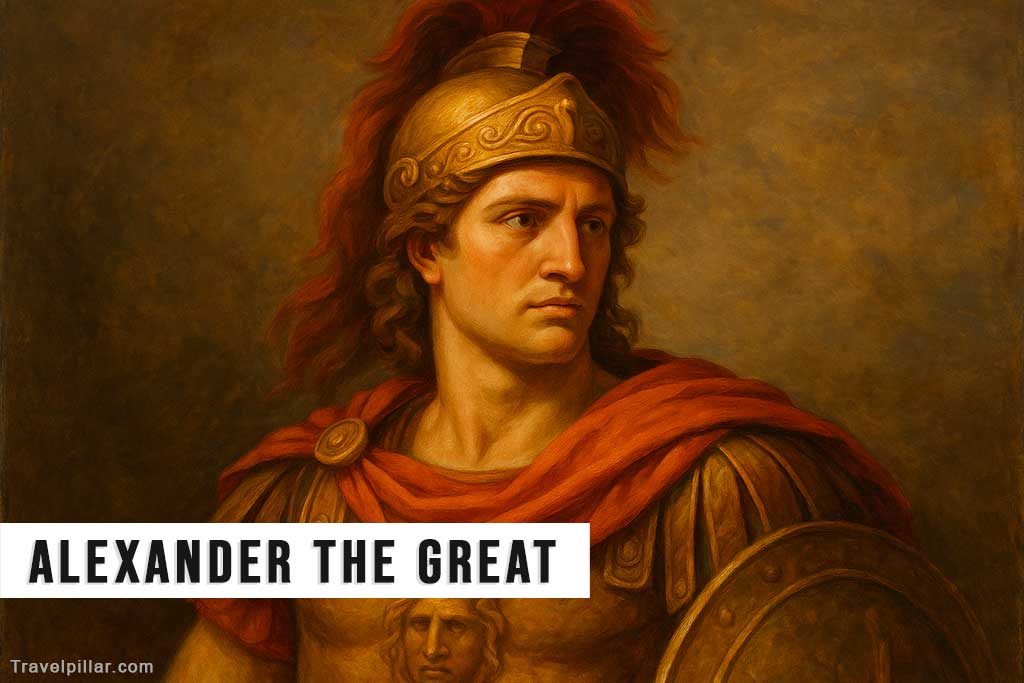
Alexander III, known universally as Alexander the Great, was born in Pella, Macedonia in 356 BC and reigned as king from 336 to 323 BC. The son of Philip II of Macedon and Olympias, Alexander was tutored by the philosopher Aristotle and ascended to the throne after his father’s assassination.
Over the next 13 years, he established one of the largest empires in history, stretching from Greece to Egypt and as far east as India. Noted for his tactical brilliance, Alexander never lost a battle despite often being outnumbered. His first significant achievement was the defeat of the Persian Empire, a long-standing enemy of the Greek city-states. Upon defeating Darius III, the Persian king, Alexander declared himself the King of Asia.
Beyond his military conquests, Alexander’s legacy includes the cultural exchange his empire engendered. He founded some 20 cities that bore his name, the most famous of which is Alexandria in Egypt. These cities became centers of Greek culture and learning. Alexander’s campaign resulted in the Hellenization of the territories he conquered, spreading Greek language, art, and culture across Asia and North Africa.
Alexander’s ambition and leadership abilities, along with his belief in his own divine origin, fueled his drive for conquest. His campaigns dramatically reshaped the world, paving the way for the Hellenistic era and the subsequent rise of Rome.
Despite his extraordinary achievements, Alexander’s life was marked by controversy and tragedy. His aggressive military campaigns, heavy drinking, and volatile personality led to periods of extreme violence and destruction. He died at the age of 32 under mysterious circumstances after a bout of heavy drinking, leaving his vast empire without a designated heir. His generals, known as the Diadochi, divided his empire among themselves, leading to a series of conflicts known as the Wars of the Diadochi. Alexander’s life and achievements continue to be studied as pivotal in the history of the Western world.