
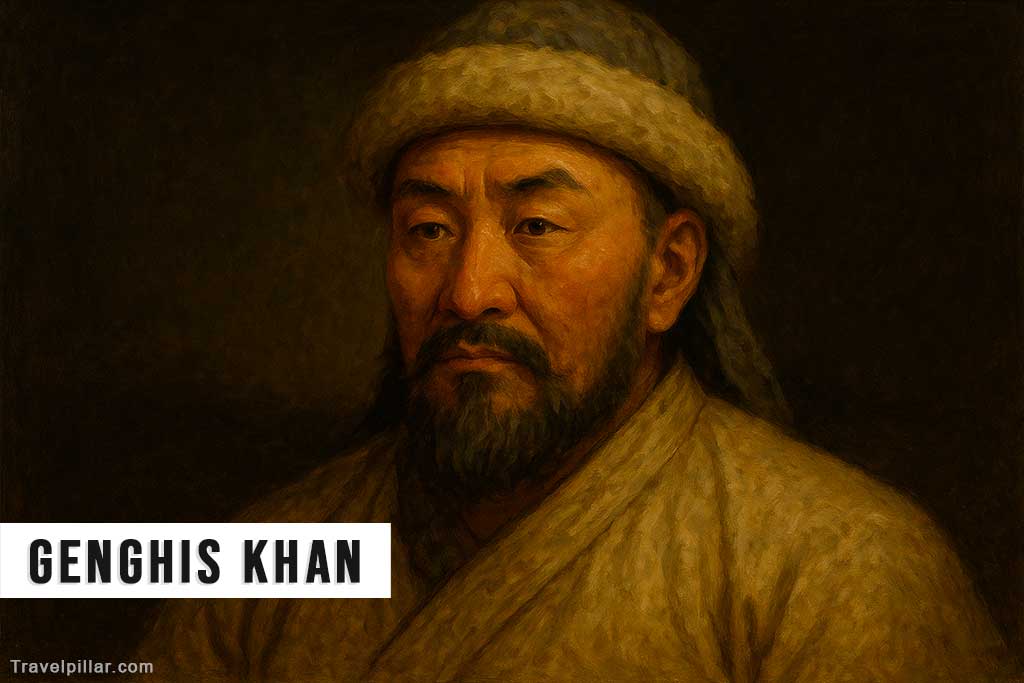
Genghis Khan, originally named Temujin, was the founder and first Great Khan of the Mongol Empire, which became the largest contiguous empire in world history after his death. He was born around 1162 into a nomadic Mongolian tribe.
Genghis Khan’s life was marked by hardship, including the early death of his father and expulsion from his tribe. Despite these obstacles, he managed to unite the Mongol tribes through a combination of strategic alliances and military prowess, becoming the leader of the united Mongol nation in 1206. It was at this point he assumed the title of Genghis Khan, meaning “universal ruler.”
His innovations in warfare, including the use of psychological warfare and a merit-based system in his armies, enabled the Mongols to conquer vast territories. These tactics were both ruthless and effective, resulting in the subjugation of most of Eurasia, from China to Eastern Europe.
Genghis Khan also established a complex administrative system based on traditional Mongol customs, promoting trade and communication. He implemented the Yassa, a legal code that, despite its brutality, provided a cultural and legal framework for his empire.
Upon his death in 1227, Genghis Khan left a legacy that reshaped the world. His descendants, most notably his grandson Kublai Khan, continued his work, further expanding the Mongol Empire and cementing the Mongol influence over the areas they conquered.
Genghis Khan’s reign has been characterized as both destructive and innovative. While his invasions resulted in widespread devastation and death, they also facilitated cultural exchange and trade between the East and the West, particularly along the Silk Road. Today, Genghis Khan remains a significant and controversial figure in world history, revered in Mongolia as a national symbol, and acknowledged globally for his immense impact on the course of history.