
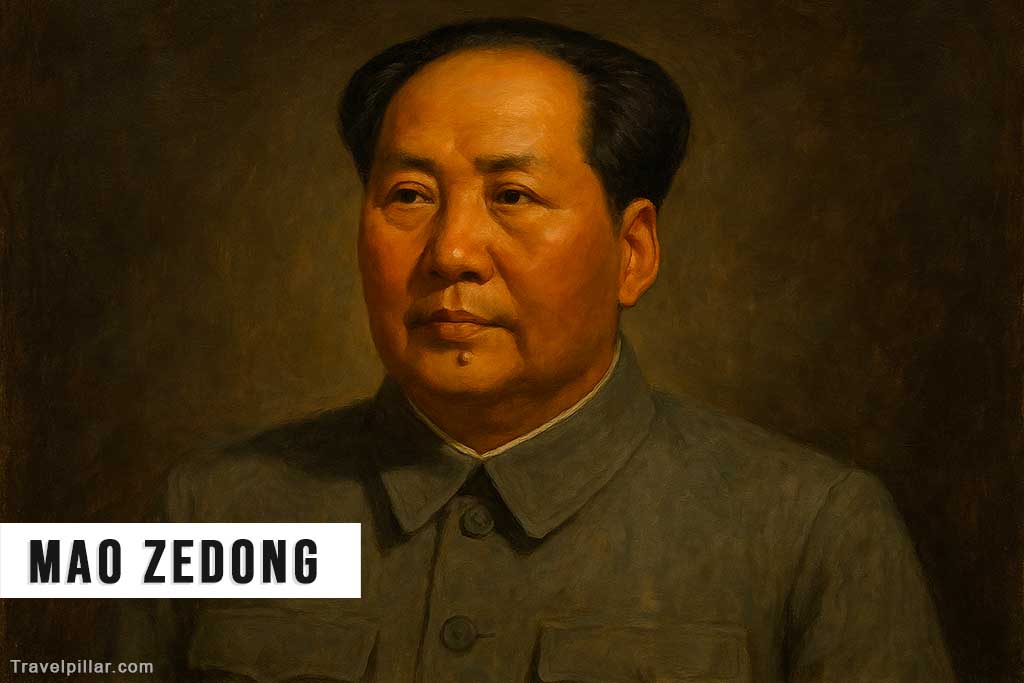
Mao Zedong, also known as Chairman Mao, born on December 26, 1893, in Shaoshan, Hunan Province, China, was a Chinese communist leader and the founding father of the People’s Republic of China (PRC). He served as the Chairman of the Communist Party of China from its establishment in 1949 until his death in 1976. Mao’s ideologies and political strategies continue to shape the structure and direction of China’s political system.
Mao played a pivotal role in the Chinese Communist Revolution that led to the overthrow of the Nationalist Government in 1949. His successful execution of guerrilla warfare during the revolution was instrumental in establishing the PRC and bringing the Communist Party to power. His “Red Army” grew from 5,000 soldiers to 200,000 soldiers, and his strategies and tactics were later published as “On Guerilla Warfare,” influencing revolutionary movements worldwide.
As the leader of the PRC, Mao implemented sweeping land reform, promoted mass campaigns such as the Great Leap Forward (1958-1962) and the Cultural Revolution (1966-1976), both aimed at modernizing and reforming the Chinese society and economy. However, these campaigns led to societal upheaval and resulted in millions of deaths from starvation, imprisonment, and execution.
Despite these controversies, Mao is viewed by many in China as a great revolutionary leader whose policies laid the foundation for the country’s economic growth and improved the social standing of women, among other things. However, his legacy remains a topic of intense debate both within China and globally.
Mao’s thoughts, commonly known as Maoism, have had a significant impact on communism worldwide, and his writings continue to be studied and widely read. Mao Zedong died on September 9, 1976, leaving a complex and far-reaching legacy that continues to influence China and the world.