
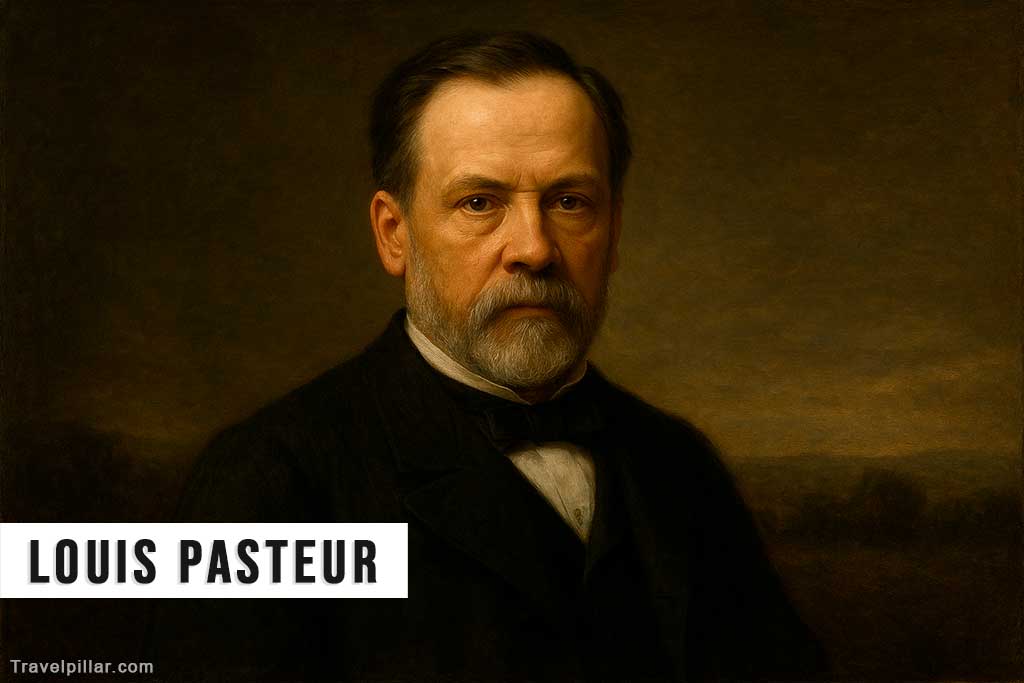
Louis Pasteur, born in Dole, France in 1822, was a pioneering French microbiologist and chemist whose work laid the foundations of several branches of science. His research led to remarkable breakthroughs in industrial chemistry, health sciences, and clinical medicine, making him one of the most celebrated scientific figures in history.
Pasteur began his scientific career as a chemist, achieving early success by resolving the mystery of tartaric acid, a compound found in wine. His research proved the existence of molecules that can exist in two different forms that mirror each other, a phenomenon now known as chirality.
However, Pasteur is most renowned for his groundbreaking work in microbiology and infectious disease. He disproved the prevailing theory of spontaneous generation – the belief that living organisms could arise from non-living matter. Instead, he proposed the germ theory of disease, which states that many diseases are caused by microorganisms. This was a significant departure from the miasma theory, the then-dominant explanation that diseases were caused by ‘bad air’.
Perhaps Pasteur’s most enduring legacy is the development of pasteurization, a process that kills bacteria in food through heat. This technique, which was first used to prevent wine and beer from souring, is now widely used in the food industry.
Pasteur also made significant advances in the prevention and treatment of diseases. His work on chicken cholera and anthrax led to the development of vaccines. Most notably, he created a vaccine for rabies, a fatal disease spread by animals to humans.
Louis Pasteur’s work has saved countless lives through improved hygiene, food safety, and disease prevention. His approach of applying rigorous laboratory experimentation to practical problems remains a guiding principle of scientific research. Pasteur died in 1895, leaving a legacy of scientific discoveries that continue to benefit humanity.