
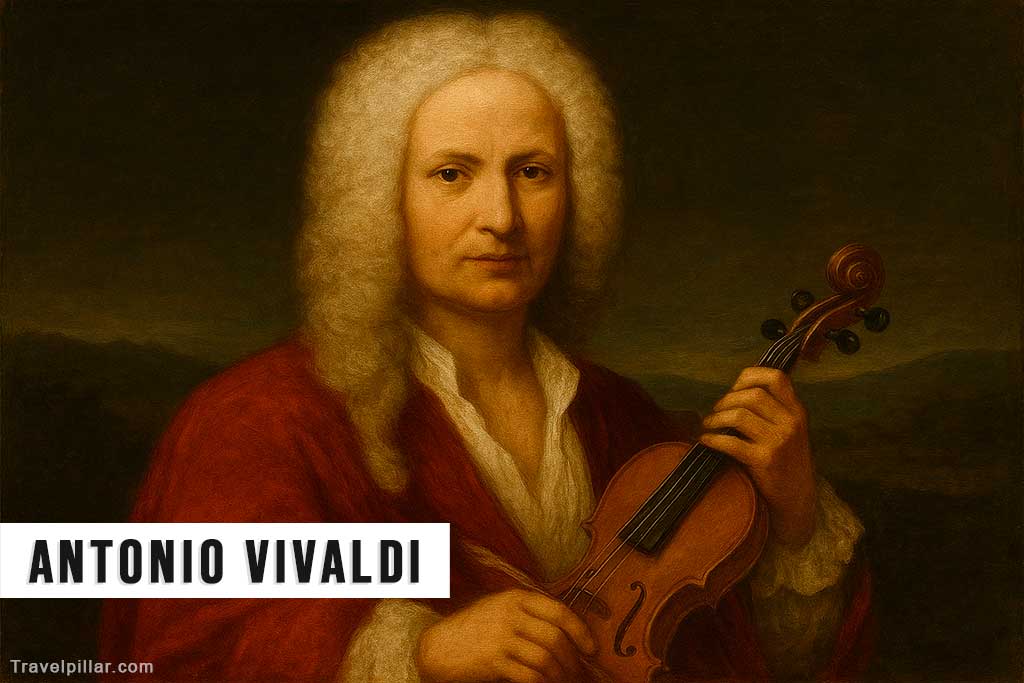
Antonio Vivaldi (1678-1741) was an Italian composer, violinist, and cleric who left a substantial impact on the music world. Born in Venice, Italy, he was one of the most influential figures in the development of Baroque music.
As a young boy, Antonio Vivaldi was trained in music by his father, a professional violinist. Although ordained as a priest in 1703, Vivaldi chose to pursue his music career rather than his ecclesiastical duties. He secured a position at the Ospedale della Pietà, a home for orphaned and disadvantaged girls, where he remained for nearly four decades. There, he composed many of his 500 concertos, primarily for the institution’s esteemed orchestra.
Vivaldi’s compositions, particularly his concertos, broke away from the conventions of his time. His works were unique in their imaginative use of melody, vibrant rhythms, and an unusual focus on the capabilities of individual instruments. He was one of the first composers to use the ritornello form, a method in which the main theme returns repeatedly throughout the composition, leading the movement to its conclusion.
Vivaldi’s most celebrated work is “The Four Seasons” (1723), a series of four violin concertos. Each concerto is associated with a season of the year and accompanied by a sonnet, possibly written by Vivaldi himself. These works are pioneering instances of program music, music with a narrative element, a significant milestone in the evolution of the concerto form.
By the time of his death in 1741, Vivaldi’s music had fallen out of favor, and he died in relative obscurity. However, a resurgence of interest in the 20th century led to a reevaluation of his contributions, and he is now viewed as a master of the Baroque era. His music has influenced countless musicians and composers, including Johann Sebastian Bach, establishing Vivaldi’s lasting legacy in Western music.