
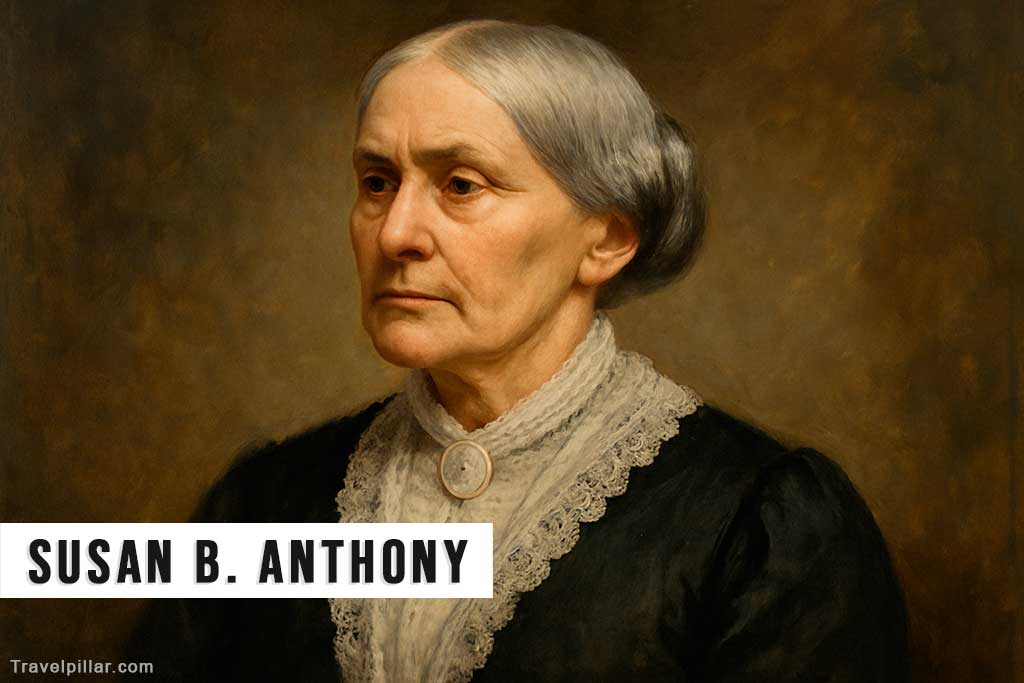
Susan Brownell Anthony (1820-1906) was an eminent American social reformer and women’s rights activist who played a crucial role in the women’s suffrage movement. Born into a Quaker family in Adams, Massachusetts, Anthony developed strong moral principles at an early age, particularly a belief in social equality.
In the mid-19th century, Anthony was a staunch abolitionist, fighting against slavery, and was a member of the American Anti-Slavery Society. She also worked for the temperance movement, advocating for stronger liquor laws. However, when Anthony was barred from speaking at a temperance convention because she was a woman, she began to focus her efforts on women’s rights.
In 1869, Anthony, along with Elizabeth Cady Stanton, founded the National Woman Suffrage Association (NWSA), a women’s rights organization focused on achieving women’s suffrage – the right to vote. They aimed to accomplish this by pushing for a federal constitutional amendment. Anthony toured the United States, giving speeches, gathering thousands of signatures for petitions, and lobbying Congress every year for the amendment.
In 1872, Anthony was arrested for voting in the presidential election, a public act that brought national attention to the issue of women’s suffrage. Although she was convicted and fined $100, she never paid the fine.
Despite her tireless work, Anthony did not live to see the fruition of her efforts. It was not until 1920, 14 years after her death, that the 19th Amendment, also known as the Susan B. Anthony Amendment, was passed, granting American women the right to vote. Today, Susan B. Anthony is recognized as a heroic figure in the fight for women’s rights, with her legacy serving as an inspiration for future generations of women’s rights activists.