
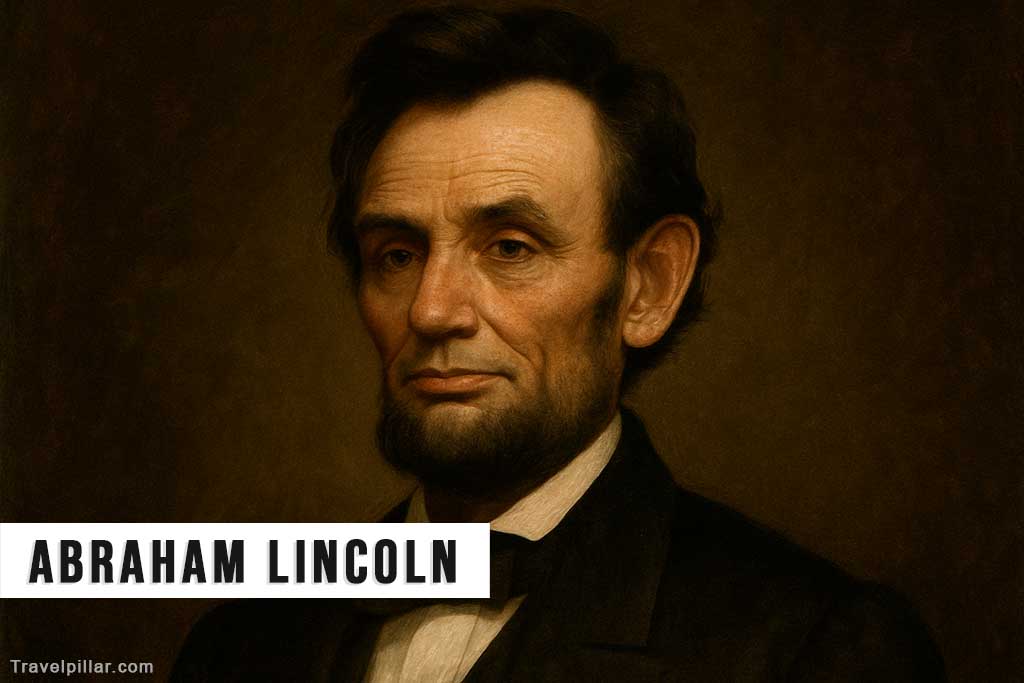
Abraham Lincoln, born on February 12, 1809, in Kentucky, was the 16th President of the United States, serving from March 1861 until his assassination in April 1865. Lincoln’s leadership during the American Civil War and his role in ending slavery solidify his legacy as one of the most influential figures in American history.
Raised in a log cabin in frontier Indiana, Lincoln’s journey to the presidency was marked by self-education and a burgeoning political career in Illinois. His debates with Stephen A. Douglas in 1858, focusing primarily on the issue of slavery, brought him into national prominence.
As president, Lincoln’s greatest challenge was the Civil War. His Emancipation Proclamation in 1862 declared slaves in Confederate-held territory to be free, turning the war into a fight not just for the Union, but also for freedom. He navigated through critical military and political situations with a combination of shrewdness, patience, and determination.
In 1863, Abraham Lincoln delivered the Gettysburg Address, a speech that redefined the Civil War as a struggle not just for the Union, but as “a new birth of freedom” that would bring equality to all of its citizens, and that would also create a unified nation where states’ rights were no longer dominant.
Despite the tremendous strain of leading a country at war, Lincoln successfully campaigned for re-election in 1864. However, just days after the Confederate surrender, he was assassinated by John Wilkes Booth, a Confederate sympathizer, on April 14, 1865.

Lincoln’s legacy is one of preserving the Union, ending slavery, and redefining freedom and democracy. His eloquent articulation of the nation’s ideals, his significant role in ending the institution of slavery, and his leadership during one of America’s most turbulent periods have earned him recognition as one of the country’s greatest presidents.