
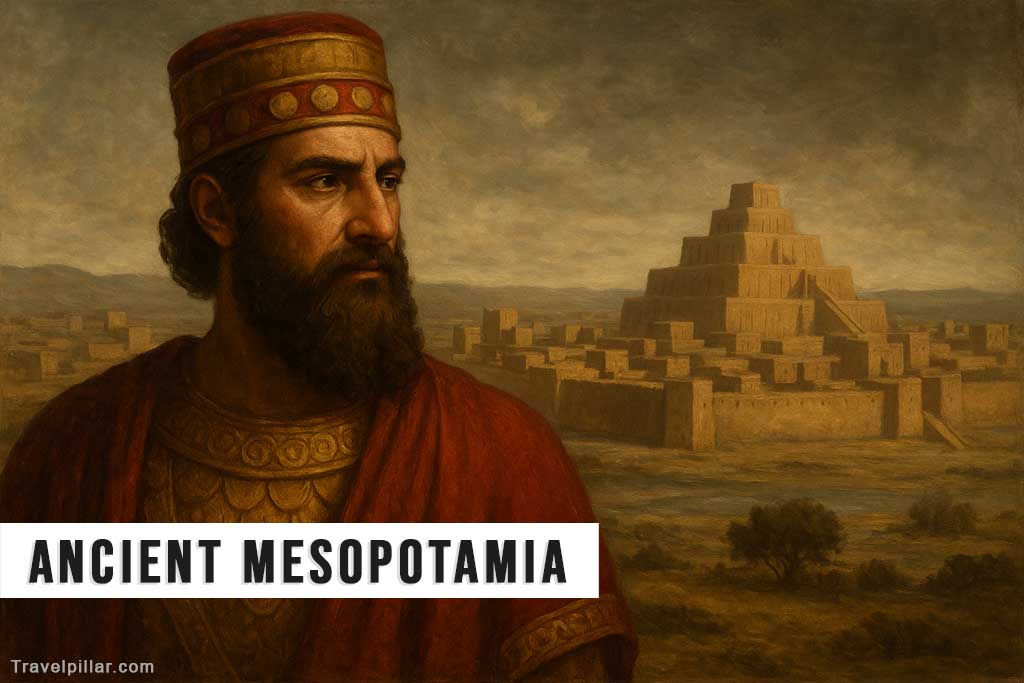
Ancient Mesopotamia, often referred to as the cradle of civilization, was an historical region located in the eastern Mediterranean. It was situated within the area that is now occupied by modern Iraq, Kuwait, and parts of Syria, Iran, and Turkey. Mesopotamia existed between the Tigris and Euphrates rivers, and it’s this landscape that provided fertile land for agriculture, leading to the growth of some of the earliest complex societies around 5000 BC.
Early Periods and the Invention of Writing
During the Ubaid period (6500-3800 BC), the first settlements appeared in Mesopotamia. This period was followed by the Uruk period (4000-3100 BC), in which we see the emergence of urban life. It’s in this era that writing first developed, with the earliest form known as cuneiform. Originally, writing was used for record-keeping purposes, particularly for recording transactions and managing the increasingly complex societies that were developing.
The Uruk period was succeeded by the Early Dynastic Period (2900-2350 BC) where the first known historical King, the King of Kish, was noted in Sumerian King list.
Sumerian Civilization
The civilization of Sumer, often recognized as the first advanced civilization, emerged in Mesopotamia around 4500 BC. Sumerians built the first cities, established the first monarchies and bureaucracies. They also developed some of the world’s first written literature and established long-distance trade with other early civilizations.
Akkadian Empire
Around 2334 BC, Sargon the Great established the Akkadian Empire, encompassing all of Mesopotamia, including Sumer. This was arguably the world’s first empire, although it was short-lived, lasting less than two centuries.
Babylonian Empire
The city-state of Babylon, under the rule of Hammurabi in the 18th century BC, expanded to create the Old Babylonian Empire. Hammurabi is known for his law code, one of the earliest legal documents that has been found, which established standards for commercial interactions and set fines and punishments to meet the requirements of justice.
Assyrian Empire
The Assyrian Empire came to power in Northern Mesopotamia around 900 BC and, at the height of its power, controlled a vast territory that included Mesopotamia, parts of Asia Minor, the Levant, and Egypt.
Late Babylonian Empire and Persian conquest
In the 6th century BC, under the rule of Nebuchadnezzar II, Babylon again became a major power in Mesopotamia, but its domination was short-lived. The empire fell to the Persians under Cyrus the Great in 539 BC.
Contributions to Humanity
The civilizations of Mesopotamia made many contributions to human history. These include the concept of time (the 60-minute hour and 60-second minute), the 360-degree circle, early advances in astronomy and mathematics, and innovations in governance and law. They also contributed significantly to the arts, with the Epic of Gilgamesh—one of the earliest known pieces of literature—originating in Mesopotamia.
These civilizations also played a key role in the development of early technologies such as irrigation, the plow, and early seafaring technology. The domestication of animals and plants in the region contributed to significant changes in human lifestyles, allowing the transition from nomadic to settled life.
Mesopotamia was also the birthplace of several major religions, including ancient Sumerian religion, Ashurism, Mardukism, and the ancient Semitic religions, and its influence can be seen in the Abrahamic religions that came