
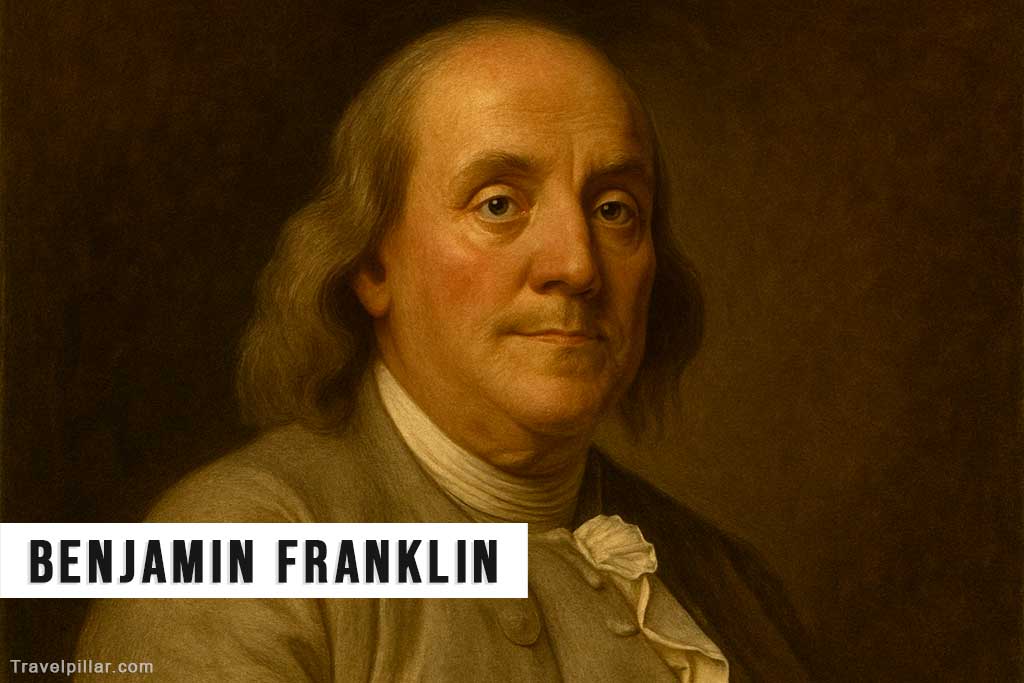
Benjamin Franklin, born on 17 January 1706, in Boston, Massachusetts, was an iconic figure of the American Enlightenment era and a man of many talents. An eminent statesman, scientist, writer, inventor, and diplomat, Franklin’s multifaceted career and contributions significantly shaped the early American society.
Franklin’s achievements in the realm of science are considerable. He is most recognized for his experiments with electricity, chiefly his renowned kite experiment in 1752. This experiment confirmed his hypothesis that lightning was an electrical phenomenon, leading to his invention of the lightning rod which is still in use today. He also invented bifocal glasses, the Franklin stove, and contributed to the understanding of ocean currents, among other things.
As a writer and printer, Franklin’s contributions are equally distinguished. His almanac, Poor Richard’s Almanack, was popular for its witty proverbs and advice, and his autobiography remains a classic in the genre. His “Join or Die” political cartoon, calling for colonial unity, became a potent symbol of the American Revolution.
In the political sphere, Benjamin Franklin held numerous positions, including Postmaster General and Minister to France, and was instrumental in the establishment of the United States Postal Service. His diplomatic work was crucial in securing French support during the American Revolution, leading to the United States’ victory. A signatory of key documents like the Declaration of Independence and the U.S. Constitution, his impact on American governance is profound.
The breadth of Franklin’s achievements spanned science, public service, literature, and diplomacy. His ability to blend practical innovation with philosophical insight and civic engagement made him a unique figure during the Enlightenment and a cornerstone of early American history. His legacy continues to influence American culture and thought today. His face on the 100-dollar bill is a testament to his lasting imprint on the nation.