
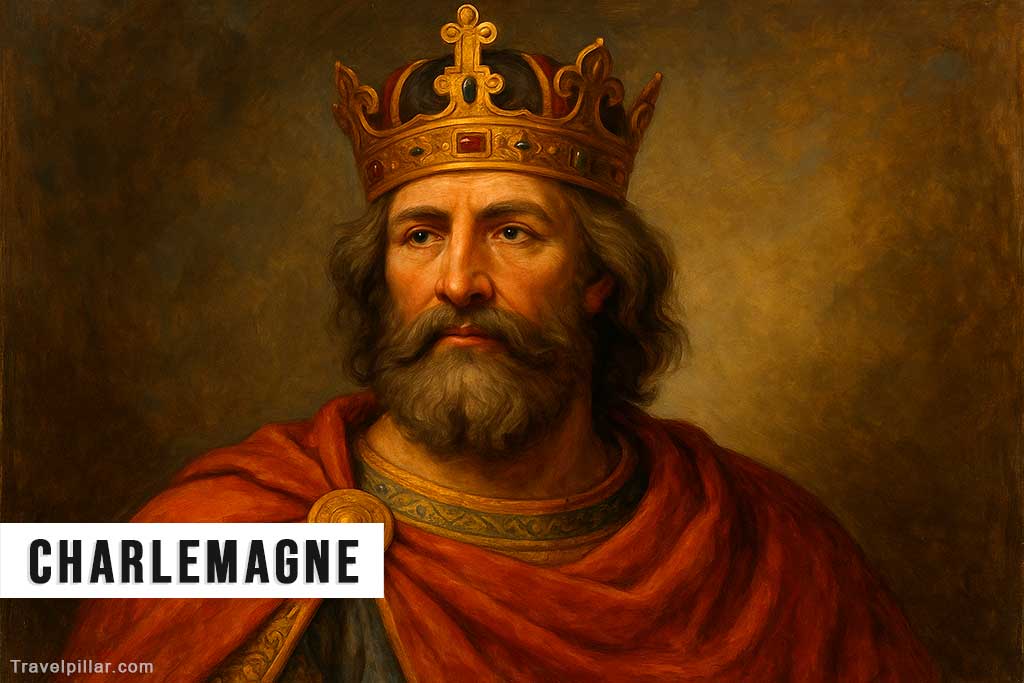
Charlemagne, also known as Charles the Great, was King of the Franks from 768 and Emperor of the Romans from 800 until his death in 814. He was born on April 2, 742, into the Carolingian family, a line of Frankish nobles.
Charlemagne’s reign marked a period of significant military expansion, cultural renaissance, and political innovation in Western Europe, leading to his recognition as the “Father of Europe.” His military campaigns extended his domain to include much of Western and Central Europe, uniting regions that had been fragmented since the fall of the Western Roman Empire.
In 800 AD, Pope Leo III crowned Charlemagne as Emperor of the Romans, a title that had been defunct in the West for over three centuries. This coronation marked a significant moment in the history of Western Europe, signifying the shift of power from the Byzantine Empire to the Carolingian Empire, and signalled the fusion of Roman, Christian, and Germanic cultures.
Charlemagne’s rule was marked by significant cultural and educational reforms, collectively known as the Carolingian Renaissance. He established a palace school at his court in Aachen, encouraging the study of classical literature and arts. He also standardized writing script, leading to the development of the Carolingian minuscule, a clear and easily readable script that influenced modern Latin script.
He instituted administrative reforms, divided his empire into counties overseen by counts, and implemented laws to maintain peace and order. His capitularies, legislative or administrative orders, covered various aspects of life, including trade, currency, agriculture, and ecclesiastical affairs.
Charlemagne’s death in 814 led to the eventual dissolution of the empire among his grandsons, but his cultural and political legacies shaped the future of Europe. He remains a pivotal figure in the history of Western Europe, symbolizing the dream of a united Europe.