
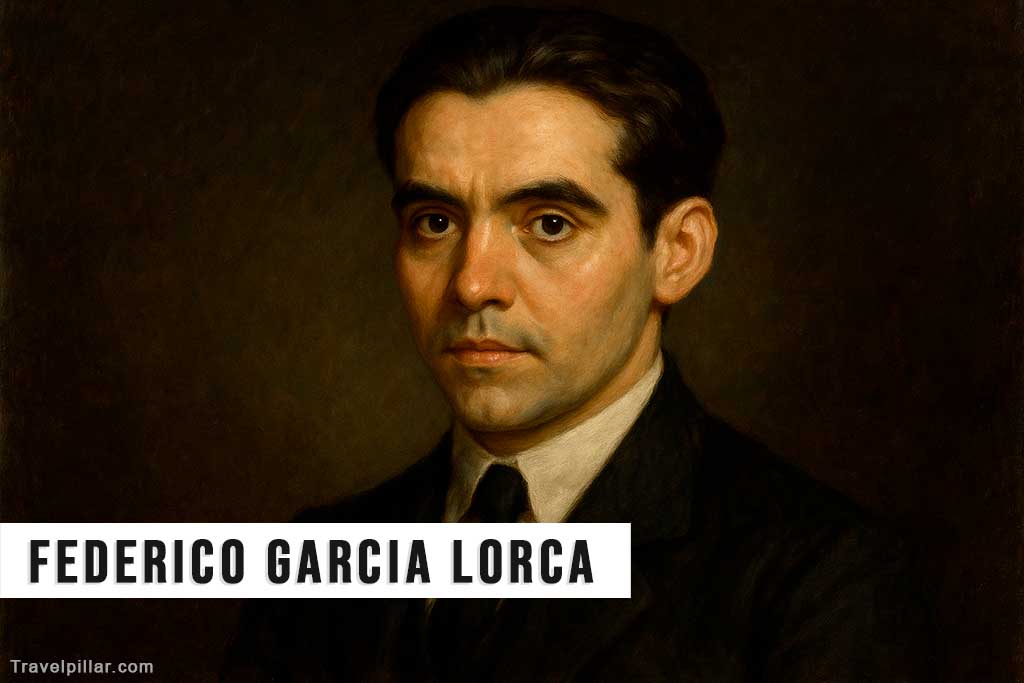
Federico García Lorca, born in Fuente Vaqueros, Spain on June 5, 1898, and executed on August 19, 1936, is esteemed for his substantial contribution to Spanish literature. As a poet, playwright, and theatre director, Lorca significantly influenced the artistic landscape of his time.
Lorca’s early life in Andalusia, a region rich in cultural diversity and folklore, had a profound influence on his work. He studied law, literature, and composition at the University of Granada. In 1919, he moved to Madrid, where he became an integral part of the Generation of ’27, a group of artists known for their combined elements of traditional styles with avant-garde trends.
Lorca’s poetry collections, including “Gypsy Ballads” (1928) and “Poet in New York” (posthumously published in 1940), are hailed for their vibrant imagery, emotional depth, and exploration of themes like love, death, and longing. His plays, such as “Blood Wedding” (1933), “Yerma” (1934), and “The House of Bernarda Alba” (1936), critically examine societal norms and restrictions, often through the lens of repressed femininity.
An openly gay man, Lorca’s exploration of homosexual themes in his work was pioneering in a time of significant societal constraint. This expression of nonconformity, combined with his vocal support for the Spanish Republic, made him a target during the onset of the Spanish Civil War.
In 1936, at the age of 38, Lorca was arrested by Nationalist forces. His execution under the order of the fascist regime was a profound loss for the world of literature. His works, rich with lyrical beauty and profound emotion, continue to be celebrated worldwide for their artistic depth and enduring social commentary.