

Piazza della Signoria, nestled in the historic center of Florence, Italy, has long been the focal point of the city’s civic and artistic life. As the main square of Florence, this vibrant public space is home to a remarkable array of sculptures, architectural marvels, and cultural institutions, making it an essential destination for visitors seeking to experience the essence of the city’s rich heritage.
The most prominent building in the Piazza della Signoria is the Palazzo Vecchio, a medieval fortress-like structure that has served as the seat of power for both the Florentine Republic and the ruling Medici family. Designed by Arnolfo di Cambio, the Palazzo Vecchio features a distinctive crenelated battlement and a towering bell tower, which dominates the city’s skyline. Today, the palace functions as both the city’s town hall and a museum, housing an extensive collection of artworks and historical artifacts.
The Piazza della Signoria is also home to the Loggia dei Lanzi, an open-air sculpture gallery showcasing a collection of Renaissance masterpieces. Notable sculptures on display include Benvenuto Cellini’s ‘Perseus with the Head of Medusa,’ Giambologna’s ‘Rape of the Sabine Women,’ and Jean de Boulogne’s ‘Hercules and Nessus.’ These exquisite works of art, freely accessible to the public, contribute to the square’s vibrant atmosphere and artistic allure.
Public square FREE entry
Google map 4.8/5
Highlights of the Piazza della Signoria
Palazzo Vecchio
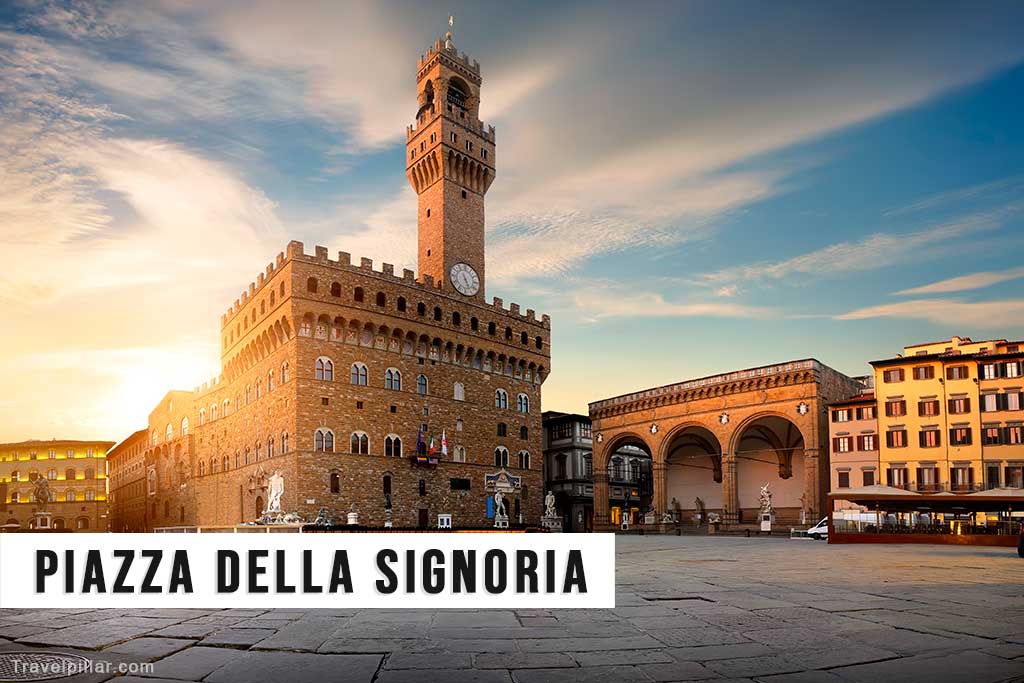
Palazzo Vecchio is Florence’s historic town hall. Constructed in the late 13th century, it served as the seat of the Florentine Republic and later the Medici government. The building features fortified architecture, the prominent Arnolfo Tower, and richly decorated interiors, including Vasari’s frescoes. Today, it functions as both a museum and the city’s town hall, offering visitors access to historic chambers, artworks, and panoramic views.
Official website: https://ticketsmuseums.comune.fi.it (tickets)
Google map 4.7/5
Replica of Michelangelo’s David

The replica of Michelangelo’s David stands outside Palazzo Vecchio, placed where the original sculpture was installed in 1504. The original was moved to the Galleria dell’Accademia in 1873 to protect it from damage. The replica maintains the same scale and detail, representing civic freedom and strength. It remains one of Florence’s most photographed landmarks and preserves the historical context of the sculpture’s original public placement.
Google map 4.7/5
Loggia dei Lanzi
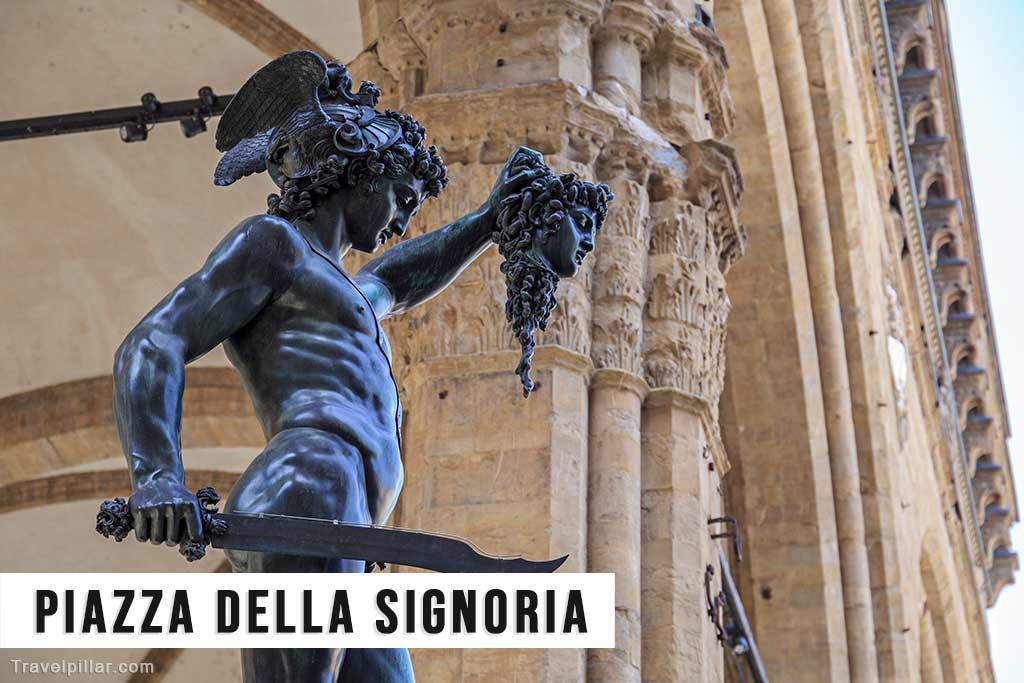
The Loggia dei Lanzi is an open-air gallery built in the 14th century, originally intended for public ceremonies. It houses several important Renaissance sculptures, including Perseus with the Head of Medusa by Benvenuto Cellini and The Rape of the Sabine Women by Giambologna. The loggia features wide arches and decorative vaulting, serving as both an architectural feature and a public display space for Medici-approved artworks in Florence’s civic centre.
Google map 4.8/5 Loggia dei Lanzi
Google map 4.9/5 Perseus with the head of Medusa
Fountain of Neptune
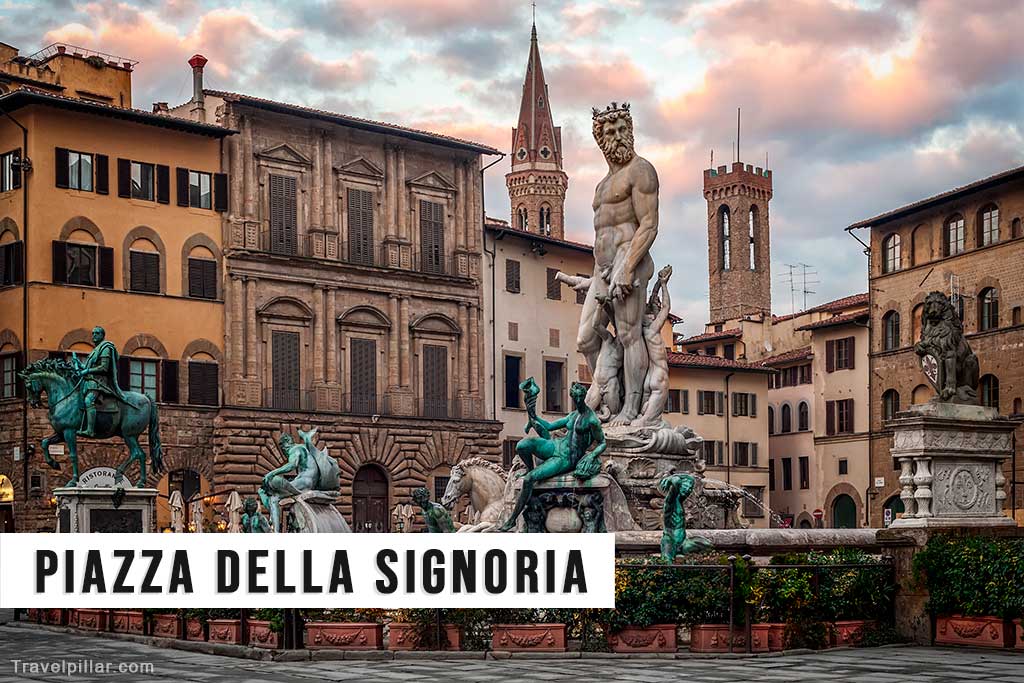
The Fountain of Neptune was completed in 1575 by Bartolomeo Ammannati and assistants. Commissioned to celebrate Florence’s maritime ambitions, it features a large marble statue of Neptune surrounded by sea creatures, tritons, and nymphs. The fountain integrates classical mythology with Medici political symbolism. Originally controversial, it is now regarded as a significant public monument of late Renaissance sculpture, forming part of Florence’s broader programme of civic and artistic representation.
Google map 4.7/5
Equestrian Statue of Cosimo I de’ Medici
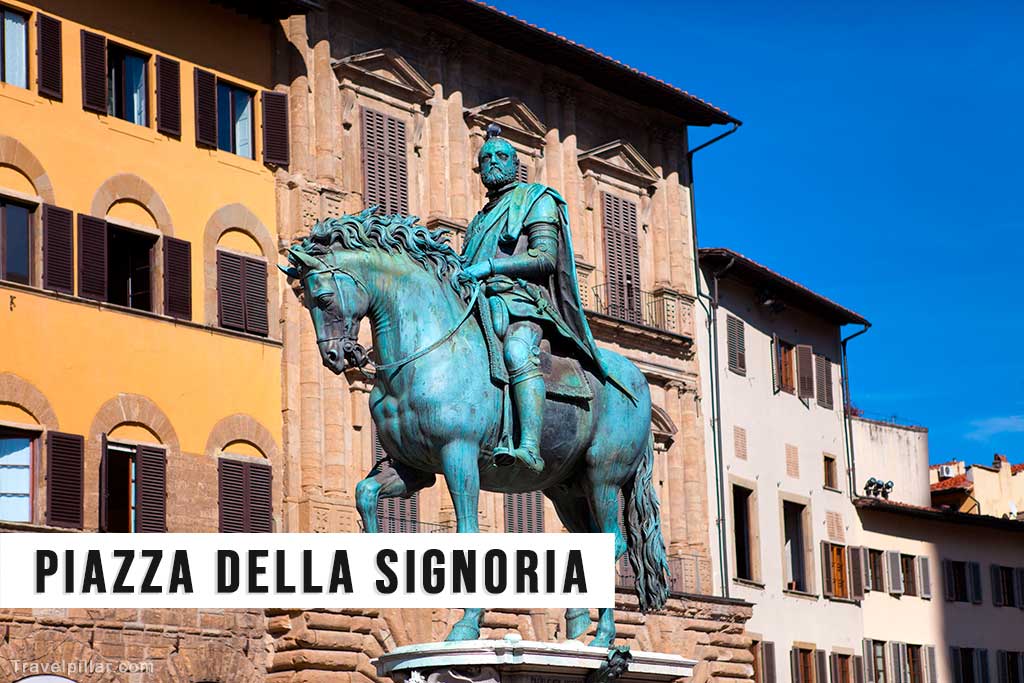
The Equestrian Statue of Cosimo I de’ Medici was sculpted by Giambologna in 1594. It commemorates Cosimo I, the first Grand Duke of Tuscany, and reflects Medici authority and dynastic legitimacy. Cast in bronze, the statue portrays Cosimo in classical military dress astride a horse, following Renaissance models of imperial portraiture. It was the first equestrian statue erected in Florence since antiquity and set a precedent for later public monuments.
Google map 4.6/5
Medici Lions
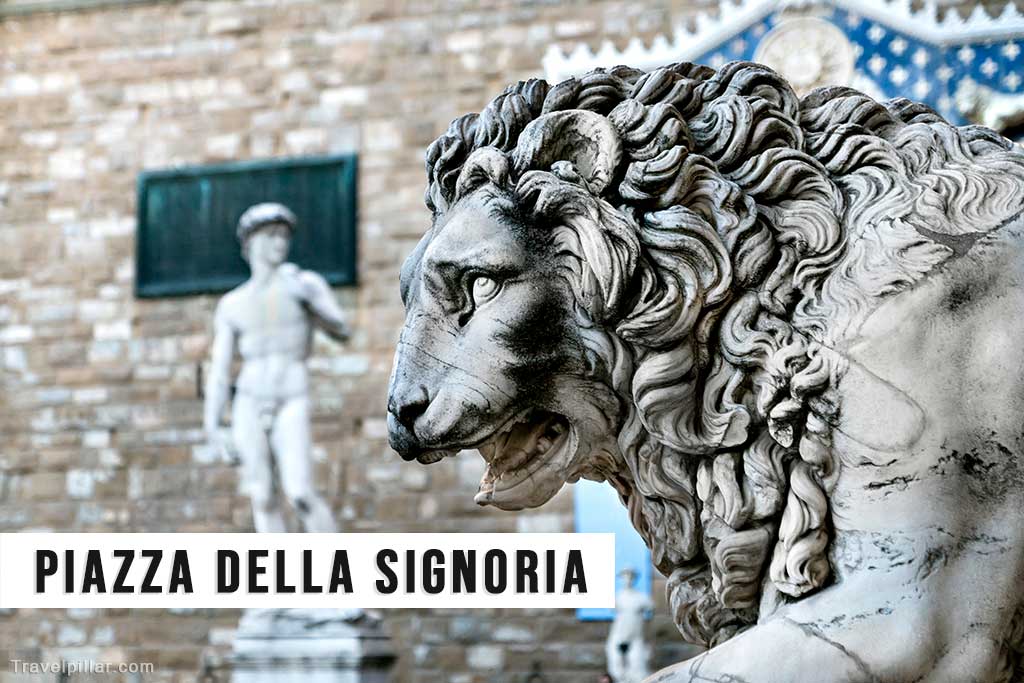
The Medici Lions are a pair of marble sculptures flanking the entrance of the Loggia dei Lanzi. One lion is ancient Roman, while the other was sculpted in the 16th century by Flaminio Vacca. Both lions rest a paw on a sphere, symbolising power and guardianship. Adopted as a symbol of the Medici family, the lions serve a decorative and symbolic function within the civic and artistic framework of Renaissance Florence.
Google map 4.8/5 Loggia dei Lanzi
Bandinelli’s Hercules and Cacus
Hercules and Cacus is a marble sculpture by Baccio Bandinelli, completed in 1534. Commissioned by the Medici, it stands near the entrance of Palazzo Vecchio as a political statement of strength and order. The work depicts the mythological hero Hercules defeating the fire-breathing giant Cacus. Intended to rival Michelangelo’s David, it reflects the muscular and dramatic style of High Renaissance sculpture and serves as a symbol of civic authority.
Google map 4.7/5
Judith and Holofernes by Donatello
Judith and Holofernes by Donatello is a bronze sculpture created in the mid-15th century. It depicts the biblical heroine Judith beheading the Assyrian general Holofernes, symbolising virtue triumphing over tyranny. Commissioned by the Medici family, the sculpture was later placed in a civic setting as a political allegory. Executed in the round, it is one of the earliest Renaissance sculptures designed for full three-dimensional viewing and public display.
Google map 4.6/5