
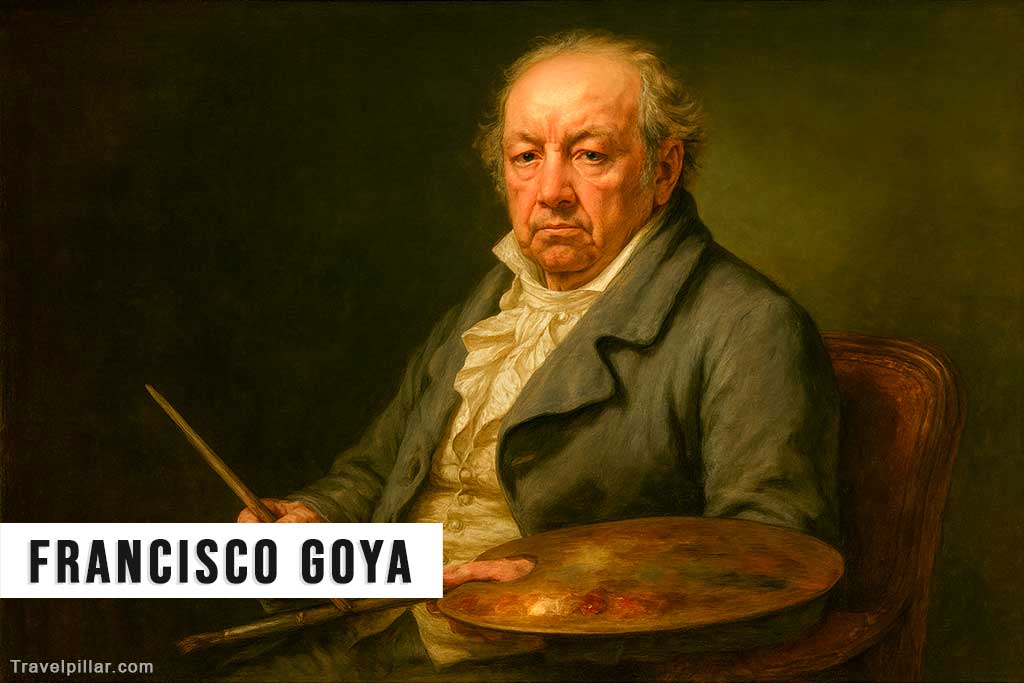
Francisco Goya (1746-1828), born Francisco José de Goya y Lucientes, was a Spanish romantic painter and printmaker, and one of the most important figures in Spanish art history. His work spanned a wide range of genres, from festive and lighthearted tapestry cartoons to somber and profound depictions of war.
Born in Fuendetodos, Aragon, Goya studied painting in Zaragoza before moving to Madrid, where he started his career designing tapestries for the royal factory. He later became a court painter for King Charles III, where he painted portraits of Spanish nobility, including King Charles IV and his family. This early period of Goya’s career is characterized by a bright color palette and Rococo-style influences.
Goya’s style evolved drastically after a severe illness in 1792 left him deaf. His work became more introspective and darker, often addressing political corruption, societal ills, and the horrors of war. This change is evident in his famous etching series, “Los Caprichos” and “The Disasters of War,” and in his so-called “Black Paintings,” a series of fourteen murals he painted directly onto the walls of his house later in his life.
“The Third of May 1808,” one of Goya’s most renowned works, powerfully depicts Spanish resistance during Napoleon’s occupation and is seen as a precursor to modern expressions of war atrocities in art. Goya’s ability to capture the human condition in all its complexity, from joy to despair, earned him a reputation as a forerunner of modern art.
In the last years of his life, Goya moved to Bordeaux, France, where he continued to produce art. He died there in 1828. Goya’s influence is widespread, inspiring later artists such as Édouard Manet, Pablo Picasso, and Francis Bacon. His innovative approach to visual storytelling and his willingness to confront societal issues continue to resonate with contemporary audiences.