
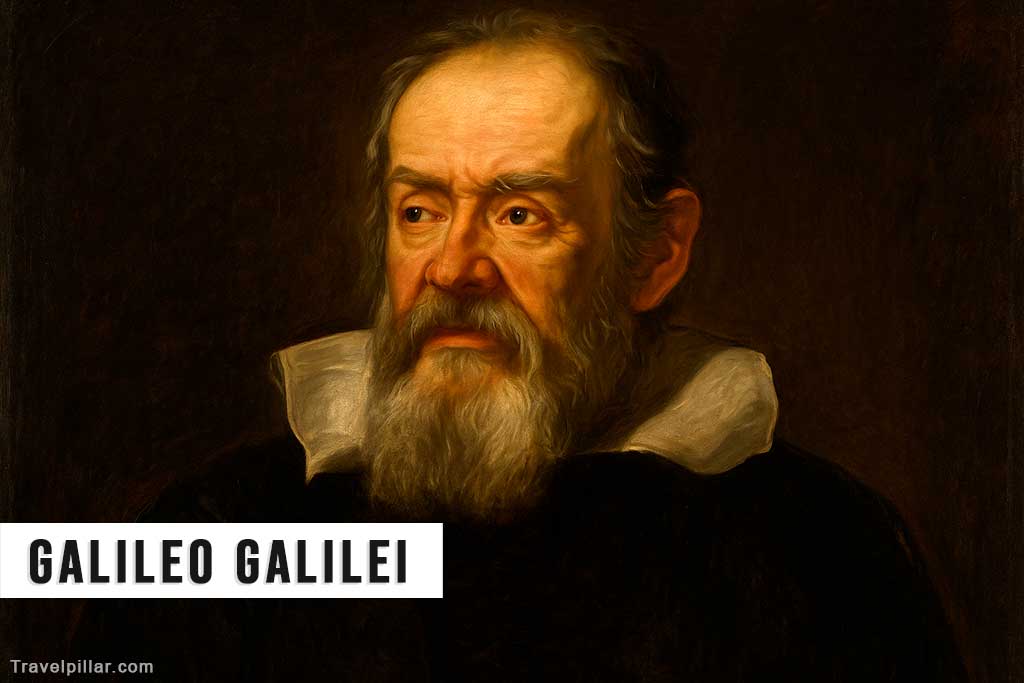
Galileo Galilei, born on February 15, 1564, in Pisa, Italy, was a physicist, mathematician, astronomer, and philosopher whose pioneering work laid the foundation for modern physics and astronomy, marking a turning point in the scientific revolution of the 17th century.
Galileo is most renowned for his astronomical observations. With the help of a telescope he improved upon, he made several significant discoveries. He observed the mountains and craters on the moon, the phases of Venus, and the moons of Jupiter, which he named the Medicean Stars, now known as the Galilean moons.
Galileo’s observations challenged the geocentric model of the universe, which placed the Earth at the center, a view upheld by the Catholic Church at the time. He supported the heliocentric model proposed by Copernicus, which posited the Sun as the center of the universe, and Earth and other planets revolving around it.
In physics, Galileo introduced the principle of relativity, and his experiments on motion laid the groundwork for Newton’s laws of motion. He established the law of falling bodies and refuted the Aristotelian belief that heavier objects fall faster than lighter ones.
However, Galileo’s support for the heliocentric model led to his trial by the Roman Inquisition in 1633. He was found “vehemently suspect of heresy” and forced to recant his views. He spent the rest of his life under house arrest.
Despite the controversies and challenges he faced, Galileo’s contribution to the scientific revolution is immense. He is often referred to as the “father of observational astronomy”, the “father of modern physics”, and the “father of the scientific method”. Galileo’s unwavering curiosity and his commitment to empirical observation profoundly influenced the course of scientific thought, and his legacy continues to inspire scientists and thinkers around the world.