
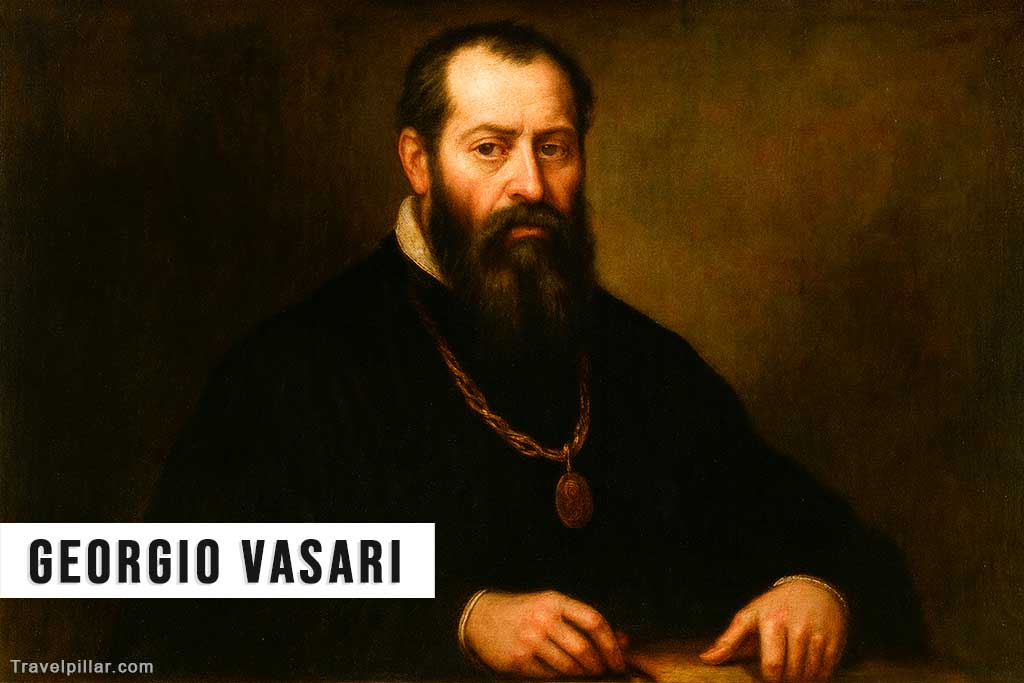
Giorgio Vasari (1511–1574), an Italian painter, architect, and writer, is most renowned for his seminal work “The Lives of the Most Excellent Painters, Sculptors, and Architects,” which is considered the ideological foundation of art-historical writing. His book significantly contributed to the establishment of art history as an academic discipline.
Born in Arezzo, Tuscany, Vasari moved to Florence at a young age to study under the guidance of renowned artists, including Andrea del Sarto. His artistic talent earned him patronage from powerful figures of his time, including the Medici family and Pope Paul III. Vasari’s works include the fresco of the Last Judgment in the Florence Cathedral and interior decorations for the Palazzo Vecchio in Florence.
However, Vasari’s enduring legacy is predominantly his writings, not his artistic creations. His book, written in 1550 and expanded in 1568, chronicled the lives and works of Italian artists from the 13th to the 16th centuries. The biographies he penned, although not entirely accurate, form the basis of much of what we know today about the artists of the Renaissance.
Vasari’s concept of the ‘Renaissance’ itself is significant. He viewed the period as a rebirth of the arts following what he perceived as their decay in the Middle Ages. He was the first to articulate the linear progression of ‘improvement’ in art, as he believed that art reached its pinnacle in the work of Michelangelo.
Vasari’s influence on the field of art history cannot be overstated. Despite the errors and biases in his accounts, his descriptions of artists and their works continue to shape our understanding of Italian Renaissance art. His writings, brimming with anecdotal, historical, and technical details, are invaluable resources for researchers and art enthusiasts alike, and his influence on the discourse of art history remains profound.