
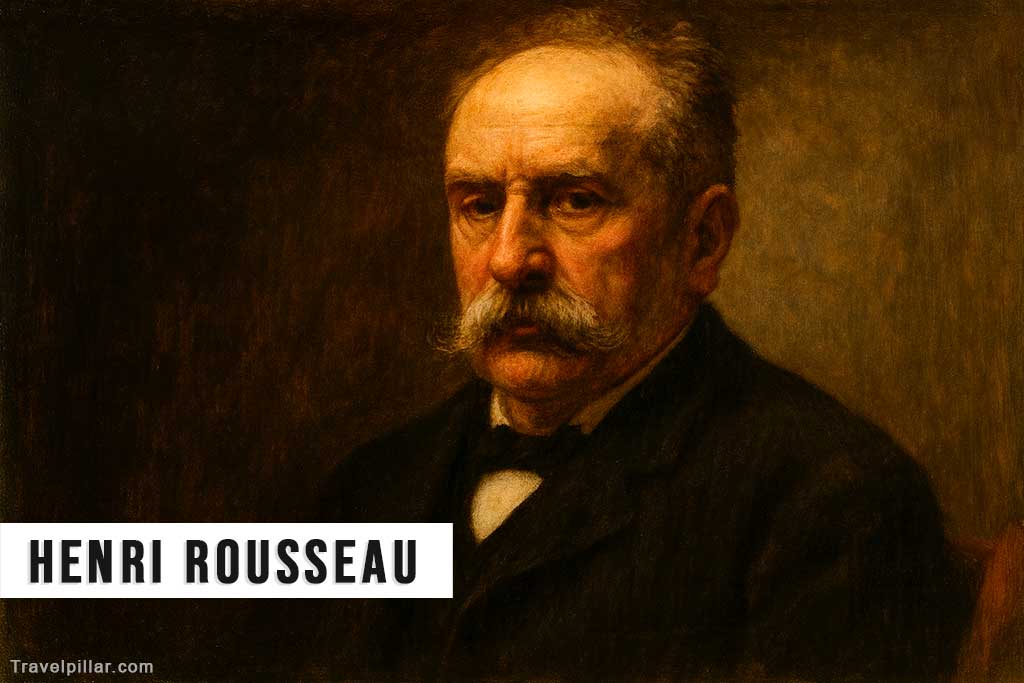
Henri Rousseau (1844-1910) was a French Post-Impressionist painter renowned for his naive or primitive style, despite having no formal art training. Working as a toll collector in Paris, Rousseau taught himself to paint and did not begin his artistic career until his forties.
Rousseau is best known for his vibrant and intricate jungle scenes, despite the fact that he never left France or saw a jungle. He drew inspiration from illustrations in books, visits to botanical gardens, and exhibitions of exotic plants and animals. These dreamlike compositions, populated with lush foliage and mysterious animals, were painted with painstaking detail and a unique sense of depth and perspective.
His most famous works, such as “The Sleeping Gypsy” and “The Dream,” are characterized by their surreal, dreamlike atmosphere and precise, detailed rendering. Rousseau’s unique style, devoid of the conventional artistic training of his contemporaries, garnered both criticism and acclaim.
While he was often ridiculed for his unorthodox style and was even considered a figure of fun in the art world, his work was also admired for its unique charm and originality. It attracted the attention of avant-garde artists like Pablo Picasso, who celebrated Rousseau’s unconventional techniques and vision.
Towards the end of his life, Rousseau’s work began to receive serious recognition, and he became an important figure in the Parisian avant-garde scene. Today, Rousseau is recognized for his self-taught mastery and individualistic style that challenges conventional notions of academic art.
Henri Rousseau’s influence on modern artists, particularly the Surrealists, is considerable. His emphasis on dream-like scenarios, imaginative contexts, and the use of flatness and simplified forms paved the way for the conceptual liberties of future art movements. Despite his late start and outsider status, Rousseau’s impact on the art world marks him as one of the pioneering artists of the 20th century.
