
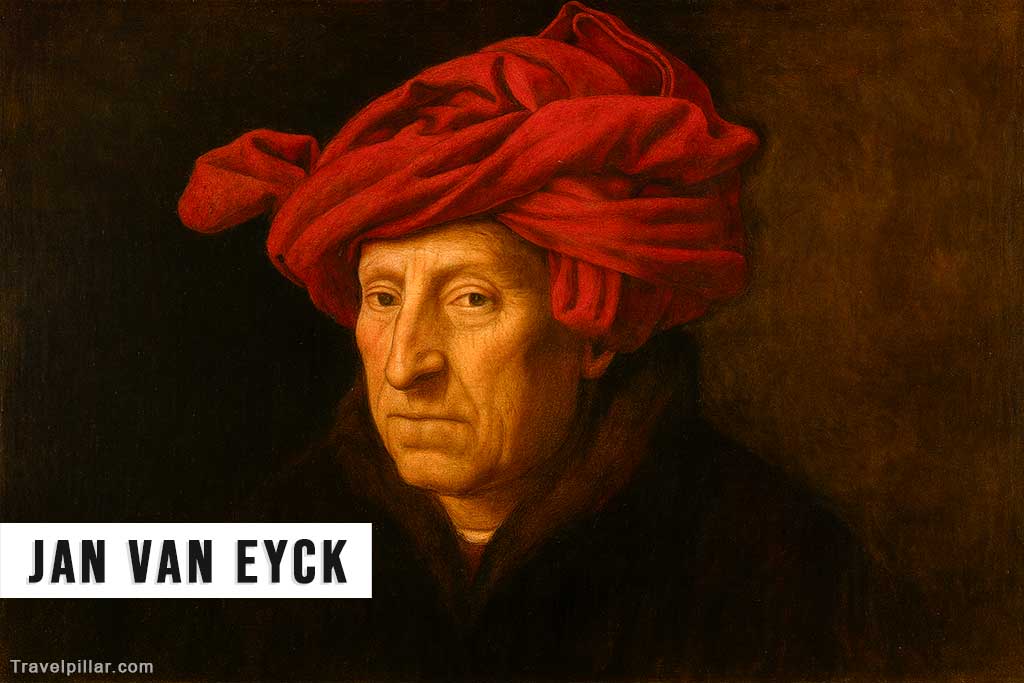
Jan van Eyck, a 15th-century Flemish artist, stands as a pivotal figure in the Northern Renaissance art movement. His contributions to the world of painting and his influence on the development of Netherlandish art make him a remarkable subject of study and admiration.
Born in Maaseik, Belgium, around 1390, van Eyck’s early life is largely shrouded in mystery. His career as a painter began around 1422 when he entered the service of Philip the Good, Duke of Burgundy, as a court painter. This position offered van Eyck the opportunity to travel, observe various artistic traditions, and gain recognition as a highly skilled artist.
Jan van Eyck’s work is renowned for its meticulous attention to detail, a hallmark of the Northern Renaissance style. His ability to render complex textures and vivid colors in oil paint set a new standard in art. One of his most famous paintings, “The Arnolfini Portrait,” exemplifies his precision and mastery. This iconic piece showcases the fine details of fabrics, furnishings, and the reflection of the couple in the mirror, illustrating his exceptional technical skill.
Religious subjects were a common theme in van Eyck’s works. His religious paintings, including “The Ghent Altarpiece,” are celebrated for their realism, profound spiritual depth, and intricate iconography. He achieved a lifelike quality in his subjects that was unparalleled in his time, making his religious art profoundly moving and inspiring.
Van Eyck’s use of symbolism and allegory in his art added layers of meaning to his works, making them not only aesthetically pleasing but also intellectually engaging. His ability to convey complex theological ideas through visual means is a testament to his artistic genius.
Jan van Eyck’s contribution to the world of art extends beyond his own creations; he had a lasting influence on the Northern Renaissance, inspiring generations of artists. His emphasis on the meticulous representation of the world and the human form, combined with the use of oil paint, left an indelible mark on the art of the Low Countries and beyond.
Today, the works of Jan van Eyck continue to be celebrated, studied, and admired, offering a window into the artistic and cultural achievements of the Northern Renaissance and providing a compelling reason for art enthusiasts to explore the museums and galleries that house his masterpieces.