
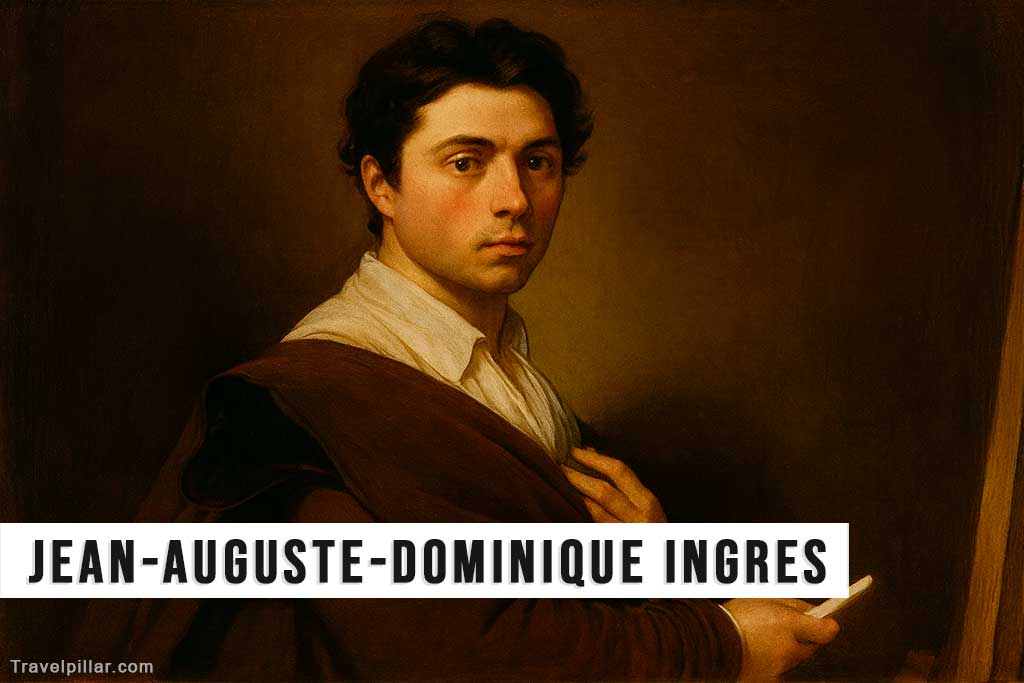
Jean-Auguste-Dominique Ingres (1780–1867) was a French painter known for his precise draftsmanship, smooth finish, and idealized portraits. He trained under Jacques-Louis David and carried forward the Neoclassical tradition, placing strong emphasis on line and form rather than color or painterly effects. Ingres saw himself as a defender of classical values in art, often positioning his work in contrast to the emerging Romantic movement.
Ingres won the Prix de Rome in 1801, allowing him to study in Italy. His years in Rome were formative, where he absorbed the influence of Raphael and other High Renaissance artists. This period shaped his mature style, which prioritized clear contours, symmetrical composition, and calm, idealized figures. He often rejected dramatic subject matter in favor of historical or mythological themes rendered with restraint and order.

https://collections.louvre.fr/en/ark:/53355/cl010065566
His portraiture, however, brought him lasting acclaim. Ingres painted members of the French elite with meticulous attention to fabric, posture, and physical likeness, while still idealizing their features. Notable works include Portrait of Monsieur Bertin (1832), which captures the sitter’s authority and presence, and La Grande Odalisque (1814), an example of his elongated, stylized treatment of the human form.
Ingres’s historical and religious paintings include The Vow of Louis XIII (1824) and Apotheosis of Homer (1827), both demonstrating his commitment to classical composition and academic technique. While some critics considered his distortions of anatomy problematic, others praised his refined execution and clarity.
Ingres served as director of the French Academy in Rome from 1835 to 1840 and later became President of the École des Beaux-Arts in Paris. His influence extended to later academic painters and shaped the course of French art education.
Today, Ingres’s works are housed in major institutions such as the Louvre and the Musée Ingres in Montauban. His legacy lies in his rigorous adherence to classical ideals, his technical precision, and his influence on 19th-century portraiture and academic art.